

<div style="text-align: center;"><div style="margin-bottom: 10px; padding-bottom: 10px; border-bottom: 1px dotted #ccc;" class="full_width_image"><img style="width: 624px; max-width: 100%;" src="https://www.ncronline.org/files/styles/email_newsletter_full_width/publ… style="color: #04619d; text-decoration: none;" href="

Timothy Schraeder Rodriguez is a writer and LGBTQ+ advocate whose work explores the intersection of faith, sexuality and belonging. His forthcoming memoir, "Conversion Therapy Dropout: A Queer Story of Faith and Belonging," tells the story of his eight years in conversion therapy and his journey to healing.
<div style="text-align: center;"><div style="margin-bottom: 10px; padding-bottom: 10px; border-bottom: 1px dotted #ccc;" class="full_width_image"><img style="width: 624px; max-width: 100%;" src="https://www.ncronline.org/files/styles/email_newsletter_full_width/publ… style="color: #04619d; text-decoration: none;" href=&quo

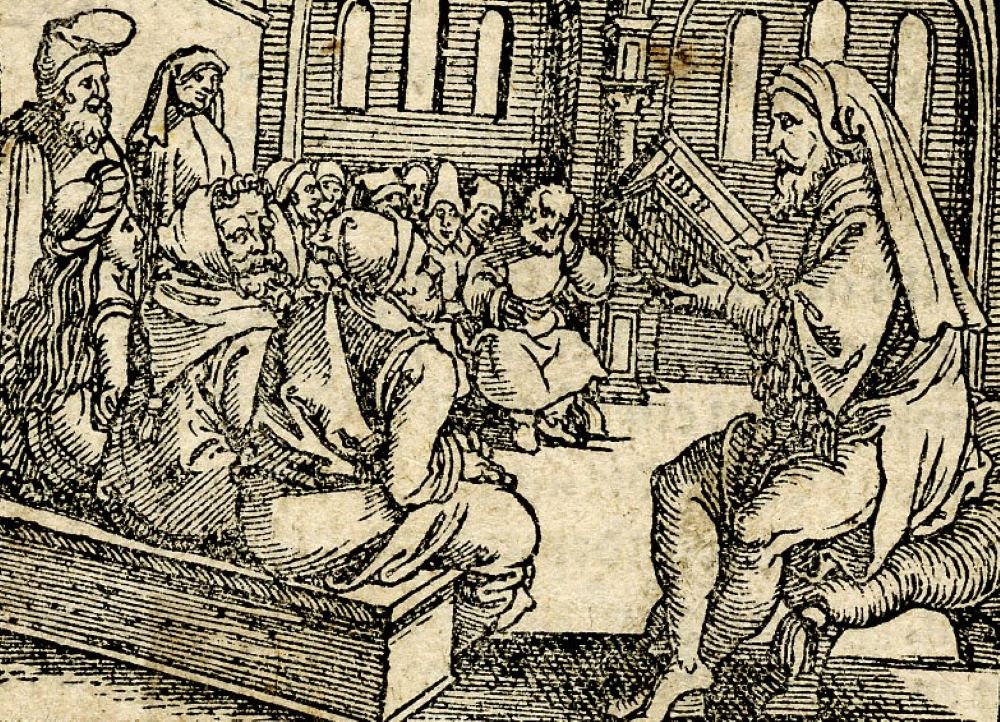
The Old Testament prophet Amos, right, is depicted in a 1533 woodcut print. (Wikimedia Commons/British Museum/Christian Egenolph)

by Mary M. McGlone
Join the Conversation
Send your thoughts to Letters to the Editor. Learn more
Amos said, "Hear this, you who trample on the needy!" Eight hundred years later, Jesus wove a puzzle/parable using economics to illustrate the message. Paul explains that when the power of those trampling on the needy makes justice seem impossible, we must turn to prayer.
Amos said, "Hear this, you who trample on the needy!" Eight hundred years later, Jesus wove a puzzle/parable using economics to illustrate the message. Paul explains that when the power of those trampling on the needy makes justice seem impossible, we must turn to prayer.
Today's Gospel tells a story that seems to be about a steward whose master was impressed by his clever manipulations. Is Jesus' point that when about to lose a job, you should intensify your malpractice to cushion a nest for the day when you're out of work? That's what it seems like. Jesus says, "The children of this world are more prudent … than the children of the light."
What? The "worldly" are more prudent? According to the Catechism of the Catholic Church (1806), "Prudence is the virtue that disposes practical reason to discern our true good … and to choose the right means of achieving it." So, the steward who worked fast behind his employer's back was discerning good and acting for it? How?
Biblical scholar N.T. Wright offers an interesting perspective on this story. He points out that Scripture prohibited the lending of money for interest. Therefore, what some clever folks did was lend in kind: olive oil, wheat, etc. on which they could collect interest. Wright suggests that the book-cooking steward went to the debtors and bargained for exactly what they had borrowed, erasing the exorbitant interest the master was charging.
In the end, the steward had made a lot of friends on whom he could count when the time came. The duped master had little recourse. He had found a way around the law; bringing the servant to "justice" would have exposed him as a scoundrel. Besides, he wasn't really losing anything — he got back what he had lent out — which was the intent of the law. Not only that, but, like it or not, the steward's action brought the master back to the realm of justice. He was no longer trampling the needy or writing them off like a pair of sandals. Folks who understood Jesus' point went home laughing.
On the way home, they may have mulled over the message: "That's a shrewd way to deal with our own, with people who say they believe what we do and who will feel shame when caught. What about the ones who have all the power and oppress us?"
Paul gives Timothy some very practical advice about dealing with oppressors. First, he says, pray for "all in authority that we may live a quiet and tranquil life." In other words, "pray for your enemies and don't poke the bear." But there's more. He adds that God wants everyone to be saved through Christ who excluded no one. Paul ends by counseling all to pray without anger or argument — an attitude that requires hard and generous prayer when it comes to people who make life harder for others.
The combination of these two readings with Amos' warning to those who destroy the poor, takes us into the ambiguous territory if we want to convert a parable into practice. Sometimes the kind of question a 5-year-old could answer helps us make a good judgment: "In Jesus' parable, who did the most good for others?" Obviously, the steward, seemingly the most dishonest of them all. What does that tell us?
Advertisement
Jesus was a master at undermining systems. Instead of fixating on clear rules and regulations, he saw beneficiaries and underdogs created by well-controlled social structures. He saw that debtors were caught in a vicious circle of increasing interests, that poor widows had very little chance to survive in a dignified manner, that the blind and lame were blamed for disabilities over which they had no control. He was not pleased with what he saw and taught that it grieved God as well. What to do?
Jesus says, "Be shrewd as serpents and simple as doves." Doesn't that describe the steward? He harmed no one and his activity helped the poor, invited the master beyond a life of usury and saved his own skin at the same time. Jesus seems to say that some laws don't merit obedience — at least not in God's eyes.
Today we're asked what we want to serve or obey. Is it law? Is it our own good? Is it the so-oft forgotten common good?
What are we to do? First, pray. Pray for the intention of doing good for all. Review who we include in the "all" we consider. Ask for a generous heart. Pray for a clear vision of what is really happening. Pray for inspiration and the creative courage needed to carry out the urgings of a critical conscience. And then, let the Spirit and your critical conscience be your guide.

A sculpture representing Moses' staff and the serpent is seen on Mount Nebo Oct. 9, 2017. at sunset in Jordan. Mount Nebo is the place where Moses is said to have seen the Promised Land and died. (CNS/James Ramos, Texas Catholic Herald)
by Mary M. McGlone
Join the Conversation
Send your thoughts to Letters to the Editor. Learn more
The feast of the Exaltation of the Holy Cross combines the paschal triduum and Christmas into one big feast. The scene depicted in Exodus demonstrates why humans need salvation. The hymn Paul wrote to the Philippians tells the story of salvation. Jesus' interaction with Nicodemus reveals the mystery of the human vocation.
Let's begin with Exodus. As Moses leads his people out of slavery, the freedom that once sounded great to enslaved people began to feel too costly. Moving from dependence and a controlled life into the open horizon tested their hope and commitment to the point that they were ready to give it all up. The attacking serpents represented the sacrifice entailed in growth. Only by summoning the courage to face them could they continue on.
Paul's song in Philippians describes Jesus Christ as a revelation of what God is like. While most religions fashion images of God as the all-powerful dominant one to be placated, as the one who dishes out punishment and reward, Jesus reveals a scandalous — some would say blasphemous — image of God in Christ.
Jesus' image of God turns human projections of divinity inside out.
Jesus' God is not a show person or super being. The God revealed in Jesus has no need or desire to awe or frighten us into submission. That was the way of the pharaoh. No, God's way is self-emptying. Jesus clung to nothing other than his mutual, self-giving relationship with the Father and his desire to reveal God's loving kindness to the world. That freed him to do anything and everything.
Paul calls Jesus a slave. In the New Testament, that word, doulos, depicts someone whose will and abilities are dedicated solely to the service of another. Paul says that Jesus took on the form of a slave. He was not purchased or compelled, rather he chose consciously and purposely to consecrate himself to doing the will of God.
Jesus loved what God loves — all of creation. He was born of a woman, he had to grow and learn and fall and get back up. He used his eyes to see God's creation, his ears to hear people's cries, his heart to know and share God's love, his touch to heal and his will to do everything he could do to help human beings to flourish. The will of Jesus' Father is always that humans fulfill their vocation to live in God.
Jesus experienced the limitations and the potential of creation. He revealed the purpose of life as growth in godliness, seeking God's will, accepting limitation and death in order to open space for God's great and mysterious love and power. That demanded a hope and trust that can only be described as "self-emptying."
John's Gospel depicts Jesus as a self-aware participant in divine life. He could say that no one else could know God's intention like he did. He described himself as sharing in the communion of God's glory, one who had known heaven and chose to reveal heaven to Earth. Comparing himself to the serpent Moses made for his people, Jesus said he would be lifted up in a most frightening way so that all humanity could be saved from every fear that would impede them from loving as freely as he did.
John offers us multiple variations on this theme. Jesus' mission was to "save," to offer us the fullness of life, to be living water, to be the good shepherd, to be the way, the truth and the life. When we celebrate the Triumph of the Holy Cross, we also celebrate the incarnation. Jesus' death was a result of emptying the self to experience creation. His cross was an exaltation in that it revealed the ultimate impotence of death in God’s design.
Advertisement
The title of this feast, the Feast of the Exaltation of the Holy Cross, expresses the paradox of Christian faith. Christ's death revealed that evil is as dead as its works. As Eastern Catholics sing, "by death, he conquered death." Christ's death and resurrection assure us that death and evil will never have the last word, that God's love is everlasting and therefore, what God loves is everlasting.
Believing in Christ means that we choose to orient our lives by faith in the God of life. It means that we bet our lives on God's undying love. It means that, like Jesus, although we may know unspeakable pain or sorrow, we have nothing to fear. It means that, as we pray in Psalm 1, evil is ultimately nothing more than "chaff driven by the wind."
Today's feast, encapsulating the entire mystery of salvation, urges us to have the courage to live in the divine paradox. It assures us that Christ has shown the way.