

George Cassidy Payne is a freelance journalist and poet based in Rochester, New York, specializing in politics, culture and faith.
<h1>Sunday Resources</h1><div style="font-size: 19px; font-family: 'Georgia', serif;"><p>National Catholic Reporter offers these resources in advance as a complimentary service to planners and preachers.</p>
<div style="margin-bottom: 10px; padding-bottom: 10px; border-bottom: 1px dotted #ccc;" class="full_width_image"><img style="width: 624px; max-width: 100%;" src="https://www.ncronline.org/files/styles/email_newsletter_full_width/publ… style="font-size: 19px; font-family: 'Georgia', serif;

<div style="margin-bottom: 10px; padding-bottom: 10px; border-bottom: 1px dotted #ccc;" class="full_width_image"><img style="width: 624px; max-width: 100%;" src="https://www.ncronline.org/files/styles/email_newsletter_full_width/publ… style="color: #04619d; text-decoration: none;" href="

<div style="text-align: center;"><div style="margin-bottom: 10px; padding-bottom: 10px; border-bottom: 1px dotted #ccc;" class="full_width_image"><img style="width: 624px; max-width: 100%;" src="https://www.ncronline.org/files/styles/email_newsletter_full_width/publ… style="color: #04619d; text-decoration: none;" href="

<div style="text-align: center;"><div style="margin-bottom: 10px; padding-bottom: 10px; border-bottom: 1px dotted #ccc;" class="full_width_image"><img style="width: 624px; max-width: 100%;" src="https://www.ncronline.org/files/styles/email_newsletter_full_width/publ… style="color: #04619d; text-decoration: none;" href="

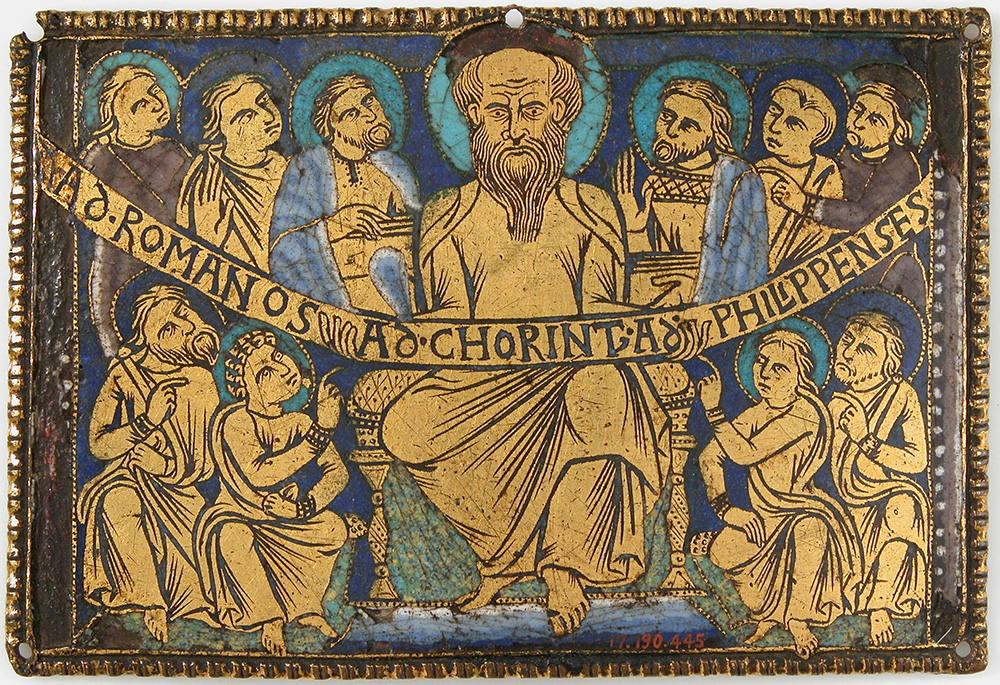
"Plaque with St. Paul and His Disciples," a possibly British, ca. 1160–80 copper champlevé enamel; the plaque's inscription refers to the epistles Paul addressed to the various early Christian communities (Romans, Corinthians, Philippians) among whom he traveled. (Metropolitan Museum of Art)

by Mary M. McGlone
Join the Conversation
Send your thoughts to Letters to the Editor. Learn more
In today's Gospel we hear Jesus describe three absolute impediments to being his disciple. He says nothing about belief in the Trinity or the Real Presence, declares no rules or laws to be indispensable. Instead, what disqualifies a person from discipleship is the prioritizing of certain people (clan, nationality, race, gender) over unbounded love, avoiding the suffering entailed in being a messenger of the Gospel and prioritizing possessions.
How did Jesus give witness to a life given to God and nothing else?
Our first reading asks, "Who can know God's counsel . . . conceive what the Lord intends?" That seems to be the question that guided Jesus' life and, therefore, his ministry: What does God intend for us?
Theologian Bernard Loomer used the term "S-I-Z-E" to describe God's intention for our growth as human beings, writing, "By size I mean the stature of a person's soul, the range and depth of his love, his capacity for relationships. I mean the volume of life you can take into your being and still maintain your integrity and individuality. … I mean the strength of your spirit to encourage others to become freer. … I mean the magnanimity of concern to … enable others to increase in stature."
Does that not sound like a description of how Jesus lived?
Jesus revealed that the vocation of the human is to grow continually in the range and depth of our relationships with God and others. The minute he began his public mission, he opened himself to deep encounter with everyone and everything. Starting with a debate with the devil, he gave individual and genuine attention to each person with whom he had contact, be they friend or foe. And, as with us, the stature of his soul grew with each relationship.
Jesus' attention to the outcast meant that he identified with them such that he suffered rejection with them. His strength of soul and generosity, his prioritizing people over institutions or rules led to his condemnation. He knew what he was doing.
People who share Jesus' magnanimity of concern for others live from a merciful heart. Mercy, as used in the Gospels, describes an unrelenting desire to relieve another's suffering. We see that in Jesus' seeking the good of others — all others — over his wants and even his needs.
Disciples are people who, like Jesus, have been captivated by God's love. They feel impelled to share that experience.
Paul's letter to Philemon offers an example of that sort of love. Paul had left his past behind and he knew the sufferings of discipleship. He wrote this letter intending to do good for two people: his convert, Philemon, and his beloved companion, Onesimus. This letter could sound manipulative, with Paul making an offer Philemon can't refuse if he wants to look like a disciple. More likely, Paul was evangelizing. Paul's request expressed his desire that both Onesimus and Philemon might "increase in stature" or S-I-Z-E.
When Jesus explained the requirements of discipleship, he spoke to a massive crowd as well as his close companions in mission. What he said sounds radical, even severe. He wanted anyone thinking of being his disciple to realize that following him could be unexpectedly and uncontrollably hard.
Advertisement
Ironically, Jesus' requirements offered absolute freedom. People whose only ambition is to grow in relationship with God and all that is of God can abandon themselves to love. People who are unafraid of suffering cannot be controlled. People whose sense of self and personal dignity comes from their loving relationships have nothing to lose. Therefore, one of the rarely mentioned but essential marks of discipleship is freedom, a freedom like that of Jesus which springs from relationship with God and the work of the Spirit.
What about us would-be disciples whose deliberations are timid and plans unsure, who understand so little? Perhaps the greatest thing about being human is our capacity to grow — to increase in S-I-Z-E. Facilitating growth could describe Jesus' intention in dealing with every person he met, just as he grew through his ongoing relationship with his Father and all of creation. The reign of God flourishes as people grow in their relationships.
Interpersonal relationships are unlimited in capacity for growth. They always move toward greater depth, breadth and intensity. Growth in being human includes an appropriate care and respect for everything in God's creation. The mountains, trees, desert and ocean, eagles and zebras, mice and bears have their own unlimited dignity.
The more we take in all of creation, the more we are following Christ. Our capacity to love freely, to suffer with others and to love everything without controlling it is unlimited. This kind of loving makes us disciples.

(Unsplash/Nick Fewings)

by Carol J. Dempsey
Join the Conversation
Send your thoughts to Letters to the Editor. Learn more
Humility and hospitality, two central themes that emerge from this Sunday's readings, are two virtues that need to be recovered for the full flourishing of life on the planet.
The first reading from Sirach, one of the Bible's Wisdom books, features a father instructing his son on how to conduct his affairs. Although the instruction is located within a patriarchal setting that privileges the education of males, the lesson taught is the lesson to be learned by people of all ages in a contemporary world culture that relishes self-aggrandizement, self-centeredness and individual achievement at the expense of others and others' resources. This lesson on humility is reinforced in the Gospel that describes table etiquette in relation to class and one's perceived self- importance. Both in the Gospel and in the responsorial psalm, humility is foundational to hospitality.
Besides being a social virtue, humility has a psychological component. It involves recognizing our strengths and limitations, appreciating the gifts and talents of others who can complement and contribute to our own resourcefulness, and respecting others' views and perspectives offered from diverse social locations and life experiences. Humility is a virtue that fosters individual and communal health. It enhances well-being, reduces defensiveness and encourages conversation, collaboration and empathy.
No finer instruction could a father give to his son than the instruction offered in Sirach that centers on humility. Both in biblical times and in today's culture, power rests with males. That power is often used egotistically, aggressively and competitively to disenfranchise, control and reinforce structural and systemic hegemony. One has only to look at how many world leaders conduct their affairs in their quest for superiority and supremacy. Would that more fathers instruct their sons in the way that the father of Sirach instructs him. Good and healthy parenting of children leads to a healthy, inclusive and just society. In the home, instruction in humility begins with parents modeling this virtue in their lives and in their relationships with their children. Regardless of age, everyone is a perennial learner.
The Gospel story from Luke adds to the discussion on humility. It features table etiquette, a virtue especially important in today's society where the table is not the oblong banquet table but the oblong boardroom table. Typically, the person with the most power sits at the head of the table, signifying leadership and authority over all other members at the table. But this arrangement has shifted in current times. Now the person with the most power, the one exercising the greatest decisive leadership, might sit in the middle position of the table. Regardless of where one sits at the table, the Gospel reading invites deeper questions such as "Who is invited to the table?" "What shape is the table — oblong or round?" "Is it a table of equals or one that is hierarchical with power resting only in the 'host'?"
Humility is a virtue that fosters individual and communal health.
Today's Gospel invites us to reflect on the current composition and leadership styles of all sociopolitical boardroom tables that set in motion decisions for our global world. The disenfranchised and those who struggle have neither place nor voice at the table, and the meal served, the policies made, nourish only a few. Focusing on social table etiquette is important, but life's pressing needs compel us to shift our critique from the dining room table to the boardroom table, to examine and critique those seated at that table, including the "host," for at that table lies the future of our global socio-political-economic well-being.
Advertisement
The responsorial psalm expands the notions of humility and hospitality. The psalm celebrates the Holy One of Israel as a benevolent God whose hospitality of heart cares for both the human and the nonhuman, for the poor, the widow, the orphan, the disenfranchised and even the languishing earth. This divine hospitality of heart, rooted in profound humility to stretch beyond oneself, is practiced not just in word but also in action.
Sweeping cuts to Medicaid are occurring within the United States, global poverty is increasing in the form of limited or no food and education access, unclean drinking water, growing economic inequality, dislocation caused by raging wars and the continued loss of habitat and food sources for our nonhuman neighbors all indicate the absence of hospitality.
This psalm asks us two questions, "If our lives are in tune with the Divine heart, then how are we making a home for those in need within our world?" and "Who are the 'poor'?" They have names and faces within our human and nonhuman communities of life. A hospitality of heart that embodies divine love begins with our recognizing "the other" as our own, with our ability to empathize and our decision to create new tables that can welcome and accommodate all.