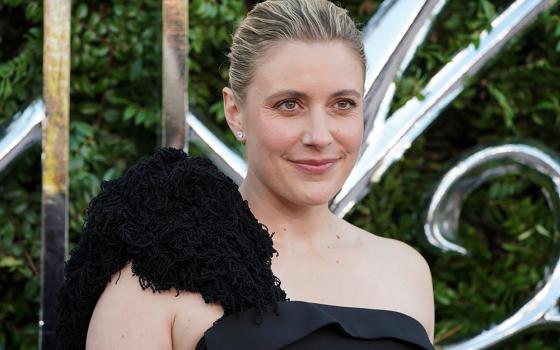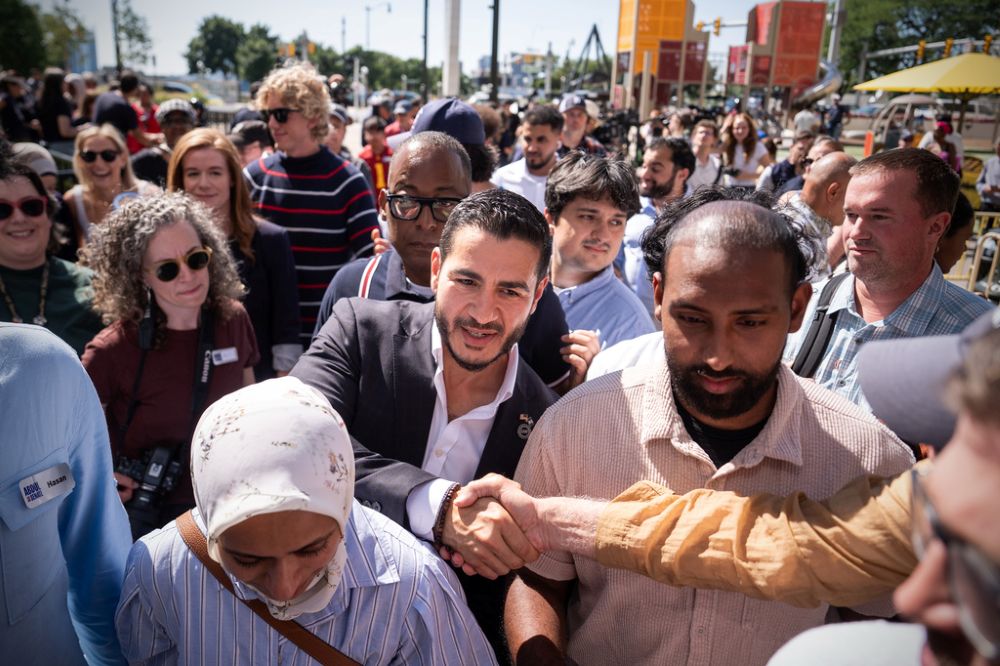
Abdul El-Sayed departs following a news conference at the Spirit of Detroit shortly after winning the Democratic nomination for U.S. Senate in Michigan Aug. 5, 2026, in Detroit. (AP/Julia Demaree Nikhinson)

Join the Conversation
Send your thoughts to Letters to the Editor. Learn more
The results of the Democratic Senate primary in Michigan are profoundly troubling. Dr. Abdul El-Sayed, narrowly defeated Congresswoman Haley Stevens, confirming that the anti-establishment mood of the Democratic Party rivals the anti-establishment mood of the Republican Party.
Here's the thing: Can a man with two doctorates, who studied at Oxford on a Rhodes scholarship, and got an M.D. at an Ivy League university, really pose as an anti-establishment avatar? What happened in Michigan was a battle between two kinds of establishment candidates.
El-Sayed is a gifted, telegenic campaigner. In interviews, he is direct and on message. He never responds with a word salad. His campaign speeches are impressive, his oratory compelling. What he doesn't do is explain how he intends to achieve his goals or that voting for him will not instantly translate them into reality.
"Get money out of politics," is one of the three items El-Sayed mentions in virtually every interview and in all speeches. But how? Last week, I noted my disgust with the U.S. Supreme Court decision Citizens United, that opened the floodgates of corporate cash into campaigns. On El-Sayed's campaign's website, he says he supports legislation to overturn the decision, but that decision was made on constitutional grounds. It can't be overturned by a statute. How does El-Sayed intend to overturn it?
"Put money in your pocket." The Catholic Church has been explicit for many years that gross income inequality is a moral abomination. All Democrats support higher taxes on the rich and more expansive social programs for the rest of us. There is nothing unique or special about El-Sayed's economic plans.
"Medicare for All." Again, Catholics support universal healthcare, but President Barack Obama couldn't get a public option into the Affordable Care Act. How does El-Sayed plan to get a public mandate enacted into law? Promising things to voters without a realistic plan to deliver is what makes people angry and anti-establishment to begin with.
If El-Sayed and other progressives want to really advance these goals, they also need to distance themselves from ideas and allies that are extreme. CNN's Kaitlan Collins interviewed El-Sayed and asked him about his association with Hasan Piker, an extremist social media influencer who has, among other things, said that America "deserved" to be attacked on Sept. 11, 2001, and joked about date rapes. He is fiercely antisemitic. Collins asked El-Sayed specifically if he would distance himself from Piker's comments. He dodged the question.
Campaigning with someone like Piker, as El-Sayed did on the eve of the election, sends a message, and it is an ugly message. Piker is the kind of left-winger who gives credibility to the Republican charge that Democrats hate America. Yet El-Sayed posted a video of him working out with Piker so it is not like Piker is a random supporter. The video made me think of a similar video of Pete Hegseth with RFK Jr. Yuck. If El-Sayed wants to win the general election, he needs to publicly disassociate himself from Piker's remarks.
Advertisement
Barack Obama did the same with Rev. Jeremiah Wright when video showed the minister making outrageous comments. Bill Clinton criticized Sister Souljah after she made offensive racist remarks. Voters expect a serious candidate to be serious, and that means distancing oneself from extremist and stupid things.
El-Sayed's attacks on AIPAC, the pro-Israel lobbying organization, are as frightening as his buddy relationship with Piker. When Rep. Joe Wilson shouted "You lie!" at President Obama during a 2009 address to Congress, the New York Times' Maureen Dowd rightly noted: "Surrounded by middle-aged white guys, a sepia snapshot of the days when such pols ran Washington like their own men's club, Joe Wilson yelled 'You lie!' at a president who didn't. But, fair or not, what I heard was an unspoken word in the air: You lie, boy!" When El-Sayed and the other progressives criticize AIPAC, I hear an unspoken word, actually two: The Jews.
These progressive candidates claim to support the working class but the working class doesn't return the favor. El-Sayed lost Macomb County with its many autoworkers, by eight points. His biggest margins were in Washtenaw County, home to Ann Arbor and the University of Michigan, which he won by 25 points.
The Washington Post reported: "He eked out his victory by winning young voters and highly educated voters — the traditional base for more liberal candidates — and he posted big enough numbers in suburbs and rural areas to keep Stevens at bay." Young people are rebellious. My fear is that the "highly educated" are also the "poorly educated." They buy into the nonsense about decolonization theory explaining the sources of the Israeli-Palestinian conflict. Schooled in deconstructionism, they are sympathetic to anti-American narratives. Unschooled in American history they fail to recognize that anti-establishment attitudes are as traditional as apple pie. The crisis in higher education is about more than tuition costs. I fear these highly educated voters do not support progressives despite their antisemitism and extremism but because of them.
El-Sayed can't win a general election in Michigan unless he expands his base to include working class voters. (Black voters too: He lost Detroit by wide margins.) Some Democrats may run against establishment Democrats — people who have been in office a long time and who have adapted to the system with all its problems — but El-Sayed is no champion of the proletariat. He is a champion of the professoriate.