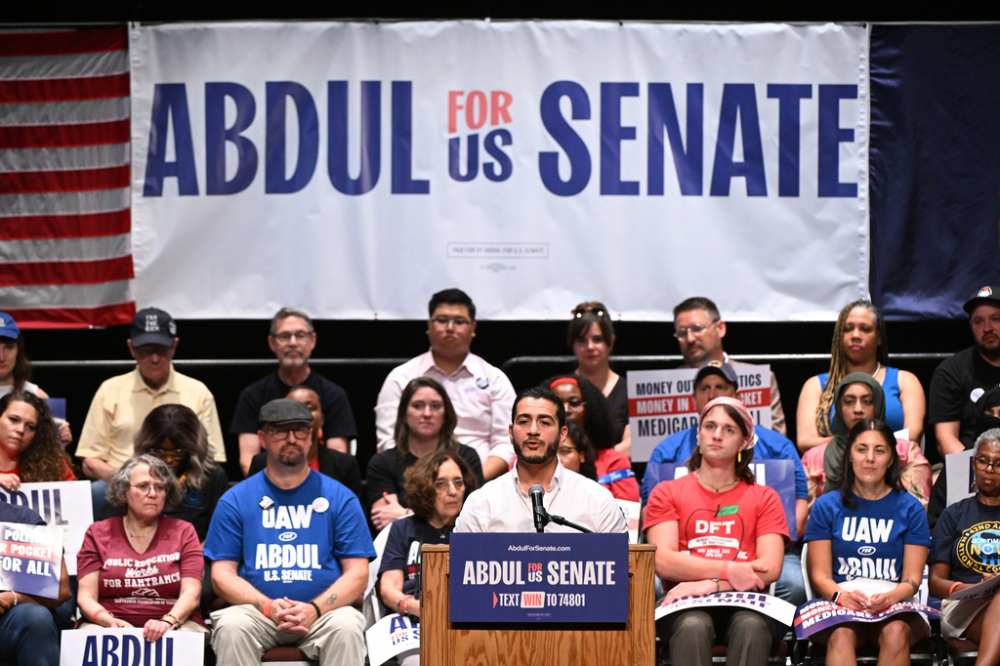
Michigan Democratic U.S. Senate primary candidate Abdul El-Sayed addresses the crowd during a campaign rally, Saturday, July 18, 2026, in Detroit. (AP/Jose Juarez)

Join the Conversation
Send your thoughts to Letters to the Editor. Learn more
Michigan Democrats go to the polls tomorrow to select their party's candidate for the U.S. Senate. The contest pits four-term Rep. Haley Stevens, who positions herself as a moderate who gets things done, against Abdul El-Sayed, a former director of the Department of Health, Human and Veteran Services for Wayne County, the state's largest county. He is running as a progressive intent on shaking up the political system.
El-Sayed is not associated with the Democratic Socialists of America, but his campaign echoes some of the same themes as progressive Democratic challengers who have unseated incumbent Democrats in heavily Democratic districts. I have raised concerns about some of them previously and much of the criticism applies to El-Sayed, especially the fervency of his opposition to Israel without qualification.
On July 17, El-Sayed tweeted that people should stop making fun of Stevens for "things that have nothing to do with her policies or politics." He then stated the issues as he sees them: "Congresswoman Stevens has welcomed corporations and special interests to support her. She votes to send our money abroad while Michiganders struggle. She's bought by DTE, Blue Cross, Big Tech, and Big Pharma who pick our pockets. AIPAC, Trump-aligned billionaires, and corporate PACs are spending $50,000,000+ to support her."
Is Stevens "bought"? Is it not possible that many corporations are supporting her because she is the kind of moderate Democrat who gets things done? Or they give because of a particular stand she takes on an issue of importance to them? I do not doubt that there are some members of Congress who really have been corrupted by corporate funding or by Donald Trump or by special interest influence over party primaries. Getting a contribution from a corporation is not per se evidence of corruption.
It is wrong to make these kinds of allegations personal. Unless El-Sayed has specific evidence of Stevens' corruption, his complaint is better directed against the system as a whole than at her in particular.
Advertisement
Many of us deplore the amount of corporate cash flooding into campaigns. Of all the Supreme Court decisions with which I disagree, their 2010 holding in Citizens United v. FEC is one of the worst. That opened the floodgates to wealthy and corporate donors to flood campaigns with cash by overturning important campaign finance restrictions. We all can wish Citizens United was not the law of the land, but it is.
Political action committees, or PACs, are older than Citizens United. They were an unintended consequence of an earlier Supreme Court ruling in 1976 in Buckley v. Valeo. The court held that the government could restrict the amount an individual contributes to a particular campaign, but it could not limit the amount of money a person spent funding an organization that advanced a particular cause because the First Amendment bars the government from regulating speech.
El-Sayed's repeated complaints about AIPAC, the largest pro-Israel political action committee, do not mention this free speech concern. He turns this into a complaint about corruption too. In a debate last Monday between the two candidates, El-Sayed complained about Stevens' vote not to cut off aid to Israel. "Just last week, our friend here voted to send 3.3 billion of your tax dollars to a foreign government," he said. "That is the pro quo that comes with the quid of $30 million spent by AIPAC."
The fact that AIPAC is spending money to support Stevens reflects their opposition to El-Sayed's strong anti-Israel politics. Stevens, like most Democrats in postwar history, believes the U.S. should stand by the only democracy in the region, not uncritically, but mindful that we share many values and many interests, even while both democracies can make spectacular mistakes. Where is the quid pro quo? As a journalist, I am not permitted to make campaign donations, but if I could, I would be sending money to candidates who take a more balanced position on Israel too. That doesn't mean I would own those candidates, only that I agree with them.
There is a final concern. The goal of a party primary is to find the candidate who can best defeat the Republican nominee. In Michigan, former Rep. Mike Rogers is the GOP candidate. In 2024, he narrowly lost the Senate race to then-Rep. Elissa Slotkin by a vote of 2,712,686 to 2,693,680, or 48.6% to 48.3%. Has El-Sayed considered what effect his personal attacks will have on the Democratic nominee if it isn't himself? Does he really want to see his words featured in GOP attack ads in the autumn?
Throughout the 1970s there was a battle for the soul of the Republican Party between the moderates who championed President Gerald Ford and the more extreme conservatives who rallied behind then-Gov. Ronald Reagan. After losing the nomination in 1976, Reagan entered the 1980 primaries and he issued what was called "the 11th Commandment": "Thou shalt not speak ill of a fellow Republican." The Democrats need to adopt that commandment as their own.
El-Sayed's narrative about the system being corrupted by money is true, but it cannot be applied to any particular person or group without specific evidence. This is one of the problems with activists: They look at the world through only one lens and, after time, they have difficulty distinguishing reality from their glasses.