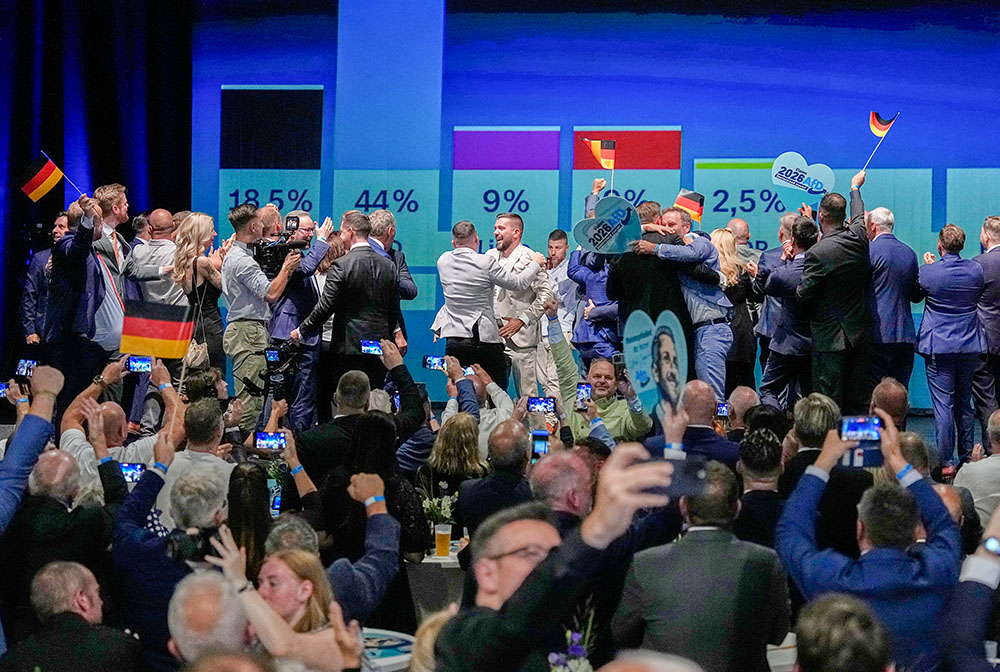
Alternative for Germany party members celebrate after the first results of the Saxony-Anhalt state elections in Magdeburg, eastern Germany, Sept. 6, 2026. (AP/Matthias Schrader)
by Renardo Schlegelmilch
Join the Conversation
Send your thoughts to Letters to the Editor. Learn more
On Sunday, Sept. 6, Germany experienced a moment that many had feared for more than 80 years. For the first time since the end of World War II, a far-right party won a regional election. The far-right Alternative for Germany (Alternative für Deutschland, or AfD) received nearly 44% of the vote in the east German state of Saxony-Anhalt. It was a landslide.
Not only was this the best result ever achieved by the right-wing populist party, which was founded just 13 years ago, it was also the strongest result ever recorded by any party in Saxony-Anhalt — and higher than any win achieved by a political party in a German election in recent decades.
All this happened despite politicians, civil society and church leaders having spoken out very clearly against the prospect of a far-right state government.
One of the AfD's most outspoken critics has been Gerhard Feige, the Catholic bishop of Magdeburg, Saxony-Anhalt's capital city. Having grown up when East Germany was still ruled by a communist dictatorship, he said he had never imagined that he might find himself facing such a situation again.
Feige is fully in line with the position of the German Bishops' Conference. Catholic bishops in Germany generally stay out of day-to-day politics. In 2024, however, they took the unusual step of unanimously adopting a document making clear that Catholic faith is incompatible with what they called "völkisch nationalism" — an ethnic, exclusionary form of nationalism rooted in the idea of a homogeneous national community.
The document does not mention the AfD by name. But it is clear who it is addressing.
The Catholic Church in Germany had never before taken such a clear stance toward the AfD. The feeling is mutual: The party has little sympathy for the Catholic Church or religions more broadly.
In its election platform for Saxony-Anhalt, the AfD called for the abolition of state funding for the churches. These funds are vital, particularly in eastern Germany, where the dioceses have few financial reserves after four decades of communist rule and remain dependent on public funding.
To the AfD, the churches are part of the left-wing, "woke" activist establishment that stands opposed to traditional values. In its election platform, the party proposes redirecting this funding to smaller evangelical religious communities rather than to the Catholic and Protestant churches, which are still formally affiliated with almost half of Germany's population.
For now, it remains uncertain whether the AfD will actually form the state government in Saxony-Anhalt. With nearly 44% of the vote, the party narrowly failed to secure a parliamentary majority, but it is far ahead of all other parties. Friedrich Merz's Christian Democratic Union, the runner-up, received just 17%.
If the AfD does form the state government, representatives of the churches and other religious communities are likely to face a difficult political environment.
Advertisement
Matthias Bethke, head of the Catholic Office in Magdeburg — the liaison between the Catholic Church and the state government — told DOMRADIO.DE: "Silence is no longer an option." Regardless of electoral majorities, he said, the church must stand up for human dignity, fundamental rights and the principles of the rule of law.
Feige takes a similar view, but his concerns extend far beyond funding or standing of the church itself. Culture, education and social services, he warns, would also suffer under a right-wing populist government.
For us at DOMRADIO.DE — Germany's largest Catholic radio broadcaster — the election also raises a fundamental question: How should we deal with the AfD if it now takes governmental power?
Unlike other media outlets, we do not have to be neutral but openly stand for a particular worldview: that of Catholic teaching. We do not have to pretend to be independent and politically neutral in the same way as a general-interest news organization.
When the pope and the Vatican speak out in defense of refugees and marginalized people, and when even our own bishops' conference declares that the AfD's values are incompatible with Christian values, it is not difficult for us to share that position.
If Germany does indeed see its first AfD-led state government, we will scrutinize its work closely from our Catholic perspective. And wherever we see Christian values and principles being disregarded, we will raise our voices.
That is how we understand our mission — as Christians and as part of the fourth estate.