(Unsplash/Sung Jin Cho)

by Scott Hurd
Join the Conversation
Send your thoughts to Letters to the Editor. Learn more
I'd wager you woke up this morning thinking that you're a human being. I know I did.
What you probably didn't realize is that you also woke up as a centaur and quite possibly a cyborg. Or, at least a proto-cyborg. Depending on your job, you might also be a "reverse centaur." And, if you aren't careful, you could also be morphing into a suicidal arctic rodent.
Allow me to explain. There's no doubt you're a human being. But if you use technology to help navigate your day, you're also a centaur. Centaurs, of course, are mythical beasts with a human torso on a horse's body. The human part controls the animal part. In tech lingo, however, a centaur is a person who controls an assisting machine, as with driving a car. That describes pretty much everybody.
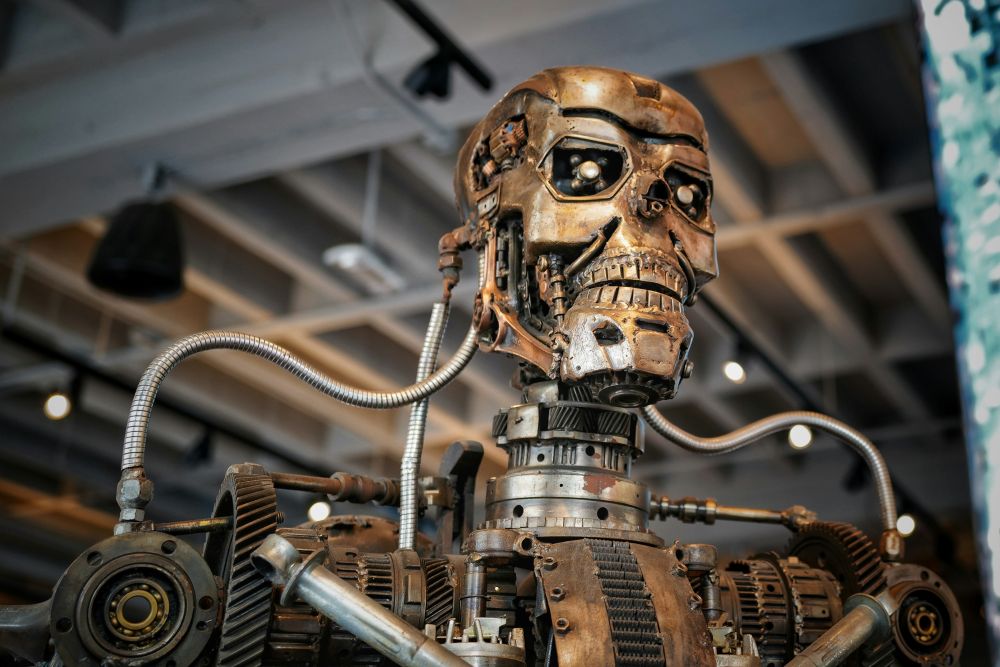
But some commentators insist that we centaurs are now becoming cyborgs — if we aren't cyborgs already. Because while centaurs are simply machine-assisted humans, cyborgs are full-blown mashups of man and machine. And given how often phones are in our hands and buds in our ears, a case can be made that the Cyborg Age is close at hand, if not already here.
Yet while we can debate about at what point centaurs become cyborgs, we're now witnessing the emergence of the "reverse centaur," which sci-fi author and tech journalist Cory Doctorow describes as "a person who is serving as a squishy meat appendage for an uncaring machine." As explained in his new book, The Reverse Centaur's Guide to Life After AI, reverse centaurs don't wield tools. Instead, they are tools of machines that do what machines can't (yet) do on their own.
Delivery drivers and warehouse workers, directed and monitored by cameras and algorithms, are prime examples. Office drones at "AI-first" organizations, evaluated on their adopting AI in preparation to be replaced by it, are others. So too are computer programmers relegated to proofreading AI-generated code, radiologists tasked with rubber-stamping AI images, and "slop janitor" Hollywood animators resigned to cleaning up AI's "blah average of things." Reverse centaurs aren't using technology. Instead, they're used by it.
And then there are those poor souls who have become reliant on the flattering and seemingly all-knowing chatbots that have flooded our world, accepting whatever they spit out as gospel truth — even when it is wrong — and who are unwilling or unable to take a step without a machine's approval, surrendering their decision-making to what ChatGPT's Sam Altman called the "magic intelligence in the sky."
Such incredulous dependents have been likened by some commentators to lemmings — arctic rodents that, according to legend, will blindly follow their herd over the side of a cliff. In this case, however, given that the chatbots being followed are constructed upon large language models, or LLMs, it's suggested that their devotees might best be labelled as LLeMmings. Get it?
Advertisement
Those applauding the new ways humans engage with machines are legion — especially those getting astronomically rich from selling them, such as Mr. Altman. A decade ago he dreamed of what he called "The Merge" between people and AI. More recently, he proposed that people merged with AI should pay for it like a utility, thereby creating for him a highly lucrative population of cyborgs, LLeMmings and reverse centaurs.
In response to such ambitions, Pope Leo XIV has expressed alarm about the "extremely rich people who are investing in artificial intelligence" while "totally ignoring the value of human beings." And in his encyclical — entitled Magnifica Humanitas ("Magnificent Humanity"): On Safeguarding the Human Person in the Time of Artificial Intelligence — he's also been warning about the prospects of cyborgs, LLeMmings and reverse centaurs.
To be fair, Leo doesn't use those exact terms. But in taking aim at technologists enthusiastic for creating a "human-machine hybrid," he's speaking of cyborgs. His caution against "persons … being reduced to achieving results, a resource to be used and exploited," is a reference to reverse centaurs. And he alludes to LLeMmings when lamenting how AI can "encourage excessive reliance … and weaken personal creativity and judgment."
To Leo, dreams of creating cyborgs, the dependence of LLeMmings and the indignities inflicted on reverse cyborgs reflect an "anti-human vision" to be resisted because "... humanity — in all its grandeur and woundedness — must never be replaced or surpassed." Leo is not anti-tech. He appreciates what tech might do for us. But he's concerned about what it can do to us.
His words aren't just for Catholics. Instead, they're part of his "dialogue with all men and women of our time, with whom we share in the events, questions, and aspirations of humanity." Which is why he makes this appeal to everyone: "In the era of artificial intelligence when human dignity is threatened by new forms of dehumanization, ours is the pressing duty to remain profoundly human."
Because if we fail to do that, we'll wake up one morning to discover we've become something else.