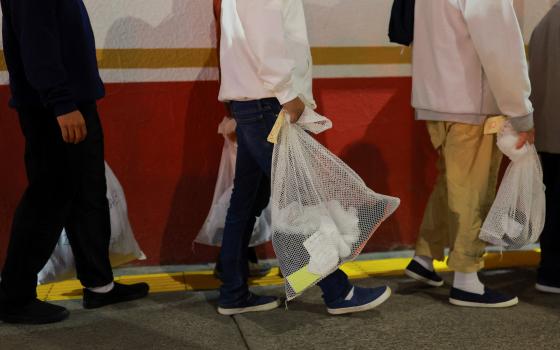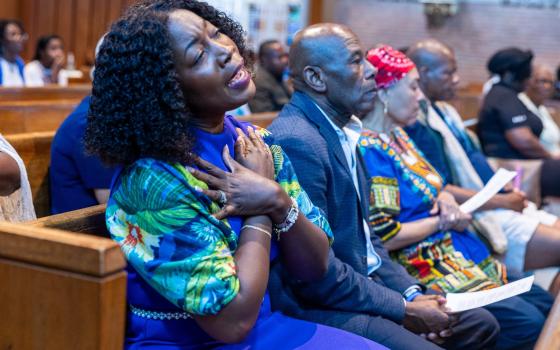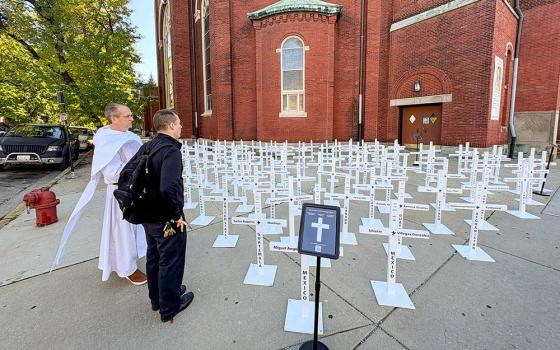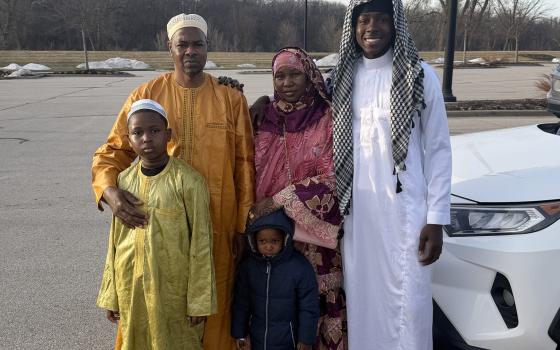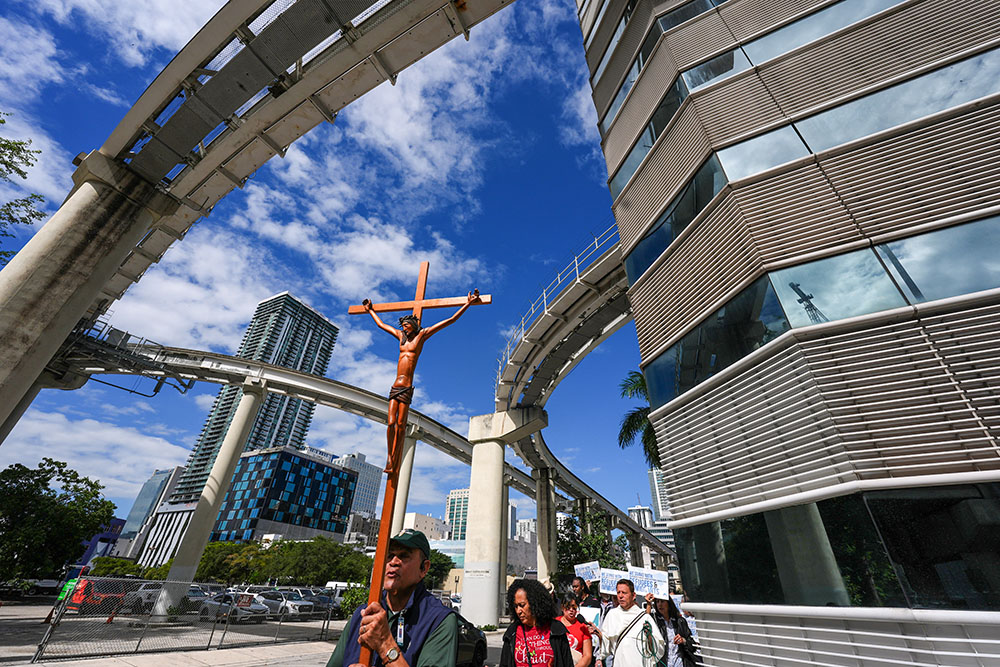
Ramon Ventura carries a crucifix as people walk from a downtown Miami Catholic church to the Miami Immigration Court to hold a prayer for immigrants, on the feast day of Mother Cabrini, patron saint of immigrants, Nov. 13, 2025. (AP/Rebecca Blackwell)

by Anna Gallagher
Join the Conversation
Send your thoughts to Letters to the Editor. Learn more
This week, Catholics around the world will celebrate and honor the World Day of Migrants and Refugees. As is customary each year, the pope chooses a theme to recognize the importance of the week. Pope Leo XIV has chosen a striking theme for the occasion: "Even just one of these children."
These words echo the teaching Jesus taught in Matthew's Gospel: "Whoever welcomes one such child in my name welcomes me" (Matthew 18:5).
This clarion call to people of faith is a timely reminder. Immigration is often discussed through numbers and statistics: how many crossed a border, how many cases remain pending, and how many were detained. Statistics can help us understand the scale of migration, but they can also obscure the individual people whose lives are at stake.
Leo has chosen a theme that invites us to begin somewhere else, with the person in front of us. When that person is a child, our responsibility becomes difficult to ignore.
For years, federal funding has sustained and supported a national network of legal service providers that helps unaccompanied migrant children navigate the complexities of the U.S. immigration system. These children often arrive without a parent or legal guardian. Many have fled persecution, trafficking, violence and abuse. After reaching the United States, they may be placed in legal proceedings to determine whether they can remain here safely or must return to the countries from which they fled.
Earlier this year, the longstanding federal contracts that supported those legal services expired. This happened after months of delayed payments, uncertainty and confusion about what would follow. This disruption has left service providers across the country struggling, and thousands of children unsure whether a qualified legal advocate will be available when they need one.
It is easy to speak about the expiration of a federal contract as merely an administrative matter. But for a child, the consequences are deeply personal.
Without legal representation, a child may be expected to understand the difference between asylum and Special Immigrant Juvenile status. She may have to gather evidence, produce complex paperwork and meet strict court deadlines. She may be asked to remember and recount traumatic experiences before an immigration judge. All of this can happen while a child is still learning to speak English, living apart from their family, and trying to adjust to this new and unfamiliar country.
No child should be expected to face our immigration system alone.
Catholic social teaching recognizes that states have both a responsibility and a right to regulate their borders. The church does not teach that governments should abandon immigration laws or stop enforcing them. It does, however, instruct that this authority must be exercised in such a way that respects human dignity and protects the vulnerable, while serving the common good.
Advertisement
The U.S. bishops have consistently included due process and access to legal protections among their pillars for a just immigration system. These protections do not undermine immigration enforcement; they ensure that it is lawful, and worthy of a nation committed to justice.
There is room for honest dialogue and disagreement about immigration policy. Catholics can reach varied conclusions about enforcement efforts, asylum rules and how many immigrants should be admitted into the United States. These are all legitimate matters for public debate.
Whether a child deserves a fair hearing should not be.
The church's preferential option for the poor and vulnerable implores each of us to pay particular attention to people with the least influence over the very institutions that shape their lives. It is difficult to imagine one with less power in a courtroom than an unaccompanied child. The church has long recognized the dangers these children face. The U.S. bishops have described children in these situations as "among the world's most vulnerable people, particularly because of their exposure to exploitation and violence."
A child's dignity does not depend on citizenship, immigration status, or the strength of their legal case. It comes from something far more fundamental: the idea that each child is made in the image and likeness of God.
At the Catholic Immigration Network Inc. (CLINIC), we believe immigration law must uphold both the rule of law and the dignity of every person subject to it. A child having access to legal representation does not guarantee that the child will win a case. It does not prevent the government from enacting laws. It simply gives the child a meaningful opportunity to understand the process and have any lawful claim for protection properly considered.
When Christ brought a child before his disciples, he did not first ask whether the child had earned their concern nor did he attach rules or conditions to the welcome he asked the disciples to provide. He told them to embrace such a child with the same welcome they would give himself.
That is what makes Leo's theme so challenging. "Even just one" resists a temptation to look away because the politics are difficult, a system is too large, or the number of those in need feels insurmountable.
One child standing frightened and alone before an immigration judge should be enough to trouble our collective conscience.
One child left without a legal advocate is not just an unfortunate statistic.
He or she is a child of God.
As this World Day of Migrants and Refugees approaches, Catholics have an amazing opportunity to make that belief visible. We should call on our elected leaders to ensure that unaccompanied children have meaningful access to qualified legal representation. The administration should restore reliable federal funding for the experienced organizations that have long provided representation to these children.
This is a plea for an immigration system where justice and mercy are not treated as competing ideals.
A system should not be judged only by how quickly it processes cases or how many people are removed. We must also ask whether it recognizes the humanity of those placed within it, especially those who are least capable of defending themselves.
Christ has already given us this measure. When just one child stands before us in need of protection, we know whom we are being asked to welcome.