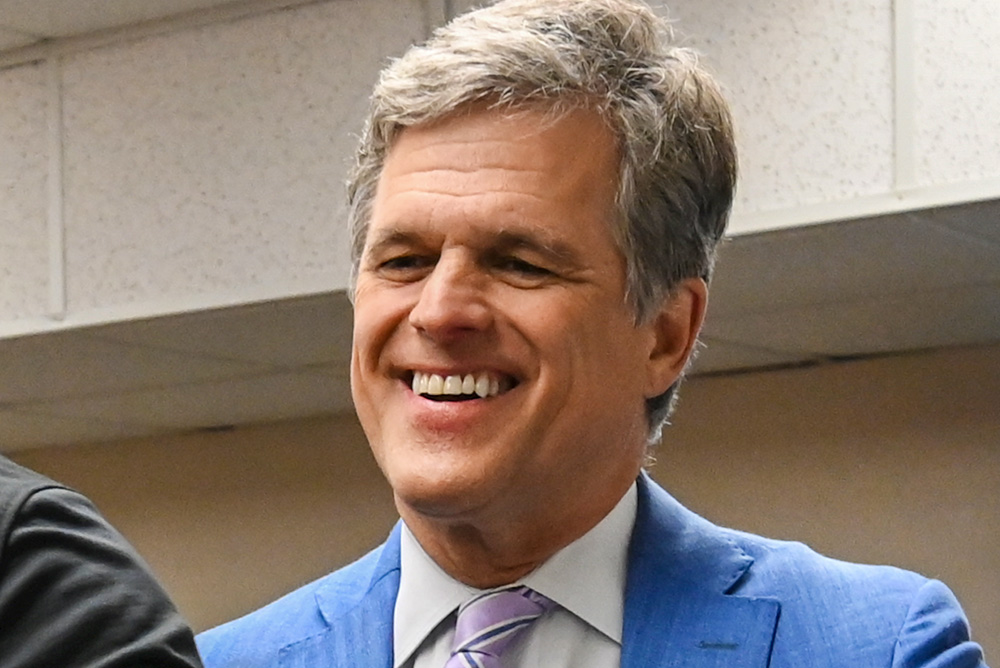
Tim Shriver in June 2025 (Wikimedia Commons/Maryland GovPics)

by John Dear
Join the Conversation
Send your thoughts to Letters to the Editor. Learn more
On this week's episode of "The Nonviolent Jesus Podcast," I speak with Tim Shriver, chairman of the Special Olympics International Board of Directors. Tim expanded the organization from 1 million athletes to more than 6 million athletes in more than 170 countries around the world.
After passing on the CEO torch, he wondered how the spirit of the athletes of the Special Olympics might provide a model for our divided world. He started a conversation with hundreds of young people, faith leaders, educators, philosophers, scientists, activists and political figures on how we might reclaim our common humanity. Tim then formed the nonprofit UNITE, which uses what he calls the "Dignity Index," a new tool to help Americans disagree without demonizing each other.
Tim went to Yale University, got his master's degree from the Catholic University of America, and a doctorate in education from the University of Connecticut. Before joining the Special Olympics in 1996, he cofounded the Collaborative for Academic, Social, and Emotional Learning, a leading school reform organization that he currently chairs.
On the side, he is a Hollywood producer of several films including "Amistad." He is author of Fully Alive: Discovering What Matters Most, and co-editor of The Call to Unite: Voices of Hope and Awakening. In May, the University of Notre Dame awarded him the Laetare Medal.
Advertisement
"My parents were innovation machines," he told me. "They were problem solvers."
His mother, Eunice Kennedy Shriver, started the Special Olympics by asking, " 'What if we just spoke each others' language and ate each others' food?' That was peace-building."
"Last year, the volunteer army of human goodness created 80,000 Special Olympics events," he said. "Go to an event! There's a recognizable presence of human dignity and therefore divine energy. There's a different vibrational field. The Special Olympics is a peacemaking movement."
Tim said UNITE and the Dignity Index is based on the insight that "our problems are not based on our differences but how we treat each other when we differ. When we treat each other with dignity, we have a good chance of solving our problems. We try to learn how to treat each other with dignity and reduce contempt."