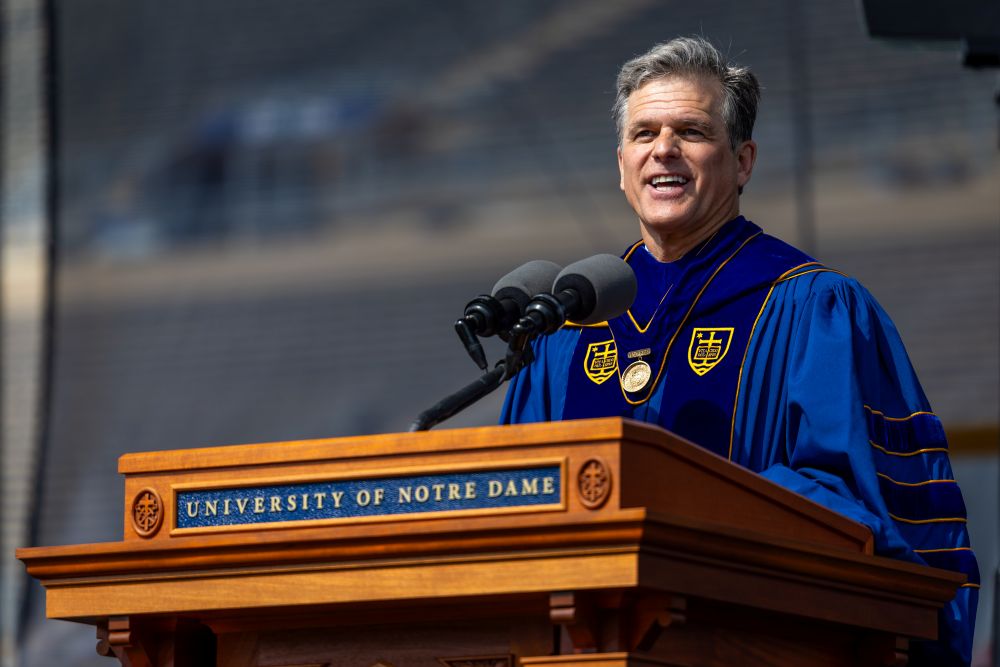
Timothy Shriver speaks at the University of Notre Dame graduation ceremony May 17. Shriver received the Laetare Medal for his leadership with the Special Olympics (University of Notre Dame/Michael Caterina)

by Catherine M. Odell
Join the Conversation
Send your thoughts to Letters to the Editor. Learn more
Timothy Shriver, son of prominent American Catholics Sargent Shriver and Eunice Kennedy Shriver, received the University of Notre Dame's 2026 Laetare Medal at the school's May 17 commencement ceremony for his leadership with the Special Olympics, a global movement that supports people with intellectual disabilities that his mother founded in 1968.
Shriver, chairman of the Special Olympics International board of directors, is not the first in his family to receive the university's annual award given to American Catholics whose lives and work have "illustrated the ideals of the Church and enriched the heritage of humanity." Both of Shriver's parents also received it: his father in 1968 for founding the Peace Corps, and his mother in 1988 for establishing the Special Olympics. Shriver's uncle, President John F. Kennedy, the first American Catholic president, also received this honor in 1961.
Timothy Shriver, 66, began working with the Special Olympics in 1996 as his parents began to "hand off the torch," as he puts it. His father served as president and board chair in the 1980s and 1990s.
"I want people to understand that the work for which I'm being recognized has also been a work of personal transformation for me," Shriver told the National Catholic Reporter the day before he received the Notre Dame award.
"I've had the chance to live with, work with, play with the athletes of Special Olympics for 30 years. It's been a great learning experience. And, it's been a great opportunity to deepen my faith," he said. "I now understand more deeply the central expression of God's presence in each of us."
He also said he has "had a front row seat in seeing the best in humanity. I go places and see people who have become infused with the goodness of God and they do things that are just extraordinary."
Shriver received a bachelor's degree from Yale University, a master's degree in religion and religious education from the Catholic University of America in 1988, and a doctorate in education from the University of Connecticut. He then worked in New Haven, Connecticut, as a teacher in public education and special education for 15 years. However, Shriver says, one of the most important things he learned came not in a classroom but from his parents.
"They wanted us to see the dignity of every human being and to stay focused on what matters most," Shriver told Notre Dame representatives in the spring when they met. His parents insisted that their five children remember that every Special Olympics child be treated with dignity and hope. "They told us: 'Give them a chance, every one of them! No exceptions!' "
Today, Shriver sees the Special Olympics movement in a deeper, richer way. "It is a prophetic movement," he insists, since it invites people to "see the world differently now" and not to "judge, humiliate and denigrate people with intellectual disabilities."
As Shriver and his team began to reach out more around the world to promote the Special Olympics, they expanded their services and began to offer help in developing better healthcare systems, inclusive education and programs promoting self-advocacy and leadership for people with intellectual disabilities. But there was rejection everywhere, he said.
"Our community is no stranger to rejection. In fact, rejection is a daily experience," Shriver said. "Rejection came from governments, schools, healthcare institutions, businesses, neighborhoods — you name it. I found it in Indiana, in Damascus, Syria, in Beijing, China, in Paris, France."
According to Shriver, most refusals would boil down to statements like: "Unfortunately, our school is for other kinds of children. We don't hire people like that," or "We don't have the money for that right now."
Advertisement
But over the years, Special Olympics found effective ways to promote itself and now has 50,000 events taking place around the world each year, Shriver said.
Even in refugee camps in Tanzania, he said he heard that refugees were seen coming out of their tents to line a field, to watch and cheer for children running to win medals.
He has also discovered another benefit about the organization is its volunteers.
"There are tens of millions of them who came to help for an hour or two, but who stayed involved with Special Olympics for years. It opened their eyes because they became more capable of seeing the goodness of God in other human beings. Special Olympics athletes showed them how to see that."