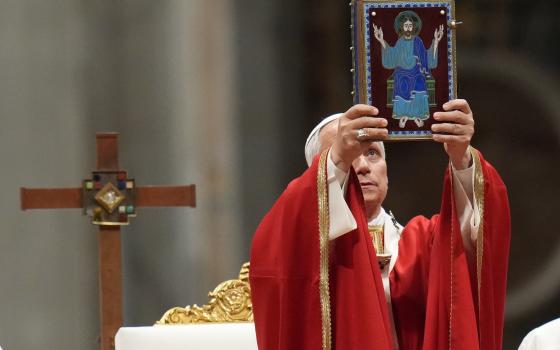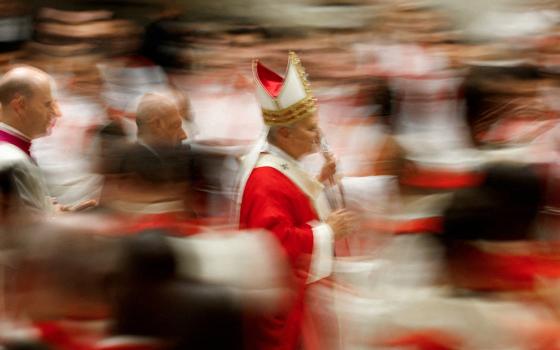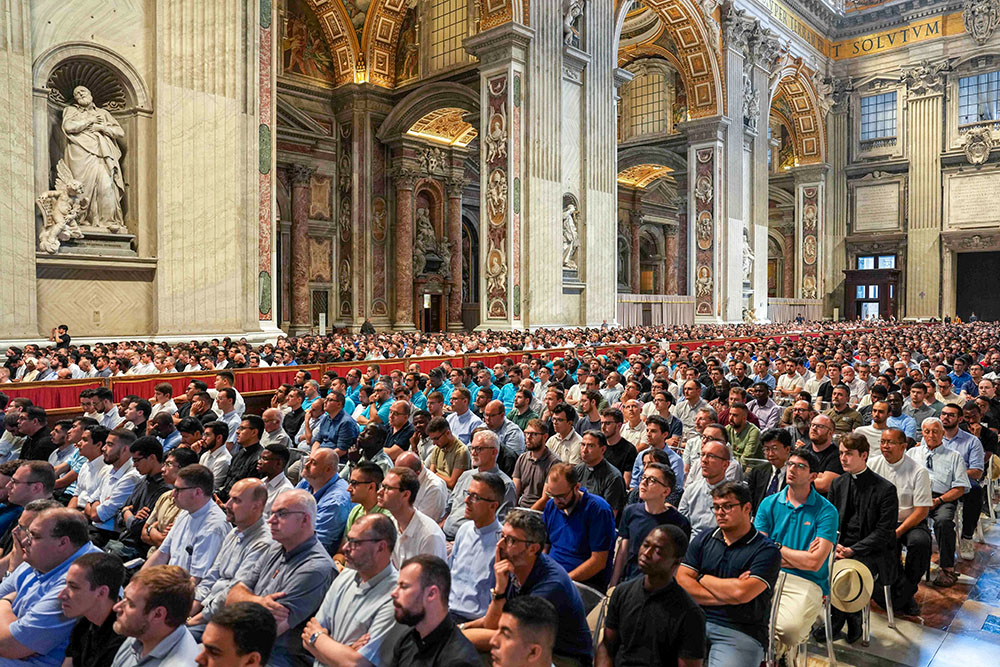
Seminarians and those involved in priestly formation from around the world attend a reflection led by Pope Leo XIV in St. Peter's Basilica at the Vatican June 24, 2025, as part of the Jubilee of Seminarians. (CNS/Lola Gomez)

by Rafael Luciani
Join the Conversation
Send your thoughts to Letters to the Editor. Learn more
The reception of the 1962-65 Second Vatican Council has reached a critical juncture in the life of the Catholic Church. While the synod on synodality and the magisterium of recent years have firmly established that the church is constitutively synodal by nature, a decisive question remains largely unresolved: How can the church as the people of God, and the shared baptismal dignity of all the faithful, take root if the institutional structures that form our ordained ministers remain anchored in the past?
Seminaries remain a blind knot in advancing the ecclesial reform initiated by Vatican II. But what does this mean and imply as we are called today to implement synodality?
Study Group 4 of the synod, coordinated by Cardinal José Cobo of Madrid, was tasked with revising the 2016 Vatican document Ratio Fundamentalis Institutionis Sacerdotalis ("The Gift of the Priestly Vocation"). The study group addresses this challenge directly in its Final Report, stating that the crisis of seminaries is fundamentally "ecclesiological."
An honest assessment of our ecclesial landscape reveals a persistent danger in many countries: that episcopal conferences, seminaries and theological faculties might reduce the orientations of Study Group 4 to mere cosmetic adjustments.
Adding modular courses on synodality or sporadic workshops on listening and discernment will remain futile if the underlying clerical culture is left intact, sustained by a faculty of professors chained to their desks, disconnected from the pastoral life of living communities. We cannot demand of students what formators and professors do not practice themselves.
As history demonstrates, every major ecclesial reform has required a reconfiguration of priestly identity and of theological and pastoral formation. The Gregorian Reform of the 11th century adopted the monastic horizon as its pastoral paradigm, and the Council of Trent, in 1563, instituted diocesan seminaries to prepare resident pastors for a society of Christendom. Today, 60 years after Vatican II, a comparable structural shift is demanded.
The Second Vatican Council's ecclesiological shift moved beyond the Tridentine model of sacerdotalization and sacralization, reshaping the identity of the presbyterate in Presbyterorum Ordinis —the Decree on the Ministry and Life of Priests — by establishing that those who are configured as ministers through the sacrament of orders have as their primary duty the proclamation of the Gospel, followed by the sacraments and pastoral governance.
The council fathers wanted to make clear that the primary duty of the presbyter was not cult, but mission. The ordained priesthood does not exist as an autonomous, self-referential caste, or as a sacred entity apart from the community. It is a ministry rooted in the communion of all the faithful.
This dismantles the rigid preconciliar divide between a teaching church and a learning church, reminding us that the ordained minister is primarily a learner, a member of the faithful among the faithful, called to listen and discern with others how the Spirit moves within the living community before attempting to govern or teach.
The urgency of reforming seminaries becomes undeniable when we examine the organizational culture of traditional seminaries, which remains deeply shaped by the Tridentine model. All too often, formation is conceived as a vertical bestowal that authority delivers, and the candidate receives with passive docility throughout years. Indeed, in many seminaries, any opinion voiced by a candidate that differs from that of a superior, formator or professor can lead directly to the seminarian's expulsion.
In this pyramidal framework, maturity is conflated with mere compliance to secure the approval of superiors, while personal vulnerability, affective uncertainty, and human limitation are masked behind a defensive spiritualization. Future ministers are trained in the closed codes of a self-referential guild, rather than equipped to unlearn authoritarian habits and to let themselves be challenged by the everyday life of the people.
Advertisement
In an effort to contribute to the renewal of seminaries, I am leading an international research project sponsored by the Latin American and Caribbean Episcopal Council (CELAM), bringing together more than 30 theologians from Latin America, North America and Europe. Our team examines the institutional variables of the traditional seminary paradigm and designs alternative models of priestly formation to implement the concluding report of Study Group 4.
Our findings confirm that the model of the seminary as an isolated boarding school, detached from the ordinary life of communities — especially the poor and the excluded — is no longer viable, and that it reinforces a false separation between evangelization and commitment to human development.
Among the essential institutional reforms needed for an authentic synodal conversion, the renewal of seminaries is vital. If future priests are to serve a synodal church, their formation must itself become more synodal.
Seminarians need to be formed not only within the seminary but also through sustained contact with the communities they will one day serve. The report of Study Group 4, for example, proposes alternating residential formation with substantial periods of living and ministering in parishes, ecclesial base communities, and social peripheries. Future priests should therefore discover their identity not in isolation, but through relationships and shared formation with laywomen, laymen, religious, families and the wider community.
This also means giving women a real voice from the earliest stages of vocational discernment. Their participation cannot be reduced to a symbolic role or occasional consultation. Women, families, and other laypersons should participate fully in formation teams, academic faculties, and the formal evaluations that take place before ordination.
The suitability of a candidate for pastoral ministry cannot be assessed solely within the seminary. It must also be discerned through the experience and active participation of the communities in which the candidate lives and serves.
Such a reform would recover an ancient practice of the church. St. Cyprian of Carthage, in Epistle 67, insisted that the suitability of ministers should be recognized before the entire community. The purpose was not simply to obtain approval, but to ensure that those entrusted with ministry had the trust and recognition of the people they were called to serve.
Seminary formation must prepare future priests for the practical demands of synodal life. For example, they need to learn how to listen, discern together, make decisions with others, and exercise authority responsibly. These practices cannot be taken for granted. They must be intentionally cultivated throughout the formation process. This implies learning that pastoral authority should listen to and take seriously the discernment of the community before making decisions and safeguarding the common good.
This is consistent with the ancient principle cited in the final document of the synod: Nihil sine consensu plebis — nothing without the consensus of the people. This entails, following the synod's document, that when pastors reach a decision that differs from the opinion expressed by the community, they should not simply impose their will. They should explain the reasons for their decision and remain accountable to the people they serve.
Seminary formation must therefore prepare future priests to understand authority not as power exercised alone, but as a ministry of listening, discernment, responsibility and service within the whole people of God.
The reform of priestly formation is no peripheral matter. It is the decisive testing ground for the credibility and institutional conversion of the church today. Without a profound spiritual, relational and structural reform of the seminary, the vision of a missionary and synodal people of God will remain an unrealized conciliar promise.
The church today does not need administrators of the sacred, but servant-pastors who walk with the faithful, listen to the Spirit speaking through them, and understand their ministry as a service of communion in the midst of the world, especially in solidarity with the poor and excluded.
The historical and prophetic courage to translate conciliar memory into concrete institutional reforms will ultimately determine the vitality of ordained ministry and of Catholic life for decades to come.
Editor's note: This column was written in Italian and translated using artificial intelligence software.