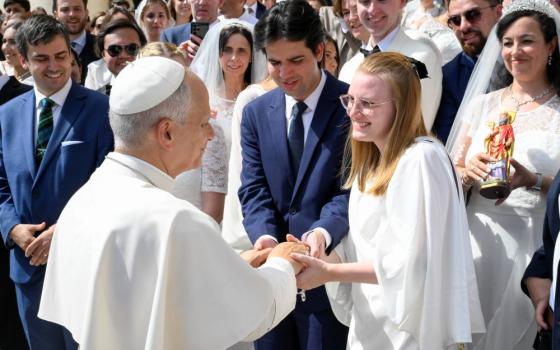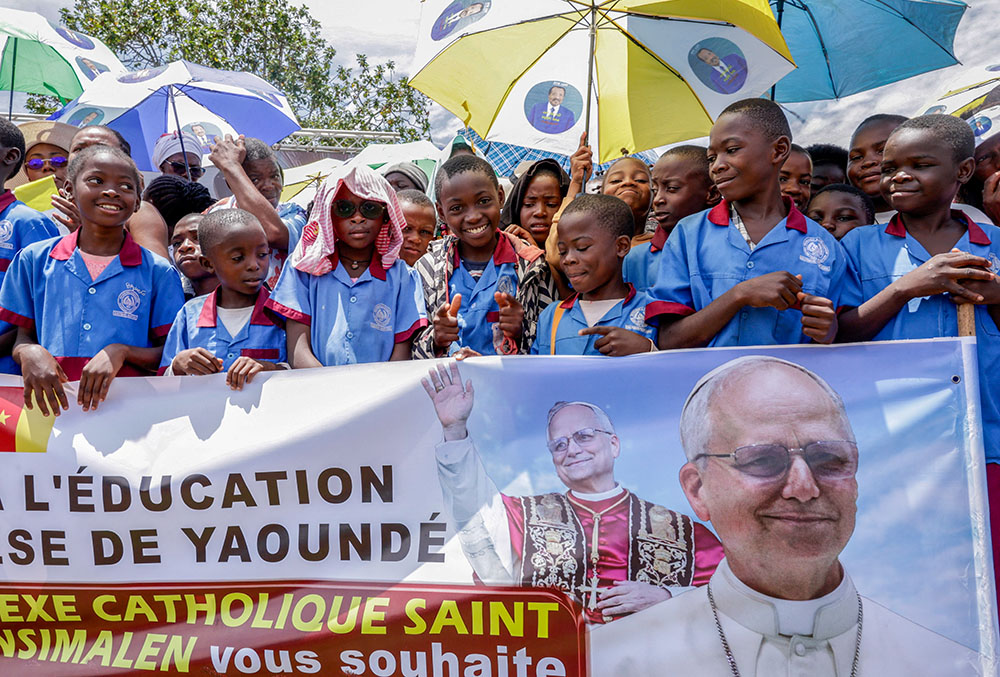
Catholic school students hold a banner as the faithful gather at Yaoundé Nsimalen International Airport in Yaoundé, Cameroon, April 15, 2026, before Pope Leo XIV's arrival to begin his apostolic journey to the African country. (OSV News/Reuters/Luc Gnago)

by Adam Kronk
Join the Conversation
Send your thoughts to Letters to the Editor. Learn more
We at Notre Dame's Institute for Ethics and the Common Good were in the middle of mapping the work being done at the intersection of Christianity and AI when Pope Francis died April 21, 2025. At a critical juncture, the large grant we were pursuing (and subsequently won) hung in the balance.
Mankind's relationship with technology had been on the pontiff's lengthy list of priorities, and it was anyone's guess whether the next head of the Catholic Church would share our institute's conviction that large language models — and their role in every facet of our lives — represented the central ethical issue of our era. Would our project gain or lose momentum? We prepared ourselves for the latter.
And then Robert Prevost from Chicago was elected on May 8, 2025. It didn't take long to suss out his stance on the matter, as he picked the name Leo and made it clear within 48 hours that the advent of artificial intelligence was to modernity what the Industrial Revolution had been when the last pope to share his name lived and moved and had his being.
Like so many, we awaited the arrival of the rumored encyclical with a heck of a lot of anticipation. And as an educator, I have to say, it did not disappoint.
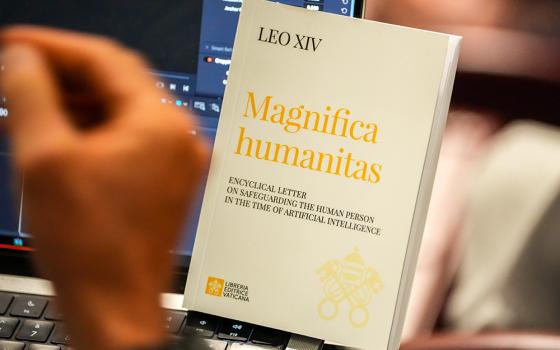
The ways in which Magnifica Humanitas resonates — or, as my children would characterize it, "slaps" — have been well documented since its release on May 25, 2026. But one thing I've been particularly excited to see and savor is the picture it paints of something for which teachers and students have been thirsting in this moment: namely, the articulation of a "dignity of learning" (my term, not his).
In the same way that Pope Leo XIII contributed a conceptualization of the dignity of labor which has helped generations from 1891 through today take into account a more expansive framing of the value of work, the 14th Leo has just contributed something analogous and sorely needed when it comes to education.
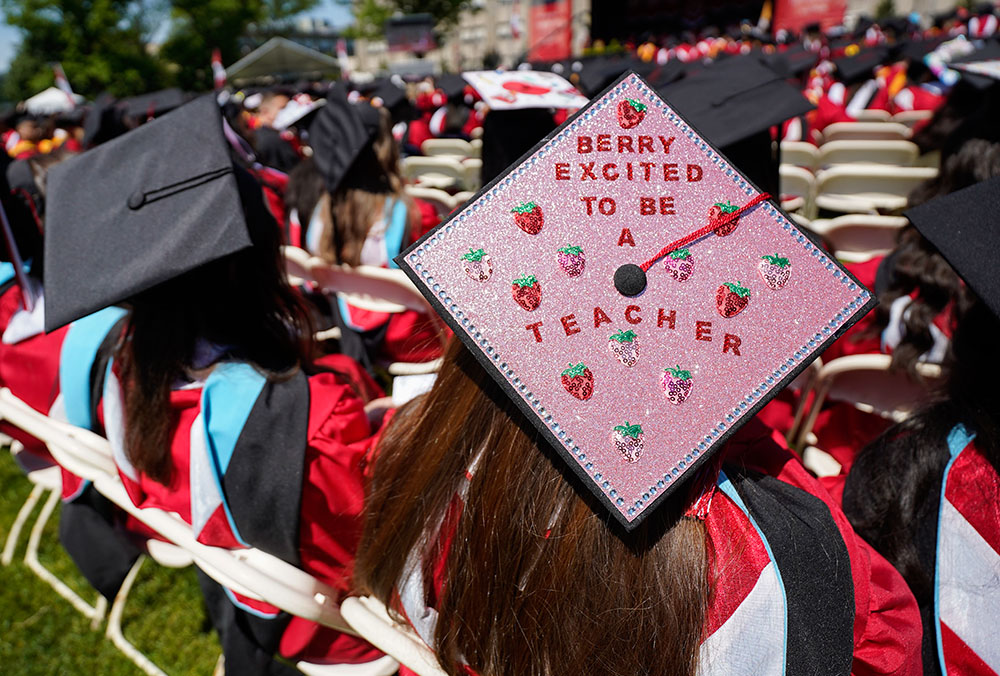
A member of the St. John's University class of 2026 uses her mortarboard to share a message about her future career during commencement ceremonies May 17, 2026, at the Vincentian school's campus in the Jamaica section of the New York borough of Queens. (OSV News/Gregory A. Shemitz)
At our university — and at schools of every level and persuasion — plenty of understandably urgent hand wringing is taking place over whether and how to integrate AI into the classroom. We must, after all, prepare the next generation for an unpredictable economy with, to understate it, an uncertain outlook. Policies and procedures are being drafted and rolled out, often skipping over the essential and foundational question: To what end?
Enter Pope Leo XIV and his beautiful, sprawling first encyclical wherein he puts the telos of school quite plainly: It is "the place where new generations can learn to seek and love the truth, to reflect on the meaning of life and to recognize the dignity of every person." And while the "advance of information technologies and AI is rapidly rendering curricula obsolete that were designed for a different era," schools "are not called to follow the pace of the digital world, but to offer that which the digital sphere by itself cannot provide, namely a shared time for learning and developing trustworthy relationships."
And it just may be that such a sacred pursuit can't be accelerated. In our productivity-obsessed context — a "culture of immediacy and hyper-stimulation" — we risk generating in ourselves and our students "apathy concerning the effort required for seeking the truth."
As wondrous as generative AI's outputs can be, the "speed and ease with which answers or summaries can be obtained risk extinguishing the desire to ask questions, which is a process that bears fruit only over time." And if I, a grown man with a fully formed prefrontal cortex, have to exercise restraint and avoid being dazzled into cognitive submission, how much more profoundly will young learners experience "that subtle temptation which renders human thought seemingly superfluous precisely when it is most needed."
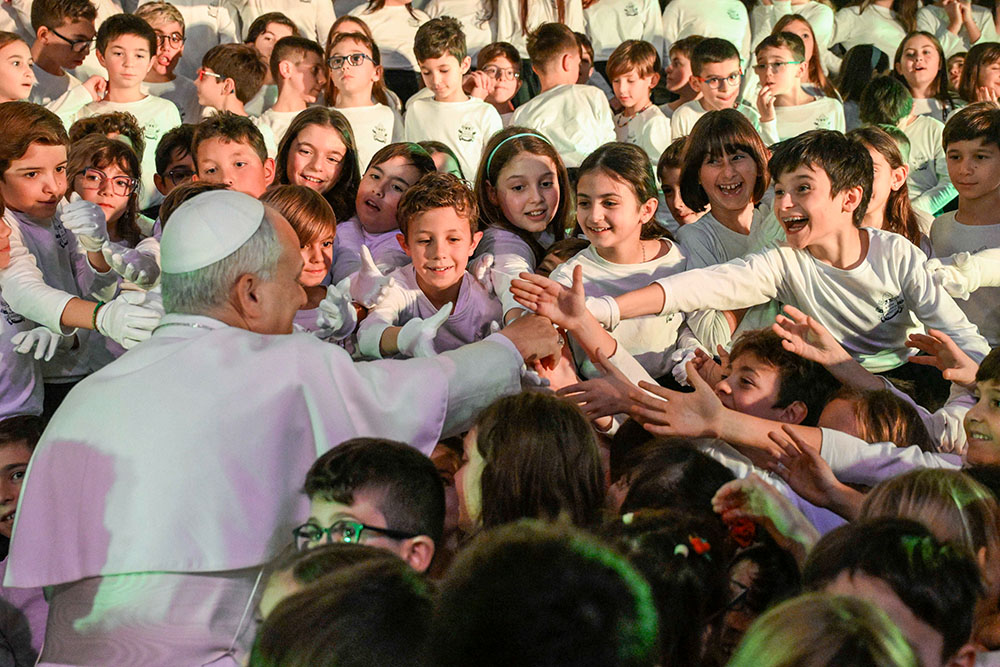
Pope Leo XIV shakes hands with students at the Pontifical Paul VI School in Castel Gandolfo, Italy, after he attended their Christmas concert in the school gym Dec. 16, 2025. (CNS/Vatican Media)
While this phenomenon is quite pronounced at present, it isn't entirely new. In an essay titled "The Crisis in Education" from almost 75 years ago, Hannah Arendt named what the collective erosion of tradition and authority was doing to learning. She famously claimed that "the essence of education is natality," meaning that each new learner is born into the world, an N of 1, an unprecedented and unrepeatable entity. Made in the image and likeness of God, we might add, each student is therefore a "precious treasure," as Leo wrote in Magnifica Humanitas.
If all this is true, it feels a little insane to abdicate any significant portion of the educational process to an anthropomorphized prediction machine. And yet its tendrils climb into every platform (even as I type this piece, any pause in keystrokes is met with an invitation to "write with Gemini"). I've got dwindling moments to wrap this up before scurrying off to my next commitment, and the siren call is enticing, indeed.
Three thinkers' notions of what's at stake help me resist.
Rebecca Winthrop last month took a stand that we shouldn't use AI to brainstorm when we're writing, and she ought to know: She's a senior fellow at Brookings who leads a global task force on AI and education. Poke around in her piece and you'll see that her observations and prescriptions aren't opinions, they're born out in large sets of data.
Claudio Nastruzzi labeled something I've been sensing in the increasingly formulaic LinkedIn drivel that has started to make the posts from people I respect become unbearable: It's called semantic ablation, and it isn't an accident — it's inherent to how large language models work. It's frustrating and sad to see otherwise insightful peers smooth their ideas into vapidity.
Advertisement
But it's French mystic Simone Weil's crusty 1943 "Reflections on the Right Use of School Studies with a View to the Love of God" that keeps coming back to me as the most compelling and, importantly, resonant with the core message of Magnifica Humanitas. "Although people seem to be unaware of it today," Weil observed, "the development of the faculty of attention forms the real object and almost the sole interest of studies. ... Directed toward God, [this ability] is the very substance of prayer."
"We do not obtain the most precious gifts by going in search of them but by waiting for them," she continues. "Man cannot discover them by his own powers, and if he sets out to seek for them he will find in their place counterfeits of which he will be unable to discern the falsity."
The very opposite of this posture of receptivity is the use of chatbots in writing. It's antithetical to what Weil celebrates as the patient process of "waiting … for the right word to come of itself at the end of our pen, while we merely reject all inadequate words."
Leo puts it plainly: "We need adults to rediscover their vocation as artisans of education, prepared to work patiently each day ... [to help students] choose what fosters inner freedom." And if ever there were a case where "do as I say, not as I do" would backfire, it's this moment in education, wherein trust between teachers and students is eroding by the minute.
We have an opportunity to do something truly dignifying if only we can counteract the constant pressure to instrumentalize learning. If we are to follow Nehemiah's example, as Leo invites us to, and get our hands dirty in the "construction sites of history" and "rebuild what has collapsed and protect what is threatened," we have to be fanatical about our commitment to every student under our care. At the forefront of our minds — and at the center of hearts — must be the recognition that schooling is a sacred setting in which much more than grades, credentials and career prep are at stake. Our purpose is indeed magnificent: to foster the dignity of learning.