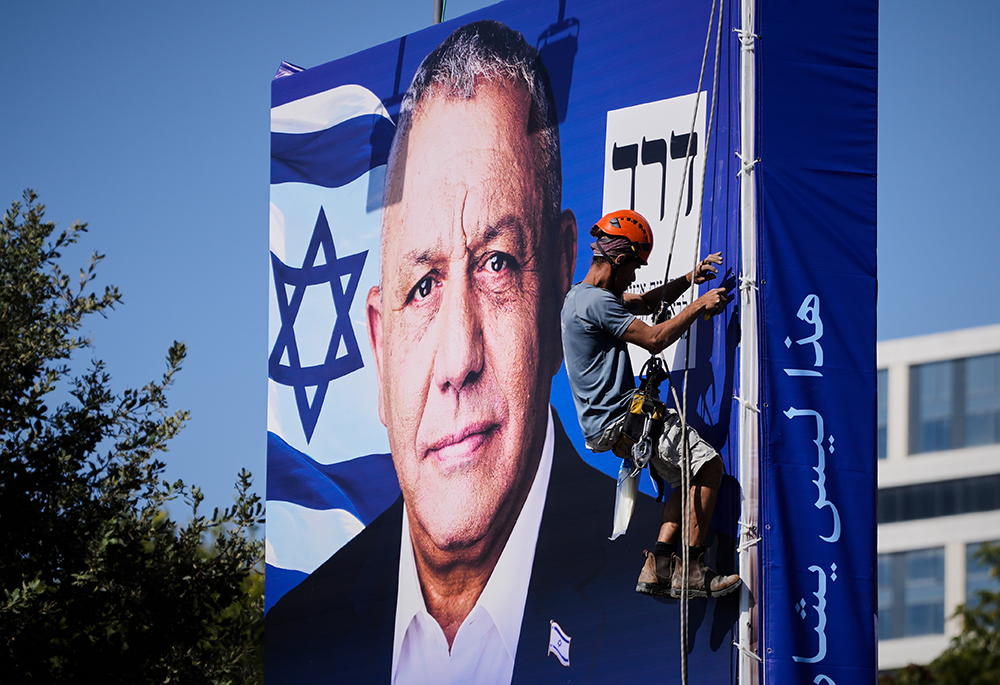
A worker hangs a campaign billboard featuring Gadi Eisenkot, leader of Yashar ("Straight") party, ahead of Israel's general election in Jerusalem, Oct. 22, 2026. (AP photo/Ohad Zwigenberg)

Join the Conversation
Send your thoughts to Letters to the Editor. Learn more
Next week, Israeli voters go to the polls to elect a new parliament, or Knesset. The polls have been like two chickpeas in a pot of boiling water with incumbent Prime Minister Benjamin Netanyahu's coalition locked in a close race with the coalition surrounding Gadi Eisenkot of the Yashar party.
I hope Netanyahu loses. His belligerence has consumed him and clouded his judgment. Yes, Israel had every right to pursue the Hamas criminals who attacked Israeli civilians on Oct. 7, 2023. Yes, Hamas could have ended the war in Gaza quickly by freeing the hostages it had taken. But, at some point, he went too far and the rising civilian death count became morally intolerable. Worse, he has coddled violence by Israeli settlers against Palestinians in the West Bank, making an eventual peace deal more and more impossible. And, we have yet to find out why he and his ministers failed to perceive the threat of an attack by Hamas and take steps to protect Israelis. For all these reasons, I hope he loses the election.
Eisenkot is no peacenik. Like any Israeli politician who has served in the military, he is aware of the existential threat Iran poses to Israel. Eisenkot's biggest difference from Netanyahu would be his treatment of Jewish extremists in the West Bank. He would also likely dismantle some of the more recent Israeli settlements in the region. This is reason enough to vote for him.
Americans, however, should not think a Netanyahu loss will suddenly bring peace to the region or that the two-state solution will suddenly become viable. Before Netanyahu, there was Ehud Olmert who offered a peace deal to the Palestinians in 2007-2008. U.S. Secretary of State Condoleezza Rice encouraged Palestinian leader Mahmoud Abbas to sign the deal, observing at the time that "Yitzhak Rabin had been killed for offering far less." Abbas never responded to the offer.
Before Olmert there was Ehud Barak and the negotiations at the Egyptian town of Taba in 2001 and at Camp David in 2000. Despite offering the Palestinians control of more than 90% of the West Bank, and a total Israeli withdrawal from Gaza, Palestinian leader Yasser Arafat refused a deal. President Bill Clinton, who hosted the negotiations at Camp David, blamed Arafat for the failure.
Rabin had been gunned down by an Israeli extremist in 1995. In 1981, Egyptian leader Anwar Sadat was assassinated by Islamic extremists after he made a peace deal with Israel. At the conclusion of the 1973 Yom Kippur War, Sadat was the most hated man in Israel. In 1977, he went to Jerusalem with a peace plan and accepted Israel's right to exist. He knew he was likely signing his own death warrant, but he brought peace, a peace which has lasted, between Israel and Egypt. Heroes often risk martyrdom.
No Israeli leader can negotiate a peace deal with the Palestinians until someone in the Palestinian political leadership is willing to make a deal. If Netanyahu loses, Eisenkot has the chance to reset Israel's policies and its diplomatic posture. No one knows how politics in the Palestinian territories will develop with Hamas gravely weakened but still in control of Gaza and after Abbas, who is 90 years old, relinquishes power in the West Bank. But at least there is a chance for change if Eisenkot wins.
Advertisement
There is one other aspect of the Israeli elections to consider, in part because it has significance for the U.S. midterms the following week. Freedom House, a nonpartisan organization that promotes democracy around the world, rates the access people have to political rights and civil liberties, and then scores each country. Finland tops the list with a perfect 100, followed by Norway, Sweden and New Zealand, all at 99. The U.S. scores an 81 and it has been dropping. South Sudan and Tibet are at the bottom of the list with a score of 0.
In the Mideast, Israel scores a 73. Her neighbors do not do as well: Egypt is at 18; Jordan rates a 34; and Lebanon is at 41. America's other allies in the region do worse: Iraq gets a 31, the UAE scores an 18, and Saudi Arabia is at 9. In short, the more than 1 million Arab citizens of Israel who will vote in next week's elections have a greater say in the direction of the Jewish state than they would if they lived and voted in any other Arab country. This is the kind of fact the new anti-Israel demagogues apparently do not know or care to ignore.
So, when Democratic Senate candidate Dr. Abdul El-Sayed softens his opposition to military aid to Israel by saying he also opposes military aid to Egypt, where his family is from, and Pakistan, Saudi Arabia and the UAE, he ignores the fact that only one of the countries on his list is a sister democracy.
President Trump's calling El-Sayed a "jihadist" is despicable and false. It also tarnishes legitimate questions about the candidate's stance on Israel. They must be posed anyway.
El-Sayed refuses to distance himself from the extremist antisemite Hasan Piker: "If you want to make this race about a streamer in California, I just think you're missing the boat. This is about affordability in Michigan," The question about Piker, however, is a legitimate one. It is about El-Sayed's judgment of character, which is an important qualification in a political leader. Associating with someone like Piker tells us a lot about El-Sayed and it is not reassuring.
In a sea of pandering, El-Sayed's self-assurance and candor can seem reassuring. But he is an ideologue who is allergic to nuance. And he is not allergic to antisemitism. It will be terrible for the country if the Republicans retain control of the U.S. Senate. But supporting someone who is too comfortable with antisemitism, who tosses around the charge of "genocide" too easily, and who says "Jewish people everywhere deserve to be safe in your homes, schools, and houses of worship" but is indifferent to the safety of Jews in Israel, that is a price too high.