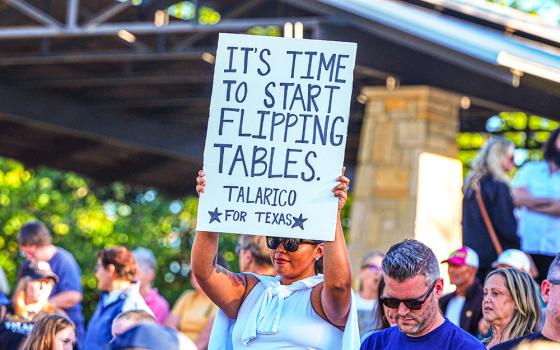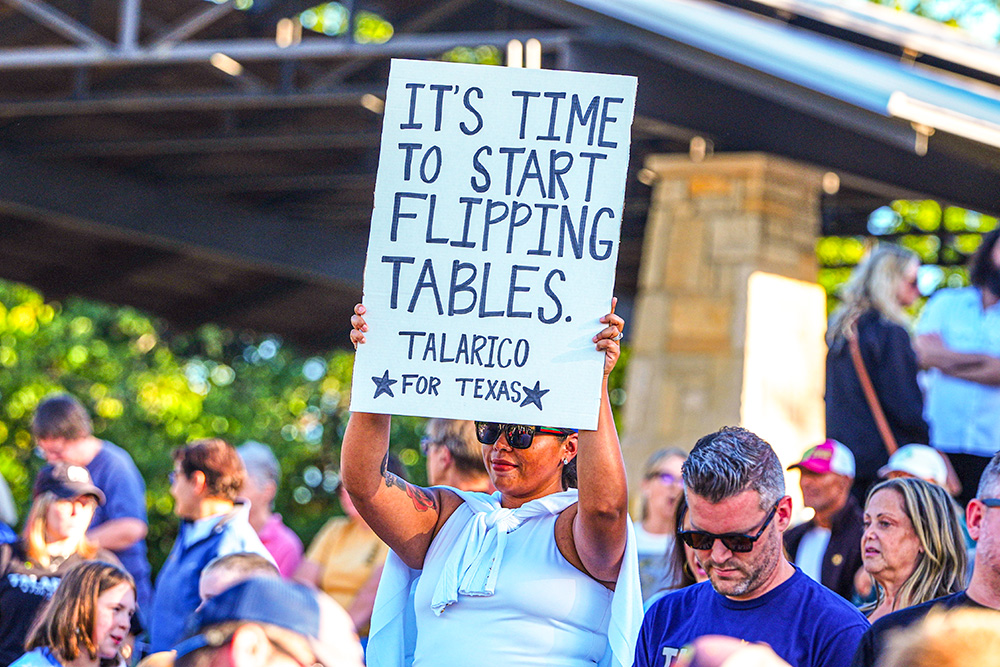
A supporter of Democratic U.S. Senate candidate Texas state Rep. James Talarico holds up a sign before a campaign event in Plano, Texas, Oct. 18, 2026. Talarico's electoral victory on Nov. 3 will make him the first Democrat in more than three decades to represent Texas in the U.S. Senate. (AP/LM Otero)

by Brian Fraga
Staff Reporter
Join the Conversation
Send your thoughts to Letters to the Editor. Learn more
This year began with scenes of clergy members marching in the streets and being arrested by federal agents during the U.S. Immigration and Customs Enforcement's winter surge in Minnesota.
Now, more than 10 months later, 2026 is nearing its end with several progressive mainline Protestant pastors and seminarians heading to Washington, D.C., as elected officials.
"We are seeing a reemergence of a religious left, but it did not start on Election Day," said Brian Kaylor, a Baptist pastor and editor of a progressive faith and politics site.
Much of the opposition to the second Trump administration, Kaylor said, has come from mainline Protestant, Catholic and Jewish faith leaders who rediscovered their voice in the public square and sued the administration for religious liberty rights while protesting against ICE.
At least a half-dozen mainline Protestant ministers emerged this year as political candidates. Running as Democrats, they prevailed in the Nov. 3 midterms in traditionally red states with a message rooted in the social Gospel.
"The 'Matthew 25' and 'Love thy neighbor' rhetoric of clergy and seminary students in this [election] cycle resonated for many voters precisely as an alternative to the political corruption, moral hypocrisy and glorification of violence dominating our political life," Kaylor told National Catholic Reporter.
Whether a new religious left is emerging remains to be seen, but political analysts agree that voters' frustrations with the Trump administration provided an opportunity in red states for Democrats who were comfortable using religious language on the campaign trail.
"I think what it mostly is is the Democratic Party realizing that if it's going to be a majority party nationally, it has to do better in traditionally red states and doing a good job of recruiting candidates who are good fits for those states," said Geoffrey Layman, chairman of the political science department at the University of Notre Dame.
"A Democratic socialist is not going to win Texas or Kansas and a highly secular, nonreligious candidate is going to have a hard time in those kinds of states," Layman said. "But somebody with a more traditional religious orientation is going to do better and somebody who is deeply devout and has a religious background is bound to do even better."
Advertisement
That was seen in the electoral victories of candidates such as James Talarico, a Presbyterian seminarian who will be the first Democrat in more than three decades to represent Texas in the U.S. Senate. In his victory speech, Talarico recounted how his grandfather, a Baptist preacher, taught him about Jesus, a "barefoot rabbi" who loved his neighbors and "flipped over the tables of injustice."
The Rev. Adam Hamilton, a United Methodist pastor who won a U.S. Senate seat in Kansas, drew on Jesus' golden rule in his victory speech: "Do unto others as you would have them do unto you."
In remarks to the Associated Press, Hamilton said he felt compelled to talk about his faith. "It's just, it's my life. It's what I eat, sleep, drink and breathe," he said.
The Rev. Adam Russell Taylor, an ordained Baptist minister and president of Sojourners, a progressive Christian organization dedicated to social justice activism, told NCR that candidates like Talarico and Hamilton applied their Christian faith to their politics in a way that felt authentic.
"And that resonated with a lot of Christians, both mainline Christians, even Catholics, and even some evangelicals," Taylor said. "They were really offering a more true authentic expression of the Christian faith by emphasizing Jesus' call to us to love our neighbor."
Taylor also said that the newly elected Christian members of Congress could serve as counterexamples to the Christian right, adding that they have "the potential to break the stranglehold that the Christian nationalist movement has held on our politics."
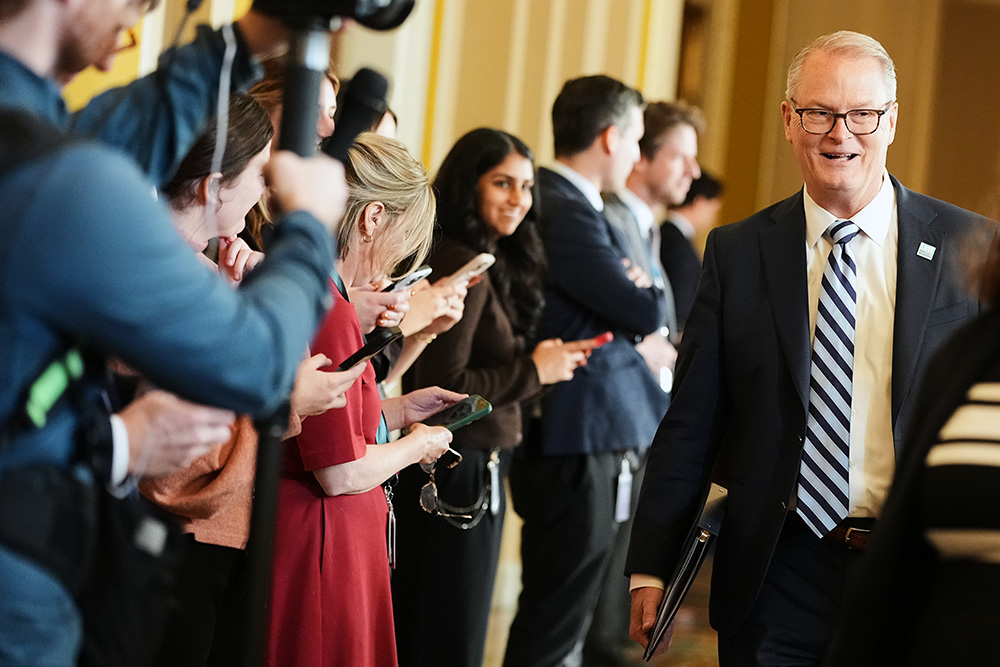
Sen.-elect Adam Hamilton, D-Kan., walks to the office of Senate Minority Leader Chuck Schumer, D-N.Y., at the U.S. Capitol Nov. 9, 2026, in Washington. (AP/Julia Demaree Nikhinson)
However, Ryan Burge, a professor at Washington University in St. Louis who studies religious demographics, said he is skeptical that recent election results herald the emergence of a new religious left.
"The religious left has existed for a long time, particularly in mainline Protestant denominations," Burge said in email. "What's changed is that some Democratic candidates seem more willing to talk openly about their faith and connect it to their political priorities."
Burge also cautioned against confusing "a handful of election victories" with a broader shift in the electorate.
"The data are pretty clear that the Democratic coalition is becoming less religious over time," he said. "Religiously unaffiliated Americans are a huge part of the Democratic base, while mainline Protestants are a much smaller share of the population than they were even twenty years ago. That's not exactly fertile ground for a religious revival on the left."
Asked whether the emergence of the new faith-forward Democrats signals a progressive response to the evangelical base of the Republican Party, John White, an emeritus professor of political science at the Catholic University of America, likened it to "a seed that could grow into something bigger."
"I do think the social Gospel, rooted in Matthew 25, is getting a revival," White said. "It reminds me of the Protestant ministers of the 1960s who were interested in both civil rights and social justice while preaching the Gospel. To me, that's the one thing I hearken to."
White emphasized, however, that the electoral successes of candidates like Talarico and Hamilton were made possible by President Donald Trump, whose job approval ratings fell under 30% in the weeks leading up to the midterms.
"Trump has gone so far that he has pushed people like Adam Hamilton into the Democratic Party, and the Democratic Party was smart enough to welcome them with open arms because [the Democrats] have had a problem for years with religious voters, frequent church attendees and the like," White said. "So this is a real opportunity for the Democrats."
Michael Wear, founder, president and CEO of the Center for Christianity and Public Life, a nonprofit based in Washington, D.C., told NCR that Trump's controversial and bareknuckled approach to politics and leadership provided an opening for the Democratic Party to be more open to moral language and discussions of character in public life.
"Trump opened up the apertures for Democrats to revisit the determination that it was just policy that mattered," said Wear, who added that the candidates' faith-infused language could provide a robust lens to legislating on Capitol Hill.
"So what does it mean for James Talarico to say that politics doesn't have to be a blood sport in the midst of investigations into the Trump administration?" Wear said. "These candidates have set a high bar in their rhetoric and frankly it's one that we should all aspire to."