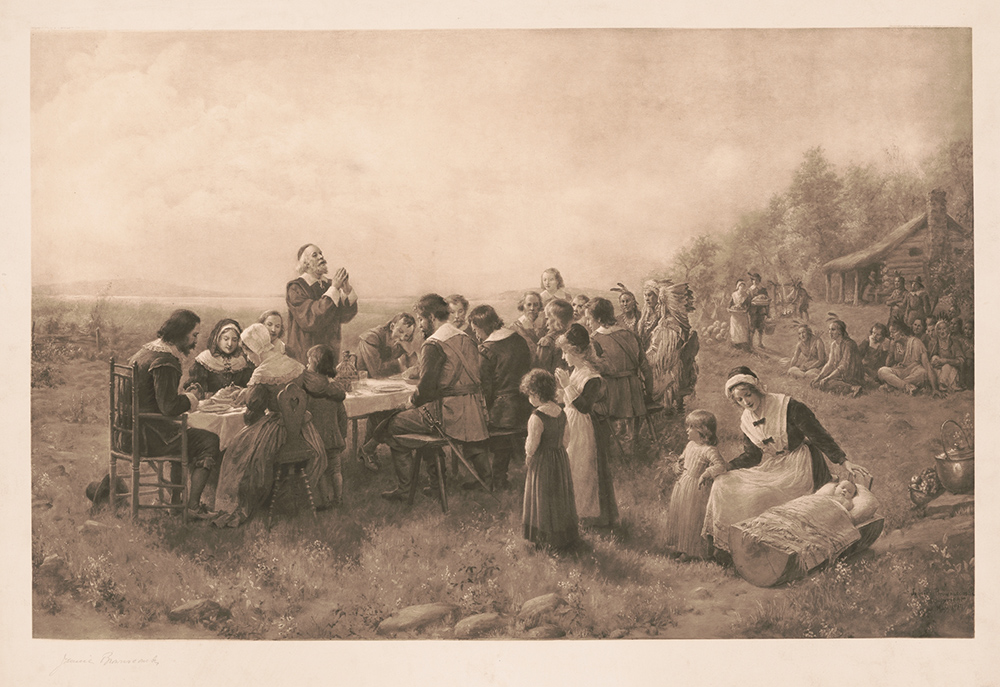
"The First American Thanksgiving" a 1914 painting by Jennie Brownscomb (Artvee)

Join the Conversation
Send your thoughts to Letters to the Editor. Learn more
This week, the nation pauses to celebrate Thanksgiving Day. It remains different from other holidays, yet the history of which tells a great deal about ourselves as a nation.
Christmas and Easter come to us from the Christian calendar, and Halloween is also borrowed from that calendar. All have been commercialized, and Easter had to become about bunnies and chocolate to achieve sufficient sales. Thanksgiving, which is the only other explicitly religious national holiday, has been largely spared over commercialization. That is one more reason to be thankful.
July 4th commemorates the signing of our Declaration of Independence and is attended by suitable demonstrations of patriotic fervor. Every nation on earth has something similar. Martin Luther King Jr.'s birthday invites us to reflect on the life of one of the greatest of Americans, something other countries do as well. Columbus Day recalls the courage of the Italian adventurer who, despite his many flaws, was credited with being the first European to reach the New World. Labor Day celebrates the working men and women of the country and their myriad contributions. None of these have been commercialized to the extent our religiously based holidays have been, which is an odd fact.
Thanksgiving services were well known throughout the early United States but it was not until 1863 that President Abraham Lincoln issued a proclamation ordaining the last Thursday in November as a national Thanksgiving Day.
Advertisement
Lincoln may have been the outstanding American theologian of the 19th century. In the midst of the Civil War, he gave expression to that sense of gratitude which is the starting point for revealed religion:
The year that is drawing towards its close, has been filled with the blessings of fruitful fields and healthful skies. To these bounties, which are so constantly enjoyed that we are prone to forget the source from which they come, others have been added, which are of so extraordinary a nature, that they cannot fail to penetrate and soften even the heart which is habitually insensible to the ever watchful providence of Almighty God. In the midst of a civil war of unequalled magnitude and severity, which has sometimes seemed to foreign States to invite and to provoke their aggression, peace has been preserved with all nations, order has been maintained, the laws have been respected and obeyed, and harmony has prevailed everywhere except in the theatre of military conflict; while that theatre has been greatly contracted by the advancing armies and navies of the Union.
This is not the Deism of so many of the Founding Fathers. Lincoln's God is a providential God, an "ever watchful" Deity. Later in the proclamation, he states, "No human counsel hath devised nor hath any mortal hand worked out these great things." Lincoln does not employ specifically Christian language in this, nor in his greatest theological tract, his Second Inaugural Address, but there is no sentiment in his Thanksgiving Proclamation which is heretical to the Christian faith.
As an undergraduate, I was profoundly blessed to study metaphysics with the great Paul Weiss. Though he was not a believer, he thought it incumbent upon a philosopher to wrestle with the idea of God and so he published his theology in 1964, The God We Seek. I have long since loaned my copy to someone, and it was not returned, but I distinctly remember his assertion that for anyone who believes in an omnipotent and omniscience God, which he knew to be the only kind of God worth believing in, all prayer was a variation of one prayer: Thy will be done.
Weiss' insight is that of the philosopher. For the believer, all prayer starts with gratitude. How would we know anything about God unless He first revealed Himself to us? The initiative in religion is always and necessarily with God, and we humans must start with gratitude for the gift of revelation. Thence we can seek to discern, submit to and incarnate God's will. Even in the midst of a terrible war, Lincoln perceived the priority of gratitude.
Gratitude faces some strong cultural headwinds. In the realm of ideas, theories of decolonization and deconstruction yield only a sense of grievance. In the realm of daily life, the acquisitiveness that drives consumer capitalism is the exact opposite of gratitude. The algorithms of social media reward anger and extremism, not thankfulness. It is not clear how we retrieve gratitude in our culture today but there will be no genuine Christian culture unless we do.
Editor's note: You are reading a selection from Michael Sean Winters' weekly newsletter. To get the full edition — including the "In the News" link roundup — delivered 24 hours before it appears online, sign up here!