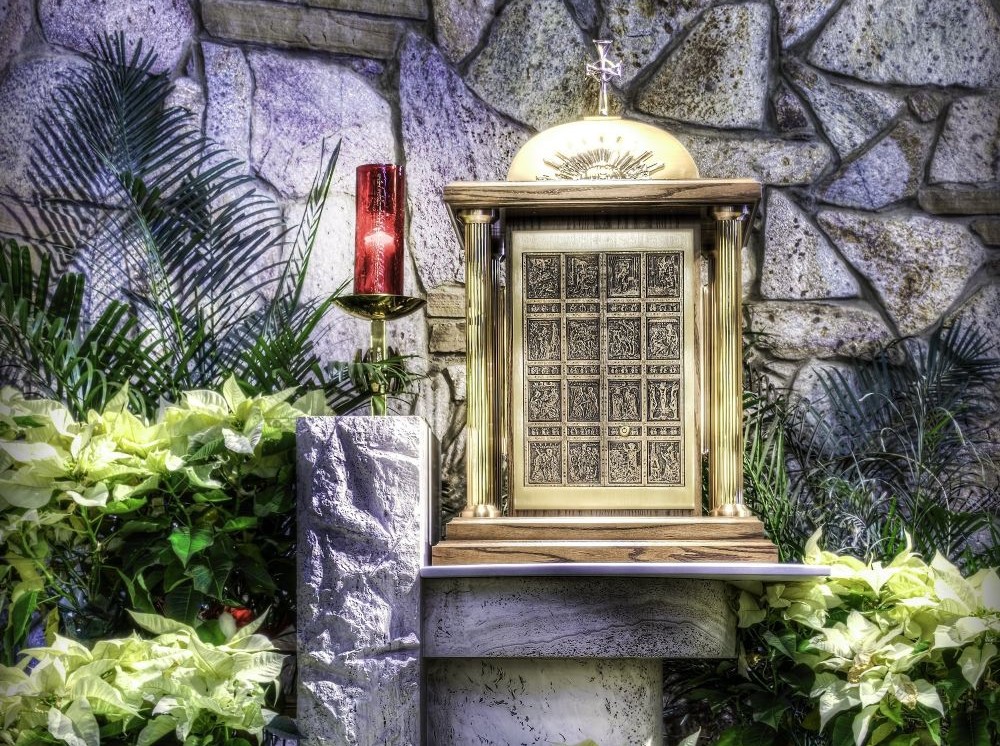
A sanctuary lamp burns beside a tabernacle, indicating that Christ is present in the consecrated hosts within. (OSV News/Pixabay/Vincent Ciro)

Join the Conversation
Send your thoughts to Letters to the Editor. Learn more
What is this fetish for returning tabernacles to the main altar?
When I returned to Connecticut in 2017, I drove down to Norwich to visit the newly restored Cathedral of St. Patrick, a church I had visited since I was young. Like many cathedrals, St. Patrick's began as a parish church, was renovated many times over the years and was named a cathedral when the Diocese of Norwich was erected in 1953.
After the Second Vatican Council, when the cathedral was changed to reflect the new rites and the liturgical ressourcement that had begun in the 19th century, the main altar was brought forward and placed underneath a new baldacchino, so it naturally drew the eye to it upon entering. The cathedra, or bishop's chair, was placed behind the main altar. A new Blessed Sacrament chapel was created nearby, close enough to get to the tabernacle as needed, but separate enough to invite quiet, prayerful reflection before the reserved sacrament. It worked very well liturgically and was quite beautiful.
It was renovated in 2010-2013 in time for the 60th anniversary of the diocese. Many of the changes introduced in 2010-2013 were excellent. They ripped up the carpet and installed wood and marble flooring, vastly improving the acoustics. The organ, an Aeolian-Skinner from 1955, was also restored and the sound is wonderful. The restoration of the paint scheme to its original Victorian panoply of color is not to my taste, but renovating a church is not really about taste. Here are some before and after photos.
The main problem was that the tabernacle had been placed behind the main altar where the bishop's cathedra had been. The cathedra was placed behind a column to the left of the sanctuary. It is difficult to see the bishop and he has to step forward several feet to lead the congregation in the opening and closing rites of the Mass. The tabernacle competes with the altar of sacrifice for the eye's attention. And, if one wishes to pray before the Blessed Sacrament, you are now in the vast nave instead of the more intimate Blessed Sacrament chapel. Cathedrals are busy places and so your prayer is often interrupted by the organist practicing or the janitor cleaning or tourists visiting. In short, the renovation does not work liturgically even though some of the artistic changes are admirable.
In 2015-2016, they renovated the Cathedral of St. Agnes in Rockville Centre and put the tabernacle on the main axis of the church, behind the altar of sacrifice. At least the cathedra is visible. St. Mary's Cathedral in Peoria completed a renovation in 2015 that put a tabernacle back at the center of the sanctuary.
New cathedrals in Raleigh, North Carolina, and Knoxville, Tennessee, also reverted to the placement of the tabernacle as the central focal point of the sanctuary.
The bishops who oversee these decisions have been to Rome. They know that St. Peter's in Rome and Notre Dame in Paris and the Frauenkirche in Munich do not have a tabernacle on their main altars. All have a distinct chapel where the reserved sacrament is kept.
Advertisement
"The move to put tabernacles on the main altar was a part of post-Reformation Catholicism," said University of Notre Dame professor Timothy O'Malley, who is the academic director of the Notre Dame Center for Liturgy and an associate director of the McGrath Institute. "It is seen as traditional even though, when you look at Christian history, that central placement isn't normative." Most cathedrals in Europe which were built before the Reformation place the tabernacle in a side chapel.
Most of the cathedrals in the U.S. were built in the Victorian era when all churches, including cathedrals, tended to place the tabernacle on the main altar. It was only after the Second Vatican Council that many cathedrals in the U.S. were renovated and Blessed Sacrament chapels were created for prayer in front of the tabernacle.
O'Malley said he thought that some people advocate for placing the tabernacle back on the main altar out of a "legitimate desire to increase devotion to the Eucharist. But we know there were high degrees of eucharistic devotion in the Middle Ages and it was not focused on the placement of the tabernacle. There are other ways to cultivate eucharistic devotion."
A comprehensive historical perspective should trump 1950s nostalgia in almost all cases, and theological considerations should trump historical precision in most cases. The theology is straightforward: Eucharist is a verb before it is a noun. The Mass is not only the source and summit of our faith, as Vatican II taught, it is the obvious source of the reserved Eucharist. You can have a Mass without a reserved sacrament. You can't have the reserved sacrament without the Mass.
I understand that in a small parish church the only realistic place for a tabernacle may be behind the main altar. But in a cathedral?
A bishop once told me that when he got to his new diocese, half a dozen parishes were divided because the pastor decided to move the tabernacle. Some were putting it back on the main altar and others were removing it from the main altar. He decreed: No tabernacles move. Why cause division? He was right.
When renovating a church or, especially, a cathedral, the placement of the tabernacle cannot be avoided. We should follow the norms of the Second Vatican Council and the ancient tradition of the church, as Pope Leo XIV recently said. I fear that some young clergy and some laity have been listening to online Catholic influencers who advocate a nostalgic return to the spirituality of the Catholic ghetto and who, regrettably, do not have two theological pennies to rub together to save their lives.
Bishops know better or they should know better. Perhaps we need a few more sermons on the closing words of the Mass: Ite, missa est. The Mass is ended, go in peace. Every Mass may or may not result in extra hosts to be placed in a tabernacle. But every Mass concludes with the command to go forth and bring the sacrificial, redemptive love we have partaken of and celebrated in the Eucharist to the hurting world around us. That remains the most important form of eucharistic devotion.