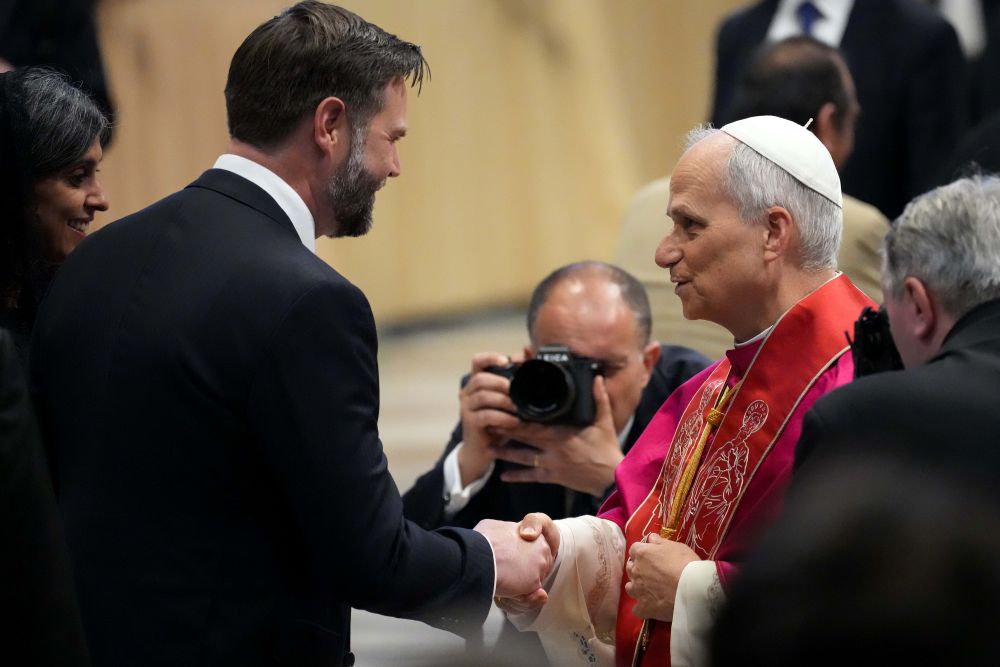
U.S. Vice President JD Vance greets Pope Leo XIV as his wife, Usha Vance, looks on in St. Peter's Basilica following the pope's inaugural Mass at the Vatican May 18, 2025. (CNS/Lola Gomez)

Join the Conversation
Send your thoughts to Letters to the Editor. Learn more
Ever since Jesus of Nazareth told the Pharisees to render unto Caesar the things that are Caesar's (Matthew 22:21), Christianity's relationship with politics has been at once ambiguous and unavoidable. The Catholic Church has survived persecution by and integration within the Roman empire, the barbarian invasions and medieval fiefdoms, the rise of the nation-state and the Cold War, but each time, theologians have had their work cut out for them trying to decide what was Caesar's and what was God's.
In our time, everywhere one looks for some insight into the relationship of religion and politics, there are theological cul-de-sacs. Liberation theology is tired at best. Integralism has made a frightening comeback but remains as coarse and hoary as its 19th century iteration. Does anyone read Jürgen Moltmann anymore? The culture war model of Catholic political engagement has proven sterile but no one is sure how to replace it.
Then Pope Leo XIV emerged on the loggia of St. Peter's and, for him, there is no escaping the challenge of figuring out how to engage the politics of our time while leading a church that is increasingly a global church. The first pope from a superpower. The first pope born in the United States. At a time when the U.S. is overturning what was best about the postwar international order. How is the pope to avoid the larger challenge of seeing all of his words and actions contrasted with those of President Donald Trump, a comparison that is entirely unhelpful to the pope?
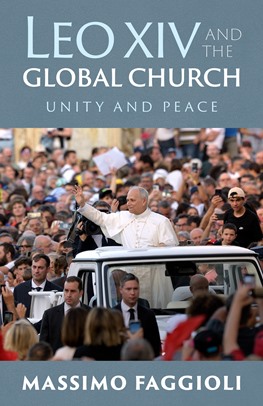
There are not many political theorists capable of analyzing the many facets of this relationship between the new pope and the political world. There are not many theologians who can discern the sources of Leo's thought and how they follow from, or differ from, the approaches of his predecessors and what that means for engagement with the world. But, Villanova theologian Massimo Faggioli is something of a cartographer for understanding the historical theology that led to this moment and surveying the political landscape in which the church today must operate. His new book, Leo XIV and the Global Church: Unity and Peace, is the map we have all been looking for and the person who should most definitely read this book is the pope himself!
Faggioli starts by noting the central leitmotif of this pontificate — unity and peace — which the new pope mentioned in his first Urbi et Orbi address shortly after his election, and indeed which are contained, one explicitly and the other implicitly, in his episcopal motto "In Illo Uno Unum" — "In the One, we are one." The author notes the many times the pope has reiterated his call for a united church capable of confronting the global crisis which was "created for the most part by his country of origin."
That last assertion is worth a debate, but it is not central to the issue at hand in Faggioli's first chapter, which looks at the history of the papacy from ancient to modern times, and how the headlines often missed the reality. For example, Faggioli rightly notes that despite the loss of the papal states in the late 19th century, and indeed in part because that temporal power was lost, "a distinctive type of 'Roman court' around the pope continued and still exists … stronger than ever, not only in the dicasteries of the Roman Curia, but also in the pontifical universities and academies, in the general curia of religious orders, in the vast network of volunteer work associated with the Holy See, and in the international press present in 'the Eternal City.' " In fact, for the church in our time, "Rome is an ideal place for global encounters precisely because it is not the economic, political or military center of Europe." And Faggioli notes that the "plasticity" of the papacy is a constant through history, no matter how much ecclesiological partisans wish to emphasize its immutability or its capacity for change, depending on their own desires.
The balance of the first chapter examines the development of the papacy in more recent times, with an especially adroit focus on Leo's immediate predecessors: Paul VI, John Paul II, Benedict XVI and Francis. So, for example, writing about the election of Francis in 2013, Faggioli observes, "Francis' papacy represented a liminal moment, a transition from popes shaped by the experience of the council to popes shaped by the experience of the reception of the council — and in Francis's case, 'from the ends of the earth.' " Certainly, part of the reason the Vatican was so flummoxed by U.S.-led opposition to Francis was the fact that we Americans, always myopic, had trouble grasping that other local churches had received the council differently from the way we did, and in the case of Latin America, in a more theologically fecund manner.
The second chapter is biographical and Faggioli notes that Leo has the most extensive experience of global Catholicism of any pope at the time of his election, given his two terms as general of the Augustinian order. He also looks at some of the differences between the Augustinian order and the Jesuit, and how those influences might differ from those of Francis. Indeed, this is the first time in the modern era when we have had two popes in a row from religious orders. "It's a good look," one cardinal told me.
Faggioli completes the biographical chapter by pondering what it might mean to have a U.S.-born pope for the U.S. church specifically. "For American Catholics," he writes, "Leo XIV's election could represent a diversion and a distraction or, conversely, a conversion from the centrifugal ideologies — both political and religious — that have influenced the daily lives of the U.S. faithful, especially since the simultaneous presence of Pope Francis and Donald Trump on the world stage."
One claim here needs clarification. Faggioli writes: "The election of the Chicago-born pope is an indirect response to the radical right-wing or alt-right politics of influential American Catholics today, which is a mixture of theological revanchism used to foster intra-confessional polemics and political messianism with neo-pagan connotations." That is a splendid description of the alt-right RCs, but to call Leo's election a response to them, even an indirect one, is misleading. Most cardinals were not looking for someone to respond to JD Vance when they cast their ballots. Better to say, Leo's election is a "de facto" response to Vance and his ideological running buddies.
It is in this chapter, also, that Faggioli quotes from a papal speech that I somehow missed. When Leo visited the Italian president, he said:
In this regard, there is a certain tendency at present, not to sufficiently appreciate at various levels, the models and values that have matured over the centuries and that mark our cultural identity, sometimes even pretending to erase their historical and human relevance. We should not despise what our fathers experienced and passed on to us, even at the cost of great sacrifices. Let us not allow ourselves to be captivated by mass-produced and fluid models that promote only a semblance of freedom, only to then make people dependent on forms of control such as current trends, marketing strategies, or other things. (cf. Cardinal Joseph Ratzinger, Homily at the Mass for the Election of the Roman Pontiff, April 18, 2005.) Cherishing the memory of those who preceded us, valuing the traditions that have led us to be who we are, is important for looking at the present and the future with awareness, serenity, responsibility, and a sense of perspective.
That is one of the sweetest but most thorough and devastating critiques of certain academic trends I have ever read.
The third chapter looks at the situation the pope faces in different parts of the world. So, for example, while rightly viewing Leo's election as continuing "the trend of a papacy increasingly less identified with Europe" Faggioli also notes: "Leo expresses a classic Atlanticist geopolitical vision closer to American Catholicism and post-1945 Europe than did Francis, but far removed from the tone of Trump and Vance who point to connections between Christianity, the West, and world civilization." There is a lot to unpack in those sentences, and Faggioli is keen to explain how he views the changing landscape. Remarkably, he is as insightful when surveying the situation of the church in Latin America or Asia as he is when surveying his native Europe or adopted America.
Chapter 4 looks at Leo's calls for unity within the church. Faggioli notes the fragmented state of modern theology in which some pine for a nostalgic Catholicism while others insist on imposing a post-colonial or decolonial lens. By contrast, "Leo XIV expresses a unitary vision of history, which is different from the identity function of opposing and antagonistic historical reconstructions." At a time when some dismiss the documents of Vatican II as outdated, Leo chose to make those texts the focus of his weekly catechesis during the General Audiences. They are the basis of whatever theological unity the church can achieve.
This chapter is likely the most challenging for the lay reader as Faggioli delves into some heavy theological issues. But, at no time does he pretend that obscurity is a virtue nor does he resort to academic jargon. You may have to read slowly, but you won't be scratching your head wondering what he means.
Advertisement
The final chapter explores the early signs of how Leo is responding to what Faggioli terms "the new social question," in which secularization, the technocratic paradigm and a politics of reaction all invite the church to embrace either an integralist outlook or a fundamentalist one. Faggioli convincingly argues that Leo rejects both options: "In a world suspended between the secular and the post-secular, between traditionalism and de-traditionalization, Leo XIV has spoken about the space contested by secularization not in terms of conflict or of reconquest, but as a space in which 'we must learn to be guests.' " Here we find a Catholicism that is "conciliar and faithful to Vatican II" yet is also "another step toward a paradoxical acceptance of the ultramontanism of Vatican Council I." What is the paradox? "The most authoritative voice warning against fundamentalism and fanaticism is the Bishop of Rome, the Catholic Church's pope, and the absolute sovereign of Vatican City State."
The most persistent thread running through this book is the influence of Augustine on the new pope. That is likely to be the most important thread running through the entire papacy. Indeed, one reason Leo's voice cuts through all the media chatter generated by postmodernity is that his principal referents are pre-modern yet Augustine's insights always sound like words freshly spoken. Augustine's theology is like a Shakespearean play: Both capture humanity with a level of profundity that is never old.
So, at a time when a "new physiognomy of technological power and industry and their capacity to neutralize political life in no less a radical way than the totalitarian ideologies of the twentieth century tried to do," Leo points to the need to form consciences capable of resisting the encroachments of the technocrats at a most foundational level:
When simulation becomes the norm, the human capacity for discernment atrophies and our social connections become closed self-centered circuits that are no longer exposed to reality. So we begin to live within bubbles, impenetrable to others. We feel threatened by anyone who is different. We grow unaccustomed to encounters and dialogue. In this way, polarization, conflict, fear and violence spread. What is at stake is not merely the risk of error, but a transformation in our very relationship with truth.
These are the words of a son of Augustine. Faggioli correctly points out that the libertarian desire for deregulation finds its most salient opposition in Augustine's concept of ordo which connects the anthropological with the political, the city of God with the city of man.
This is a great book. It is not an easy read. Some sentences I had to read two or three times to make sure I grasped what Faggioli was trying to tell me. His sustained examination of theological history gives him a unique and refreshing lens through which to assess the ambient culture. He connects the dots for us — and for Leo — offering the best map I have read of this unique moment in the life of the church. Get this book and read it. And let's hope someone gives it to the pope, too.