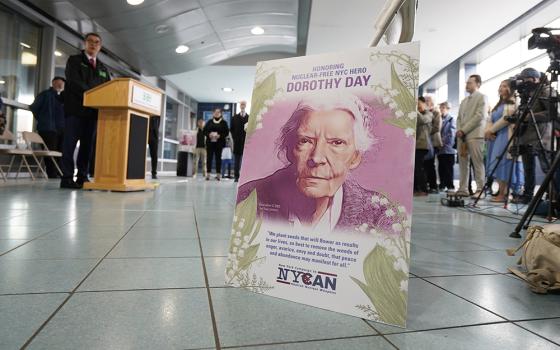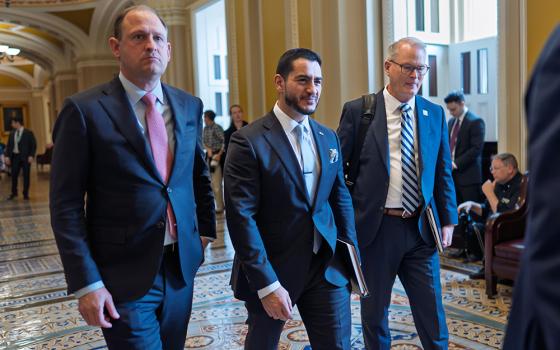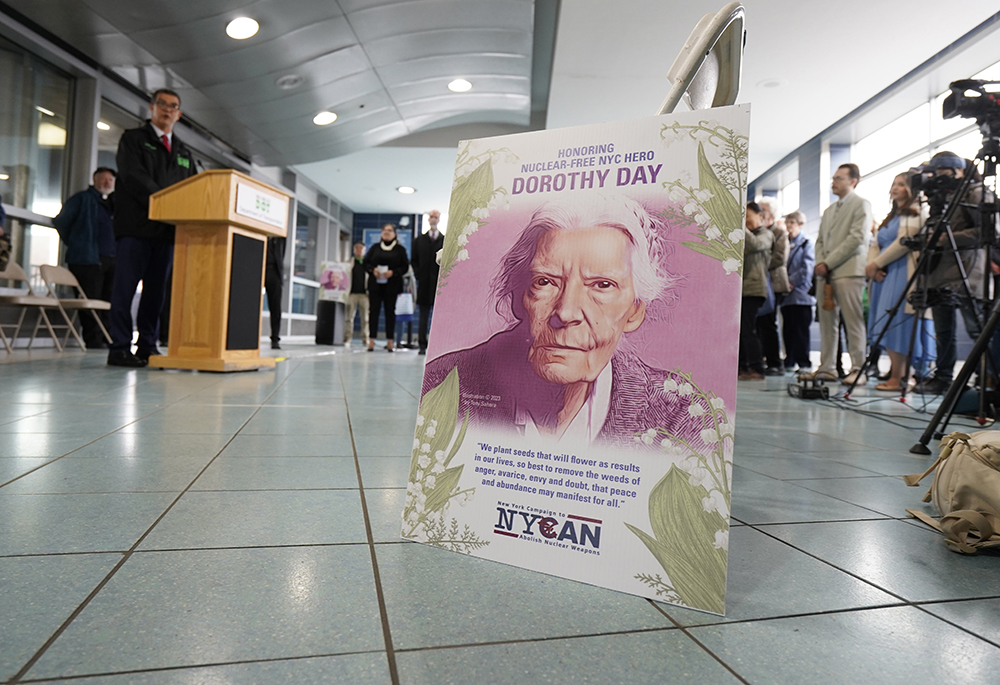
An image of Dorothy Day is seen during ceremonies marking the maiden voyage of the Dorothy Day ferry boat at the St. George Ferry Terminal in Staten Island, N.Y., April 28, 2023. The Staten Island Ferry fleet's vessel is named for Day, who was received into the Catholic Church on Staten Island. (OSV News/Gregory A. Shemitz)

by Ryan Byrnes
Join the Conversation
Send your thoughts to Letters to the Editor. Learn more
At the close of the sophomore year of Trump 2.0, I look around me and see a church that's waking up. The last two years, Catholics have said and done things they never would have imagined. They stood on snowy street corners to protect their neighbors from ICE thugs. They gathered at city halls to resist data centers. They marched under the baking sun to oppose the war in Iran. I can't help but recall the many protests of Dorothy Day, who was arrested at various points in her life for women's suffrage, opposing nuclear weapons, and farmworker protests. Many Catholics regarded her as a dangerous radical in her day, though it seems the average believer is finally starting to catch up to her.
You have likely heard the breathless declarations of the midterm results. 50% of Catholic voters supported the Democrats, which according to pollster Patrick Ruffini constituted a +16 shift toward the Democrats since 2024. Why such a big change? According to the AP Voter Poll, nearly 40% of voters said their top issue was the economy, a euphemism for tariffs, affordability and job loss. Maybe this will prove to be a short-lived revival like the Labor Party experienced with Keir Starmer, but for the moment American Catholics are losing patience with unchecked capitalism.
In the spring of 1933, as the country hit 25% unemployment in the throes of the Great Depression, a young journalist Dorothy Day walked into the bustling Union Square of Manhattan to hand out copies of her newspaper The Catholic Worker. "Capitalism is godless," she once wrote, quoting Osservatore Romano. She opted for personalism, an economy centered neither on the accumulation of money nor the dictates of the state, but rather the dignity of the human person. She and Peter Maurin called for the establishment of houses of hospitality and farming communes, where members shared everything in common and cared for each other.
This led to the creation of the Catholic Worker Movement, which today is 93 years old and includes around 180 grassroots communities around the world. If you are a Catholic who became more economically populist during Trump 2.0, then I highly recommend you Google a Catholic Worker community near you, or at least read Dorothy Day's memoir The Long Loneliness.
Two months ago, I was excited to discover that the Catholic Worker community Dorothy Day founded in Manhattan — my backyard — is alive and well. Tucked away in an old music school in the Lower East Side, 20-30 people are simultaneously helped and helpers, providing meals, beds, and showers, offering glimpses of a society where, in the words of co-founder Peter Maurin, "it is easier to be good." Since then I have had the joy of participating in this wonderful community.
The return of material concerns to U.S. Catholics shows a departure from the culture war that has defined voters and the church more broadly over the last seventy years. After World War II, American Catholics drifted away from the urban, working-class, pro-union coalition of the New Deal; buoyed by postwar prosperity, they moved to the cookie-cutter suburbs en masse and embraced plastic consumer lifestyles. Stephen Koeth recounts this history in his book Crabgrass Catholicism: How Suburbanization Transformed Faith and Politics in Postwar America.
During the Cold War, the American Church was enlisted in the fight against communism, and for decades they muted critiques of wealth distribution espoused by liberation theology. Unable to levy any sharp critiques against Wall Street or the Pentagon, the American Church naturally gravitated toward the only issue left on the table: sexual ethics. While sexual ethics is important, it is an ostensibly "safe" issue that frames morality around the individual while conveniently avoiding wider questions about power and class.
By the early 2000s, when I was just entering grade school, Gallup reported that the overall rating for organized religion plunged to its lowest levels in more than six decades. This culminated in the church's reputation hitting a low point: Not only had they failed to push back sufficiently against economic inequality and foreign wars, but their main rallying point, sexual ethics, was immediately undermined in the sexual abuse crisis.
Advertisement
However, things are changing gradually. Moves by Popes Francis and Leo have indicated that Catholic social teaching is increasingly placing primacy on material concerns. As Pope Leo famously said, "The unity or division of the church should not revolve around sexual matters." Pope Leo has repeatedly focused on the pressing matters of the war in Ukraine, the genocide in Gaza, the treatment of immigrants, and the hoarding of wealth, and this reflects the views of an increasing number of American Catholics.
While traditional forms of Catholic charity emphasize the corporal works of mercy — feed the hungry, visit the imprisoned, visit the sick, bury the dead, and so forth — many American Catholics have historically been hesitant to address the systemic causes that necessitate this mercy in the first place. At worst, the corporal works of mercy can be corrupted into a well-meaning but ultimately superficial display, painting a pretty picture of mercy while allowing the problem to persist. Call it token mercy.
The recent midterms showed that for American Catholics, it's no longer enough to feed the hungry. We want to know why the prices of groceries are skyrocketing in the first place. It's no longer enough to visit the imprisoned. We want to know why the United States has a for-profit prison industry that locks away nearly 2 million people — the most of any country on Earth. It's no longer enough to visit the sick. We want to know why diabetics are rationing their insulin, or why insurance companies are denying chemotherapy to cancer patients. And finally, it's not enough to bury the dead. We want to know why so many people are dying in foreign wars and name the ones responsible.
This brings us back to Dorothy Day and the Catholic Worker Movement, who have shown that to truly live the Gospel of Jesus we must be willing to get radical, something the American Church has shied away from. Just like in Dororthy Day's time, many American Catholics are once again returning to an economic-populist mood, and the Catholic Worker Movement is here for it.