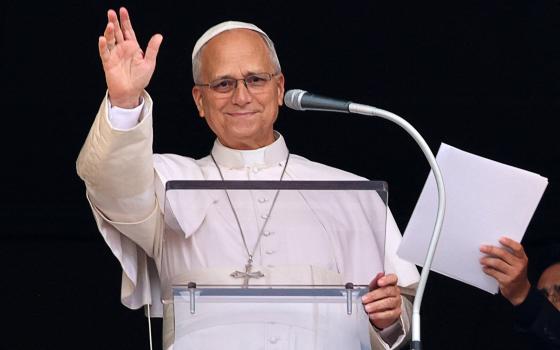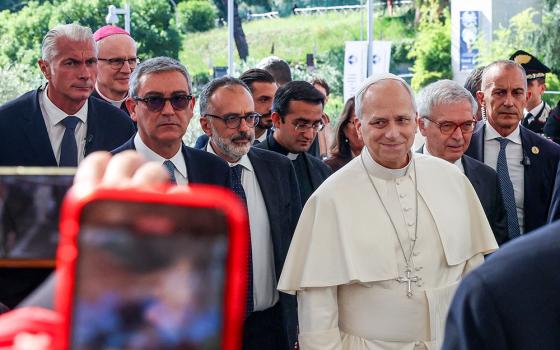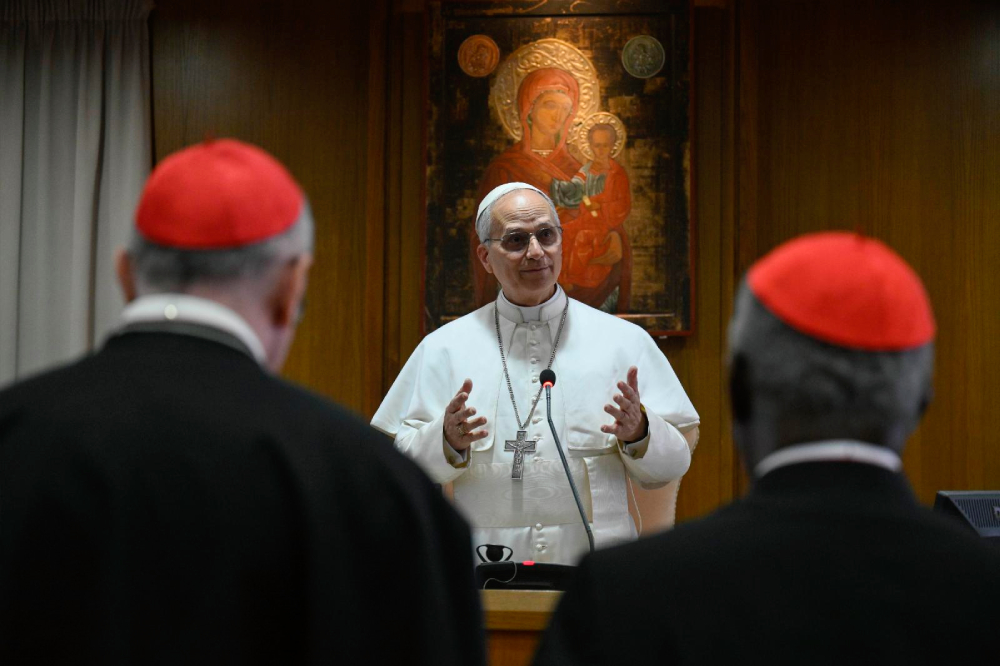
Pope Leo XIV speaks with the College of Cardinals in the New Synod Hall at the Vatican May 10, 2025, during his first formal address to the college since his election. (CNS/Vatican Media)
by Rafael Luciani
Join the Conversation
Send your thoughts to Letters to the Editor. Learn more
Pope Francis devoted his 12-year pontificate to recovering synodality as a constitutive dimension of the church, rooted in the church's long historical tradition and matured by the reception of the Second Vatican Council's ecclesiology of the people of God. Pope Leo XIV appears to be increasingly focused on translating that vision into permanent forms of governance, participation and shared discernment through collegial decision-making bodies, particularly through organisms of participation such as pastoral councils.
This approach is significant since the fundamental question the Catholic Church faces today is no longer whether synodality matters, but how it is received and implemented as a constitutive mark of the whole church's life. Synodality is not an option anymore. It is essential and the church's way of proceeding in our day.
Thanks to various theological developments in recent decades, the Synod on Synodality and the Francis pontificate, synodality moved to the center of contemporary ecclesiology and pastoral theology. For example, the project "Together" that I presented to Leo in August 2025 is the first project aiming to build a "global network of networks" promoting research, formation and international conferences on synodality. The initiative is being developed by the Jesuit School of Theology of Santa Clara University in collaboration with the Latin American Episcopal Council (CELAM) and the Latin American Confederation of Religious (CLAR).
Leo is revealing what may be the defining ecclesiological direction of his papacy. As a Pan-American pope whose ecclesial and pastoral identity is deeply rooted and defined by the Latin American church, he is signaling the emergence of a fifth phase in the reception of the Second Vatican Council. Francis inaugurated the fourth, after Paul VI launched the first, and John Paul II and Benedict XVI presided over the second and third. He appears to stand at the intersection of two unfinished, yet ongoing processes: the reception of the Second Vatican Council and the implementation of synodality as articulated during Francis' pontificate. His challenge is to bring together the memory of the Council and the future of synodality. This is the context in which Leo's pontificate unfolds.
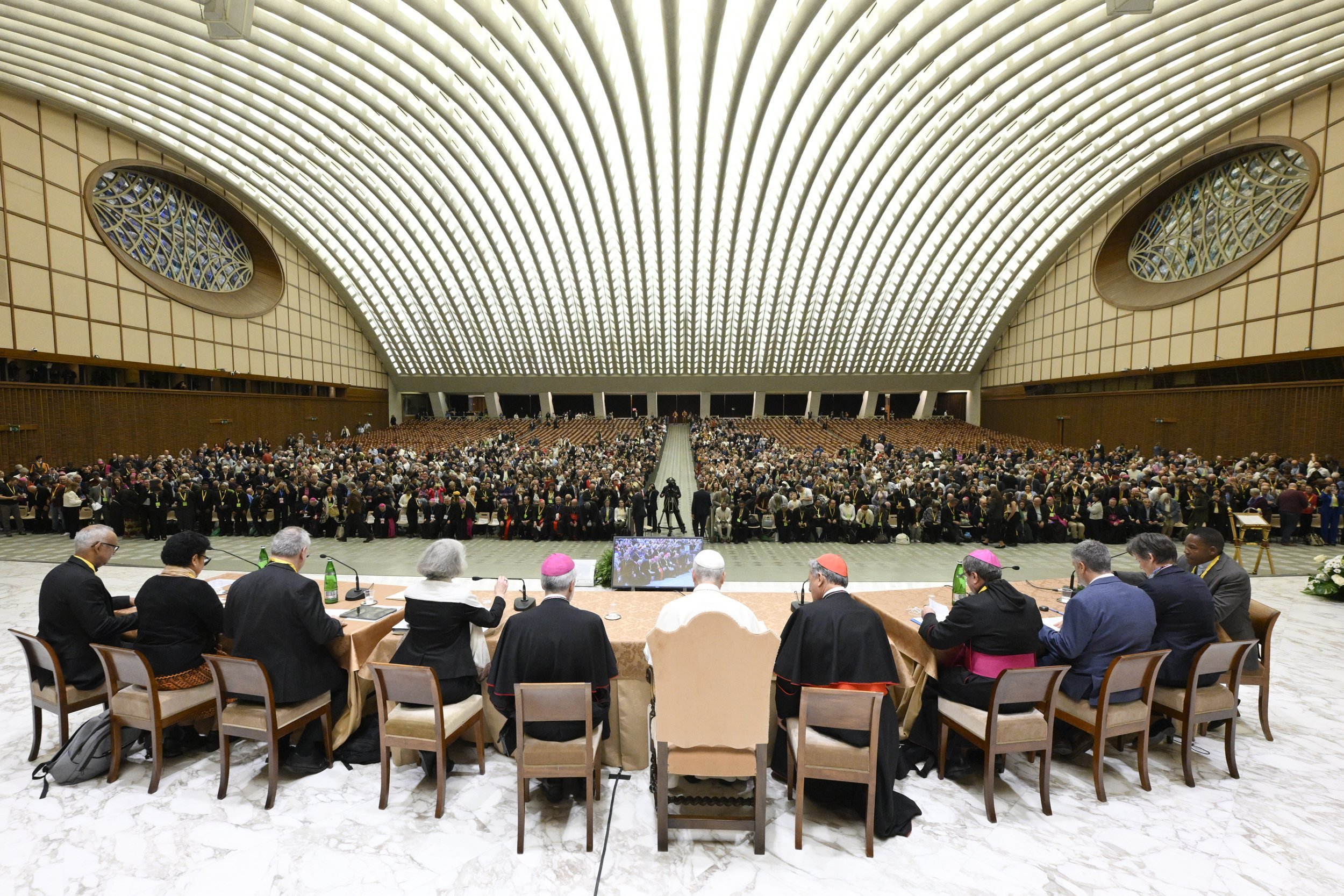
Pope Leo XIV, with regional representatives of synod teams, listens to and answers questions from participants in the Jubilee of Synodal Teams and Participatory Bodies in the Vatican audience hall Oct. 24, 2025. (CNS/Vatican Media)
The pope himself seems acutely aware of this ecclesial responsibility. Speaking to the College of Cardinals in January 2026, he insisted that mission and synodality are "deeply rooted in the Second Vatican Council and in the entire journey that has sprung from the Council," adding that "we can never emphasize enough the importance of continuing the journey that began with the Council." It is no coincidence that he chose to begin his weekly catechesis commenting on Vatican II, calling it the "guiding star" of the church, and explaining that "the term ekklesia is an assembly of people who recognize that they have been summoned together". Therefore, for Leo, synodality is not a new ecclesial project separate from Vatican II, but a further stage in its reception.
On the evening of his election, he clearly spoke of the desire for "a synodal church, a church that walks." That phrase situated his pontificate within Francis' ecclesiological vision. Leo's subsequent interventions during his first year suggest that he wants synodality to reshape ecclesial governance in a sustainable way, balancing unity in diversity and diversity in unity, in a church of churches.
Such language is not accidental. Since the conclusion of Vatican II in 1965, the church has been engaged in understanding itself more deeply as a communion of faithful, of bishops and of churches: all the baptized, the people of God, walking together and participating in the life and mission of the church. Synodality further asks how participation of all, communal discernment, shared decision-making processes, and accountability should shape the everyday life of the Church. Leo has inherited the task of giving this vision clear institutional consistency. As he said to the participants of a conference in Camaldoli, Italy, in 2025, on the theme, "What kind of bishop in a synodal Church?": "walking together as authentic synodality, by its very nature, requires listening and the participation of all the baptized".
Francis had emphasized the participation of the entire people of God and repeatedly described synodality as "the path that God expects of the Church of the third millennium." A first step taken by Leo to implement this vision is his emphasis on what we can call episcopal collegial synodality rather than on ecclesial synodality, a concept that was particularly embraced and developed within the Latin American Church by the Latin American Episcopal Council. This was done more explicitly at the opening of the extraordinary consistory in January 2026.
To frame this discussion, it is important to recognize that Leo's pontificate is situated within the third phase of the Synod on Synodality (2025-2028), a period marked by the emergence of new ecclesiological and pastoral questions. As this phase develops, we will learn more about Leo's understanding of the relationship between the all, the some and the one — the entire people of God, the bishops and the ministry of the pope. Francis articulated these three subjects through a deliberative dynamic, practicing the exercise of the primacy (the one), alongside with the bishops (the some), but as part of the whole of the people of God (the all). This was achieved completely by Francis, when led the discerning, drafting and voting of the synod's final document with the whole synodal assembly and declaring it magisterium of the successor of Peter, fully implementing Episcopalis communio.
Leo's early pronouncements suggest that he sees this balance as the central challenge of the next phase of synodal reception. This is why so many of his speeches regularly return to themes such as consultation, reciprocal listening, communal discernment and shared decision making-taking processes as a style that should be assumed at all levels and by all people in the church. These are not merely spiritual nor methodological attitudes. They are part of a constitutive synodal church through which participation of all and authority of some can be integrated without diminishing either.
Advertisement
To achieve this, a concept emerging from Leo's addresses is what we called in the synod's final document relational conversion. Speaking at St. John Lateran, he described listening as a capacity that allows the church not only to respond to the faithful, but also to anticipate their needs and expectations. Such language points toward a model of authority that is exercised as a service to all through reciprocal listening rather than unilateral action. This is something we can see in his own personal style, since he was bishop in Peru. In fact, during the Jubilee of Synodal Teams and Participatory Bodies, Leo stated that "being a synodal church means recognizing that truth is not possessed but sought together." Such a brief affirmation captures the theological foundation of his vision.
This perspective mirrors one of Francis' most consequential ecclesiological insights. In his 2021 address launching the synodal process in the Diocese of Rome, Francis insisted that synodality is neither a slogan nor a temporary initiative but rather expresses "the nature of the church, her form, her style, her mission."
What appears in Leo's early pontificate is an effort to operationalize that vision. Leo began his pontificate in the midst of the third phase of the synod, dedicated to implementation and reception. As a result, his focus is not necessarily the what of synodality but how it can be concretely embodied in the Church's structures. Consequently, Leo's regular emphasis on pastoral councils, diocesan consultative bodies, and synodal teams should be understood in that context. He has consistently argued that these structures cannot become merely bureaucratic mechanisms. They must be real spaces of listening, discernment, and shared decision making and taking processes.
For Leo the task is not simply to preserve Francis' legacy but to determine whether the ecclesiological vision of Vatican II matured throughout the process of the Synod on Synodality can become the ordinary way of proceeding and being church. Leo's challenge will be to demonstrate that a synodal church can also be a governable church, and strengthening collegial synodality will be a major step forward in that regard. All of this is moving toward new ways of understanding and embodying ecclesial synodality, whose contours will likely become clearer in the ecclesial assembly of October 2028 in Rome.
The implications of synodality for institutional life are still being defined, and many questions concerning authority, participation, and decision-making remain unresolved. The historical significance of Leo's pontificate may ultimately lie in his ability to hold together realities that are often presented as antagonistic, such tradition and reform, or primacy, collegiality, and participation of all.
The starting question for Pope Leo XIV is not whether the Church should become synodal. That was already answered by the XVI General Ordinary Assembly of the Synod of Bishops. The church is constitutively synodal by nature. His is a pontificate tasked with bridging the memory of Vatican II and the implementation of the church's synodal identity into the future. Whether he and the rest of the people of God succeed achieving this goal or not will shape Catholic life for decades to come.