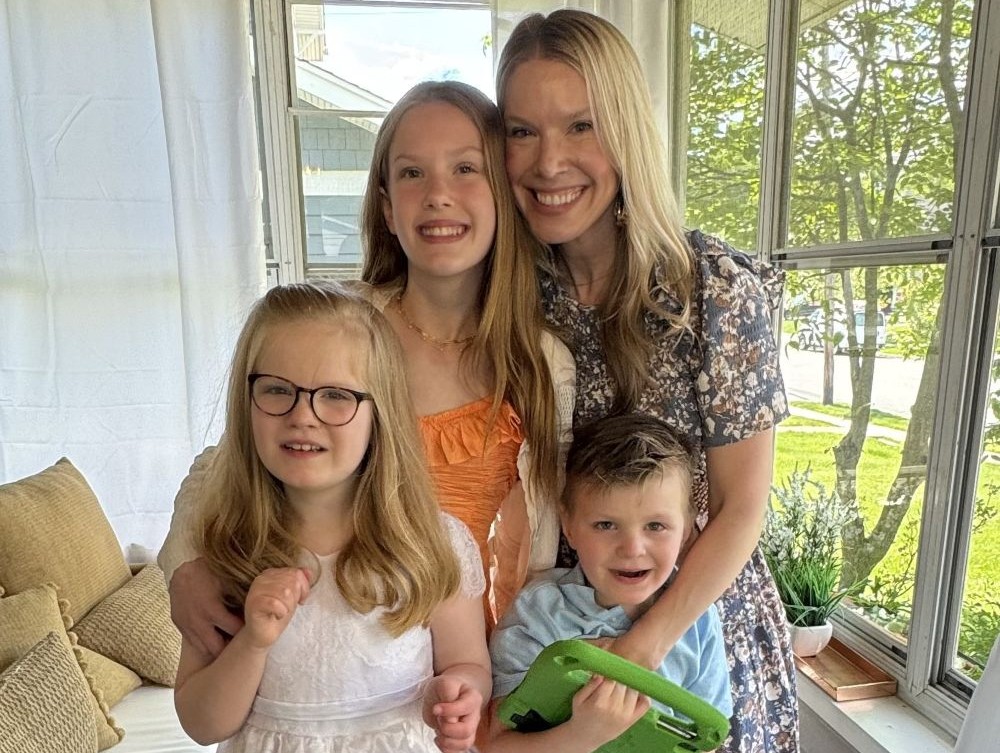
The author poses with her three children. (Courtesy of Sarah Kernion)

by Sarah Kernion
Join the Conversation
Send your thoughts to Letters to the Editor. Learn more
Two of my children, Milly (11) and Mack (8), have profound, nonspeaking autism. They require 24-hour care. Not in the general way all children need care, but in the intimate, physical, ongoing way that reaches into nearly every part of daily life: bathing, toileting, changing, brushing teeth, washing hands, keeping them safe.
Over the past decade, I've learned that profound autism rearranges far more than a family's calendar. It changes your relationship to time itself. There is no rushing through a bath, hurrying an eye exam, multitasking during a dental visit or mentally checking out while your child is near water. Milly and Mack have quietly retrained my attention until presence stopped being something I aspired to and became the way love asks me to live. And one of the places I feel this most completely is the bathtub.
When Milly is in the water, I cannot let my attention drift. I am watching her hands, her face, the movement of her body, the depth of the water, the slippery edge of the tub. My awareness becomes immediate and whole. There is no multitasking. No glancing away. No stepping out of the moment.
But the bathtub is not only a place of vigilance. Sometimes the Beatles' "Blackbird" begins to play, and at the first few notes a look comes across Milly's face — joy mixed with sweet anticipation. It is so quick and so full that I have learned to wait for it. I sing along. I change my voice. I become silly. I meet her eyes and try to catch the exact moment when her smile is ready to arrive.
There are no words between us, but there is so much being said.
I used to think of presence as something I chose. A practice. A way of slowing myself down enough to notice the life in front of me. I would linger longer with my oldest child. Put my phone down. Try to feel grateful for an ordinary moment before it passes.
That kind of presence was real, but this life has taught me another kind.
There is a presence that is not chosen so much as required. It does not begin in quiet or leisure. It begins because someone you love needs you completely. It begins because their safety, comfort and joy depend on your attention.
This kind of presence is not always peaceful. Sometimes it arrives in laughter. Mack gets off the bus and heads for the street, and I redirect him toward the fenced backyard. Then he realizes I am chasing him, and suddenly he is laughing — full, bright, irresistible giggles that fill the yard. I am tired, but I run. His delight pulls me into the moment before I have time to decide whether I have the energy for it.
Sometimes presence arrives in the cold. We live in the Northeast, and there are winter days when Milly steps outside and the wind hits her face with such force that her whole expression changes. She is offended by it, personally wronged by the weather. I find myself laughing and saying, "Oh man, I feel ya, Mills. This is frigid." For a second, we are simply two people meeting the same cold air.
And sometimes presence arrives in ways I do not want.
It is holding Mack through a dental cleaning because his fear is bigger than his ability to understand what is happening. It is sitting with Milly on my lap, holding her head still so a special-needs optometrist can look into her eyes. It is feeling my own body become the place where care, resistance, fear and necessity all meet.
These moments are not pretty. They do not feel like the kind of sacredness we usually know how to name. Yet they, too, ask for all of me.
For Milly each morning, I stopped giving directions and started singing them. "This is the way we brush our hair, brush our hair, brush our hair … " I sing as I gently work through the tangles after a night's sleep where her wild mop needs to be tamed. The melody softens the moment for all of us. It slows my own breathing. It steadies my pace. It reminds me that my children often experience the world through rhythm before language.
Advertisement
The Catholic tradition has long spoken about the holiness of the present moment. We encounter Christ not only in extraordinary acts of faith, but in ordinary acts of love repeated with fidelity. We find him in washing feet, feeding the hungry, tending to the sick and remaining with those who depend on us. I understood those truths intellectually for years. Motherhood taught me what they felt like.
Still, I did not expect motherhood to teach me theology this way.
I did not expect the present moment to be revealed through bathwater and eye exams, through winter wind and backyard chases, through the daily work of keeping two profoundly disabled children clean, safe, comforted and known.
I did not expect gratitude to change shape.
For much of my life, I thought of gratitude as a feeling I could summon or a reflection I could make. I thought it meant pausing long enough to recognize the goodness in front of me. But caregiving has made gratitude less like a thought and more like an offering.
There are many moments when I do not feel grateful. I feel tired. Overstimulated. Worried. Physically spent. But I am still there. I am still washing hair, singing songs, meeting eyes, chasing giggles, holding steady when care becomes hard.
And sometimes, only afterward, I realize gratitude was present anyway — not as a mood, but as a form of attention.
So many spiritual traditions speak of the power of now. The wisdom is everywhere: Be present, receive the moment, notice what is before you. I believe that wisdom is true. But I also know that for some people, presence is not a practice we seek out after life becomes manageable. Sometimes it is the shape life takes before we are ready.
My children have placed me inside the present moment more completely than any book, retreat or prayer practice ever has. Not because they are lessons, but because they are people. Because they need me. Because they delight me. Because they stretch me beyond myself.
There is a hidden gift in that, though I would never want to make it sound easy. The gift is not that caregiving is peaceful. It often is not. The gift is that love keeps bringing me back to what is real.
A song begins. Milly looks up.
The wind blows. She scowls.
Mack laughs and runs.
The bathwater gathers light.
And I am here. Not perfectly. Not always willingly. But fully enough to receive the moment before it passes.
Perhaps that is where God has been meeting me all along. Not outside this life, once it becomes quieter. But here, in the demanding holiness of the present moment.