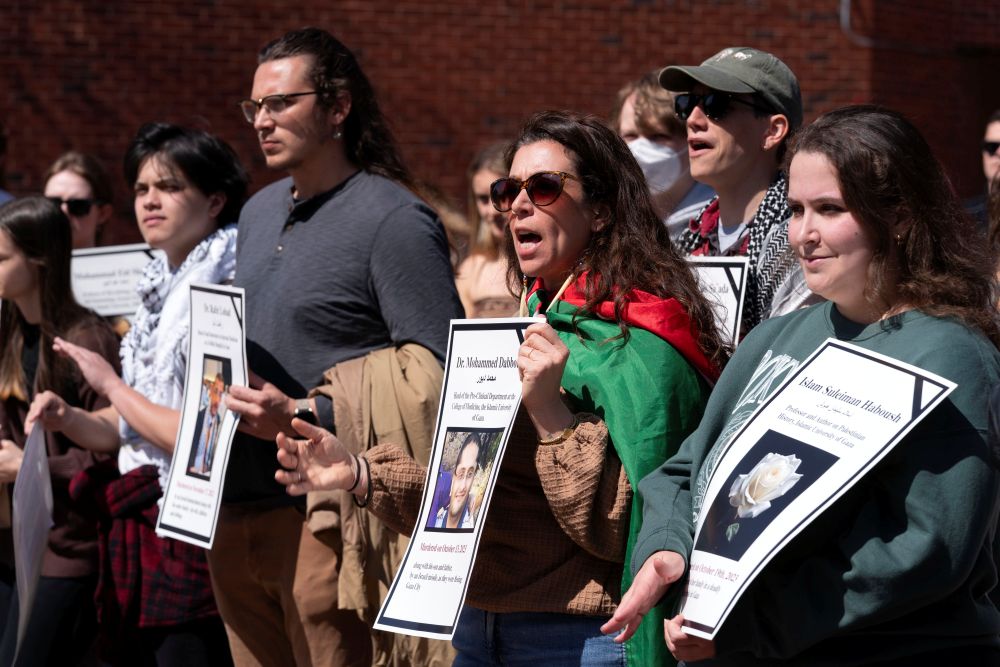
Georgetown University students hold pictures of people killed in Gaza as they rally in support of Badar Khan Suri, a Georgetown University professor, demanding his release from a deportation process over his views on Palestinian and the war in Gaza, at Georgetown University in Washington, March 25, 2025. (AP/Jose Luis Magana)

by Erin Cline
Join the Conversation
Send your thoughts to Letters to the Editor. Learn more
When I joined the Theology and Religious Studies Department at Georgetown University in 2009, I never imagined how much the religious backgrounds of our students — even those choosing to major in theology and religious studies — would change in less than two decades. The publication of my most recent book, The Problem of God: The Challenges of Faith, Religion, and Spirituality Today, gave me an opportunity to reflect on the evolving religious outlooks of our students.
The title of the book is taken directly from the required introductory theology course for most of our undergraduates at Georgetown. "The Problem of God" course seeks to foster an understanding of religious beliefs and their role in human history, offer students the opportunity to explore the possibility that God/the divine/the infinite exists, and to wrestle with the difficult questions that come with faith.
The course is one of the ways in which our Jesuit, Catholic and Christian identity as a university is palpable, for it is rooted in St. Ignatius of Loyola's conviction that there is a distinctively spiritual dimension of the human person that needs exercise, just like the body needs exercise. My aim as the professor is to get students to seriously consider whether Ignatius might have been right and to explore how the spiritual dimension of the human person is understood, not just in Ignatius' home tradition of Christianity but in different religious and spiritual traditions around the globe.
I do teach more students from different religions (such as Judaism and Hinduism) than when I first arrived at Georgetown 20 years ago, but the biggest religious change in our students has been the increasing number who are religiously unaffiliated. This mirrors the changes that have taken place in American religiosity.
As author Ryan Burge demonstrates in The Vanishing Church, the strongest predictor of a person's current religion is the religion in which they were raised. Consider, then, that the data shows a decisive shift in the 1990s: Unprecedented numbers of young Americans began to identify as having no religious affiliation. They are now the age of the majority of my students' parents.
As students encounter religious traditions from all over the globe that describe religious experiences and ways the spirit can be exercised, most are intrigued. This is as true for "nones" as it is for Catholics, Buddhists and Muslims. My approach to teaching is deeply Ignatian: It is rooted heavily in experience, not doctrine. But students learn that religious experiences frequently occur within the context of religious communities, which give us language and concepts to describe and understand such experiences.
I have adapted my course over time to address the changes in the religious backgrounds and religious literacy of my students. But the students who did not grow up attending religious services of any kind are no less curious. Rather, instead of coming into the classroom hoping to learn about how their religion compares with others, or about the differences between Catholics and other Christians, many more students enter my class today wondering what religion really is, what we mean by the word spirituality, and what people actually do in religious communities.
Advertisement
I'll never forget the first time we were discussing Augustine's Confessions and a student asked, "What do you mean by a 'religious experience'?" After that I began to include an introduction to the concept of religious experience in my classes, offering examples and distinguishing them from other experiences.
I also remember the first time a student asked me what translation of the Bible she should buy, because she had never read any of it before. She added that she especially wanted to learn who Jesus was and what he taught. While my students read several Christian sources in my class, I realized that an increasing number of them lacked an understanding of the person at the center of the tradition responsible for our university's founding (by the Society of Jesus). I began assigning selections from the Gospels and added an introductory lecture on Jesus.
Initially I worried these adjustments might detract from the course for students who were coming from religious backgrounds. But an interesting thing happened instead: The Christian students were just as interested in my lecture about Jesus as the students who had never read the Bible.
Even though more Georgetown students still list "Catholic" as their religious affiliation than anything else, many did not grow up regularly attending Mass. Those who are regular church-attenders tell me it is enriching for them to hear questions from students with different religious backgrounds. They find themselves reflecting more deeply on their faith, and the importance of understanding the religious perspectives of others, as a result.
College students across the U.S. were clashing with police and university officials over Gaza protests when I began writing my book in the spring of 2024. One day during that time, I was talking with a friend who teaches at an Ivy League university about our shared desire to help students think carefully about their beliefs and those of others, including beliefs concerning God's plans for particular groups of people, the idea of a Promised Land, the horrors of the Holocaust and its aftermath, and historical oppression and violence — including both Islamophobia and antisemitism. My friend remarked, "You're so fortunate at Georgetown, because as a Jesuit school, you have a built-in curricular opportunity to engage all of your students on these subjects." He was right.
While some may question whether theology courses are an outdated requirement at Catholic universities, there is good reason to believe they have never been more timely than they are today.