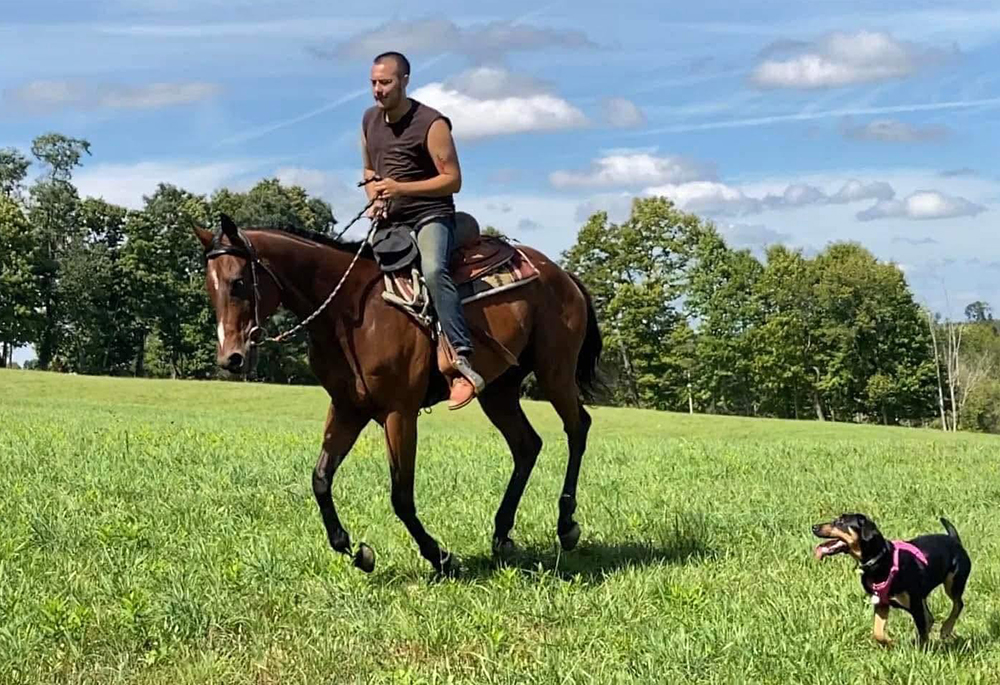
Maxwell Kuzma rides a horse on the Ohio farm where he makes his home. As this year's Season of Creation nears an end, Kuzma reflects on the invitation to pay attention to our interconnection with the natural world. (Courtesy of Maxwell Kuzma)

by Maxwell Kuzma
Join the Conversation
Send your thoughts to Letters to the Editor. Learn more
Moving to a farm as an adult has a funny way of challenging your assumptions about the natural world. The first time our thoroughbred started pawing at and rolling around on the ground, I had no idea whether he was having a grand old time or whether something was seriously wrong. I was completely green, having been dropped rather suddenly into a world of responsibilities I had never encountered before.
I would come to discover that ducks are intelligent enough to learn verbal commands, such as "go to bed" when it's time to tuck into their coop at night. I learned to watch for single digit temperatures because the horses would have to be bundled in their blankets and their heated water tank monitored for freezing. There was much to learn about miniature donkeys, chickens, horses, ducks and rabbits.
Beyond the animals, there was much to learn about myself. When my partner and I moved to rural Ohio, it was at an important time in my life: I had just gone through gender transition. Moving to the farm was the start of a new chapter, one in which I could fully be myself from the beginning. I embraced the chance wholeheartedly, finding within the rhythms of farm life a corresponding spiritual rhythm that led me to experience embodiment in a new and powerful way.
Those early embodiment discoveries often ran parallel with the animals: learning to ride a horse, training dogs, or riding my bike past the livestock pastures nearby. As a kid, I'd loved being outside; but puberty brought severe, unrelenting dysphoria, and over time I withdrew from doing anything active, much less outdoors. Once I transitioned, this changed. I was able to dive into farm life as my true self.
On the farm, all of the creation around me insists that I am part of it. The work of caring for animals reminds me that I am not standing outside creation as an observer but living within it, dependent upon the same rhythms of light and dark, hot and cold, harvests and barrenness. The farm doesn't allow me to pretend that the natural world is mere scenery surrounding my life; it demands that I participate in its care and recognize my own dependence upon it. Simple daily tasks like carrying hay, filling water troughs or gathering eggs remind me that my life is entangled with the lives of other creatures.
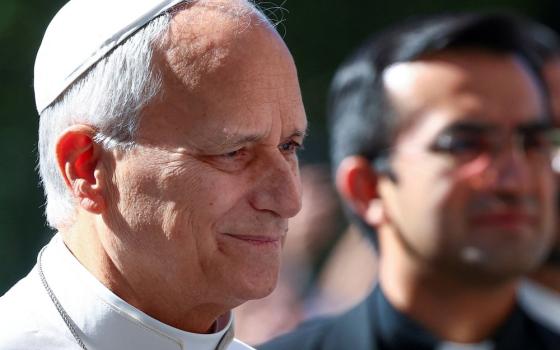
The Season of Creation, which the Catholic Church joins other denominations and faiths in celebrating from Sept. 1 through Oct. 4, invites us into precisely this kind of attention. We get to see ourselves as interwoven with the world around us. Pope Leo XIV's message for this year's World Day of Prayer for the Care of Creation calls us to an "authentic ecological conversion," in which our encounter with Christ changes our relationship with the world around us. In the pope's homily to open this year's Season of Creation, he encouraged us to put the noise of human activity into "silent mode" so we might hear the voice of creation.
Advertisement
For me, listening to that voice has also meant listening to my own embodiment, deepening my experience of grace and discernment. My body is the place where I have found peace. Our bodies can reveal mysteries about both ourselves and God that cannot be captured by rote theology.
If you spend enough time paying attention to the natural world, it becomes difficult to ignore how much variation exists. Life-forms — including, but not limited to, humans — have a spectrum of chromosomes, hormones, reproductive anatomy and secondary sex characteristics that do not fit neatly into the binary categories we as a society have constructed. This complexity needn't feel like a threat to our belief in a Creator; rather, we can experience it as an invitation to wonder.
Catholic theology has long recognized that God exceeds the categories we use to describe God, even as those categories remain meaningful and necessary. We speak of God through finite human language, but our words can point toward divine mystery without ever exhausting it. Likewise, the categories through which we understand human beings may be useful without being exhaustive. The world God made is not required to conform to the categories we use to organize it. If anything, creation continually reminds us that our descriptions are smaller than the reality they seek to name.
To echo Leo's message for the Season of Creation this year: it is our encounter with Christ that opens us to everything creation has to offer.
In our busy, chaotic, challenging world, we are being asked to pay attention; to encounter what God has actually made, rather than only what we expect to find.
The more closely I pay attention to the life-forms around me on the farm, the less I can conceive of creation as something simple, static or rigidly binary. Life is stranger, more varied, and more mysterious than that. Encountering creation means to not simply admire what God has made, but to recognize ourselves within it. We humans are not exceptions to creation, standing outside of its complexity and mystery; we are part of it.