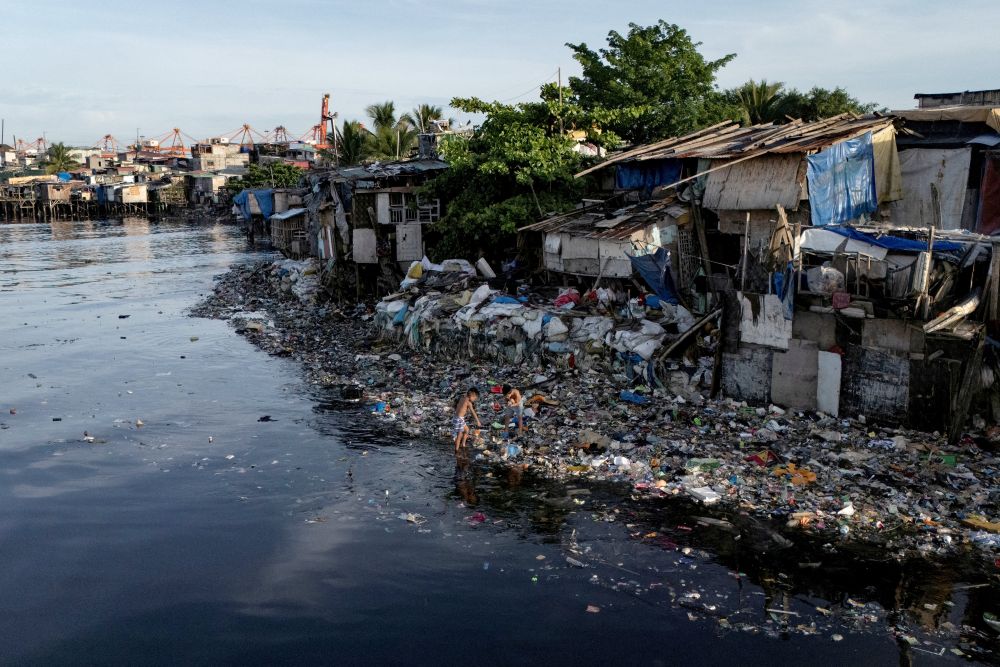
A drone view shows children picking through washed-up garbage along the polluted Pasig River in Manila, Philippines on June 5, 2025. (OSV News/Reuters/Eloisa Lopez)

by Daniel P. Horan
Join the Conversation
Send your thoughts to Letters to the Editor. Learn more
The recent publication of the document "Caring for our Common Home: A Responsible and Fraternal Response to the Triune God" by the International Theological Commission is a welcome contribution to ongoing discussions about theologies of creation and ecospirituality. Its release on Sept. 2 during this year's Season of Creation is providential, and the content of its theological reflection, rightly challenges anthropocentric or "human-centered" thinking.
Among the most significant themes engaged in this text, which is at present only available in Italian, is the concept of "ecological sin," which has been a topic of interest since at least Pope Francis' 2015 encyclical Laudato Si', On Care for our Common Home. Although Laudato Si' does not directly use the language of ecological sin, much of the encyclical focuses on right relationship between the human and nonhuman communities and a call to ongoing conversion striving toward integral ecology.
And while he didn't use the language of sin explicitly, Francis did cite Ecumenical Patriarch Bartholomew's 1997 statement that "to commit a crime against the natural world is a sin against ourselves and a sin against God."
Subsequently, in 2020, the final document of the Synod of Bishops on the Pan-Amazon Region offered a preliminary definition of ecological sin:
We propose to define ecological sin as an action or omission against God, against one's neighbour, the community and the environment. It is sin against future generations, and it is committed in acts and habits of pollution and destruction of the harmony of the environment. These are transgressions against the principles of interdependence, and they destroy networks of solidarity among creatures (cf. Catechism of the Catholic Church, 340-344) and violate the virtue of justice.
This definition builds on passing references in regional episcopal documents from around the world and set the stage for the International Theological Commission's work.
The ITC framed its definition of ecological sin within a distinctively theological context, noting that the language of sin has a particular force and meaning within the Christian tradition as opposed to some other term or phrase that might arise from the natural or social sciences (such as "ecocide"). Additionally, the ITC explained that the category of ecological sin is best likened to the "notions of social sin and structures of sin," which can be traced back to important documents issued by Pope John Paul II.
In defining this concept, the ITC explains:
We propose to understand this sin against our common home as a sin against creation and against the Creator in that it violates the meaning of creation intended by God the Creator. The expression "creation" itself has a profoundly theological meaning: it directs us to think not so much of the mere sum of all created beings, but of each and every one of them as related to an origin in God who constantly sustains and contains them. Moreover, every sin is part of our relationship with God. The Creator has given us the mandate and the task of caring for, and even perfecting, our common home. Failure to do so, by action or omission, is disobedience to God. By failing to care for our common home with sufficient wisdom, diligence, and short-, medium-, and long-term vision, we not only fail to respect God's plan and mistreat creation, but we also harm our [human] neighbors, especially the poorest and future generations. Sin against creation, therefore, affects our relationship with God the Creator, with our [human] neighbors, and with creation, distorting the three relationships that constitute us.
This is a very helpful definition and one that will continue to invite further reflection, elaboration and revision as the church takes the reality of ecological sin more seriously. And I can see several implications that arise immediately from the ITC's work in this area, which affirms the magisterial teaching of both Francis and Pope Leo XIV.
Advertisement
First, when it comes to catechetical ministry, religious education and the ongoing faith formation of all the baptized, the church and its ministers must include discussions about ecological sin so as to assist in forming the consciences of the faithful (Gaudium et Spes, 16). Just as we regularly discuss other forms of sinful transgression against God and our human neighbors, we ought to discuss ecological sin from an early age and draw from Scripture and tradition — including Laudato Si', Laudate Deum and Magnifica Humanitas — to help shape the moral imagination and promote ecological conversion.
Relatedly, this category of ecological sin should be added to the Catechism of the Catholic Church, which is primarily a teaching resource for catechumens and candidates and often serves as a reference point for those already in communion with the church. Francis proposed this as a possibility in November 2019 when he spoke to participants at a conference on criminal law gathered in Rome.
Second, having this definition more formally articulated gives all the faithful a means to hold one another and us to account. The language of ecological sin is appropriately serious and not something easily dismissed as "optional" or "for environmentalists" alone. We can now name what is happening on an individual, communal and global level in a way that we couldn't before in our ecclesiastical discourse.
Third, presiders at the sacrament of Penance and penitents alike will need to rethink and renew their approach to confession and the penances assigned. It is worth noting that the prayer of absolution opens with a proclamation about salvation that is not anthropocentric but includes the whole of creation. The priest prays over the penitent: "God, the Father of mercies, through the death and resurrection of his Son, has reconciled the world to Himself, and poured out the Holy Spirit for forgiveness of sins … " Echoing the famous passage in Romans 8:19-21 in which we hear about how all of creation is longing for the day of salvation, the prayer of absolution situates God's forgiveness of our sins within the cosmic vision of salvation and not a myopic focus on our human context alone.
This leads me to what I think is the most important implication that this definition of ecological sin presents to us today: namely, that we need an ecological examination of conscience.
Fortunately, there are already some great resources available to help get us started. For example, the Society of Jesus and the Ignatian Solidarity Network has a helpful website titled "Reconciling God, Creation, and Humanity: An Ignatian Examen," which invites individual Christians and communities alike to reflect on what we have done and what we have failed to do concerning ecological sin.
The University of San Diego has posted a reflection by ethicist Meghan Clark, which likewise challenges readers to prayerfully reflect on the wisdom of Francis' Laudato Si' as a way of examining one's thoughts, actions and failures to act. And there are other resources hosted by parishes and dioceses around the world worth exploring.
But we need more educational and spiritual resources to help inform the minds, shape the hearts and form the consciences of the faithful. It's never too late to begin integrating how we are living out our relationship to the more-than-human world as we periodically examine our consciences. This is a great practice to begin as the end of this year's Season of Creation quickly approaches.