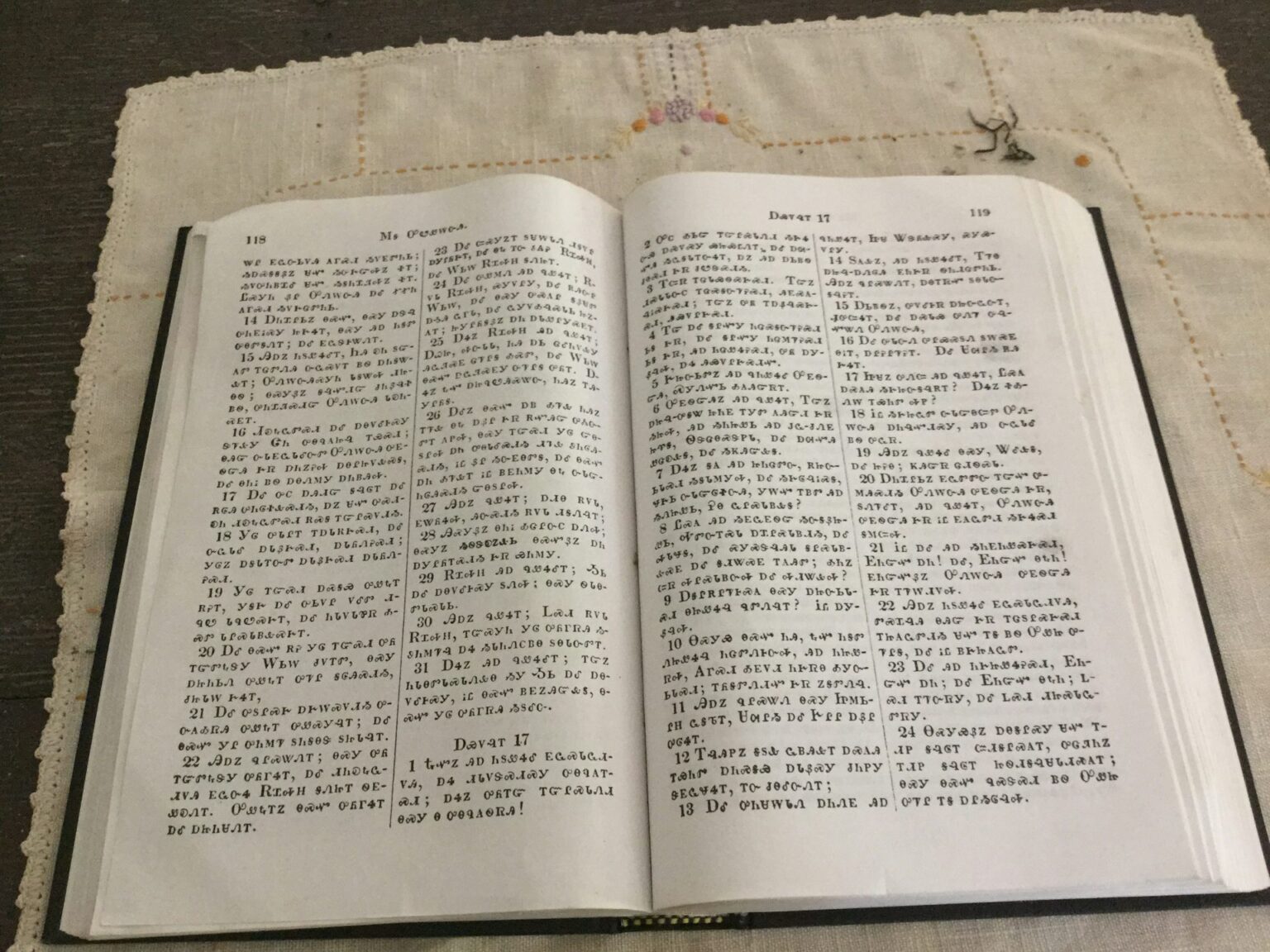
Sequoyah's invention of a Cherokee syllabary helped translate the Bible soon after missionaries' arrival. (The Conversation/Wikiemedia Commons/Wesley Fryer/Cherokee Heritage Center)

The Conversation
Join the Conversation
Send your thoughts to Letters to the Editor. Learn more
If you wanted to learn the Cherokee language in the 1990s, there weren’t many written resources. Even on most Cherokee land, it was unusual to see street or building signs in this endangered Indigenous language. While there are nearly 500,000 enrolled members in the three federally recognized Cherokee Tribes, only about 2,000 of those speak Cherokee as a first language.
But over the past few decades, opportunities for learners have exploded. Cherokees of all ages across the U.S. are working to revitalize the language in new ways, from apps, games and videos to social media, music and immersion schools.
Amid all this innovation, there is also a 200-year-old resource that language learners turn to: the Cherokee translation of the Christian Bible.
Translating the Bible into Cherokee began early in the 19th century. Cherokee Sequoyah invented an easy-to-learn writing system for the Cherokee language in 1821, resulting in high literacy rates. Teams of Euro-American missionaries and Cherokee converts produced a Cherokee version of the Book of John in 1824. A complete Cherokee New Testament and most of the Old Testament emerged in the following decades.
For language learners today, the Cherokee Bible does more than show how the Cherokee interpreted Christian theology; it is a window into the Cherokee worldview.
Some challenges existed. At the time of translation, the Cherokee did not have words for many of the concepts found in the Bible – hypocrisy, poverty, power and king, to name just a few. Additionally, Christian missionaries drew a clear distinction between the sacred and the secular; but in Cherokee culture, science, ritual and belief are tightly intertwined. Specialized Christian terms such as resurrection, repentance, sin, purity, baptism, salvation and blessing didn’t translate well into that worldview. The expression of those concepts in Cherokee thus reads as more ordinary and accessible than in English.
Major differences between the grammars of Cherokee and English also shaped how Cherokee Christians reframed biblical concepts. For example, Cherokee has no gendered pronouns: no equivalents of he, she, him, her, his or hers. This means that beings who are not clearly recognizable as human men or women, such as angels, devils and God, come across as gender-neutral in the Cherokee translation.
God becomes masculine only when referred to as a father, as in "ogidoda," "our father." Instead, the Cherokee Bible most commonly translates God as "unehlanvhi," which is usually interpreted as meaning a gender-neutral creator. Jesus is described as the "uwetsi," or child, of God – even though there is a fuller Cherokee phrase, "uwetsi atsusa," boy child, that could have clearly identified Jesus as the son of God.
In English, some speakers consider "mankind" to refer to both men and women. But in Cherokee, the word for man, "asgaya," is not interpreted that way. Whenever the word man appears in English translations of the Bible, the Cherokee word "yvwi," person, is used, or occasionally "kilo," someone. This inclusivity would have resonated much better with traditional Cherokee culture, which was more egalitarian and matrilineal, with ancestry and property passed down through mothers.
The Bible plays various roles in today’s Cherokee language learning, including as a source of vocabulary – for example, the most widely used online Cherokee dictionary gives Genesis 28:18 as its sample text for the word "go’i," oil – but it also models how to form fluent phrases and sentences, mark transitions, narrate events and correctly use Cherokee’s complex grammar.
Perhaps even more importantly, the Cherokee Bible offers invaluable insight into Cherokee-specific meanings, interpretations of social and spiritual concepts, and a benchmark for understanding how the language has changed.
Although the history of the relationship between Christian missionaries and Indigenous people is complex, this historic text is supporting an impressive contemporary wave of cultural and linguistic renewal.
Advertisement