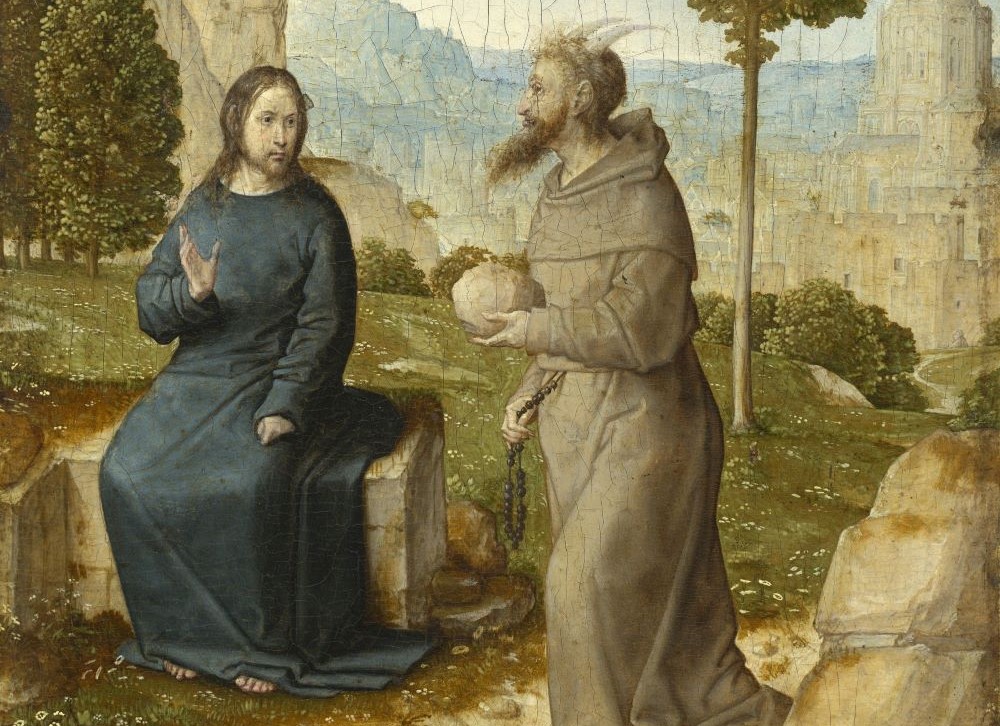
Detail from "The Temptation of Christ" (ca 1500-1504) by Juan de Flandes (Artvee)

by Sr. Mary M. McGlone
Join the Conversation
Send your thoughts to Letters to the Editor. Learn more
Who are we and who are we to become? Adam and Eve tell us one story, Paul another, and Jesus, well, I think we should assume he's the one who gets it just right.
Adam and Eve, our mythical ancestors, lived in God's garden and had permission to help themselves to its goods, a vocation to tend it, and a prohibition against eating from one tree, a command to remind them that they were not in charge of everything. When they ventured outside God's plan, they discovered a new dimension of their humanity. They hadn't realized that their actions would change them forever and call forth new lovingly creative responses from God. A new, powerful, confusing and dangerous dimension of their humanity had emerged. They had become the creatures who could make choices for good or evil. Because they could decide, everything they did involved choice. While they hid in fear, their God began offering alternatives to the situations they created. They were evolving and God kept up with them at every turn.
That summary may sound unconventional, but Paul's words to the Romans affirm it: "The gift is not like the transgression." With every error or misstep, the grace of God overflows. We change reality with every action and God continually calls us into greater life with divine grace and creativity. These two readings illustrate how God keeps drawing us to grow in the divine image.
And Jesus? Immediately after his baptism, the Spirit sent Jesus to the desert, John the Baptist's turf. Why 40 days in the desert?
Every account tells us that the Spirit sent Jesus out to where he would be stripped of his ordinary life: company, food, synagogue, family and a place to lay his head. There, midst nothing and nowhere, he would delve deeply into the mystery of who he was called to be. Far from the baptizer and the crowds, he needed to choose how to become who he truly was.
The temptations challenged his identity and presented him with three dimensions of the most personal and universal dilemma of life: Who and whose are we? The devil's offers depict the choices that define us all. The tempter challenged Jesus' fundamental identity: "If you are Son of God … "
His first question focused on the human condition. Jesus was hungry, needy like every human being. The enticer taunted Jesus like those who mocked him by his cross: "Turn these stones into bread, look out for number one." And Jesus said one does not live on bread alone. Humans are nourished through relationships with God and others (John 4).
Not willing to admit defeat, the tempter tried another way to undermine Jesus' identity as Son of God. This offer proposed that Jesus demand that God obey him. "Throw yourself down, demand that your Father prove his protective love on your terms." Jesus’ response: "God's angels aren't first responders. We are responsible for what we do."
Advertisement
Pressed hard, but not crushed, the fiend tried to detour Jesus with a promise of power. "Stop appearing so weak. How could your lowliness image God? I'm the real model for you. You could wield real power! Don't waste this chance!" That was the last straw. Jesus expelled the demon from the desert with the message: "Your hour has come. I am sent to counter your worthless enticements by drawing others into the Reign of God with me."
Temptations would continue throughout Jesus' ministry and so would his faithful responses. Every retort Jesus shot at the tempter revealed his devotion and commitment to collaborate with God's design for creation. Led daily by the Spirit until the very end, Jesus learned how to be, grow and act as the Son of God. In countering every one of the demon's enticements, Jesus deepened his identity as faithful Son of God and model for us.
And us? We, too, face the temptations to put ourselves first, to expect God to do everything or to choose wealth, power or prestige over human persons. It will happen because we have needs, desires and free will. At the very same time, God's grace remains available, offering creative alternatives to the messes we make and leading us to greater love. Under the guidance of the Spirit, we can keep learning how to expose and expel the idols, the demons who promote domination, self-centeredness and the relentless quest for power, fame, beauty, luxury and the like.
If we are children of God …
Lent offers us the opportunity to spend time asking ourselves who we are at our core and who God wants to help us become. Growing in our identity as daughters and sons of God will continue until we take our last breath. It takes time — more than 40 days.