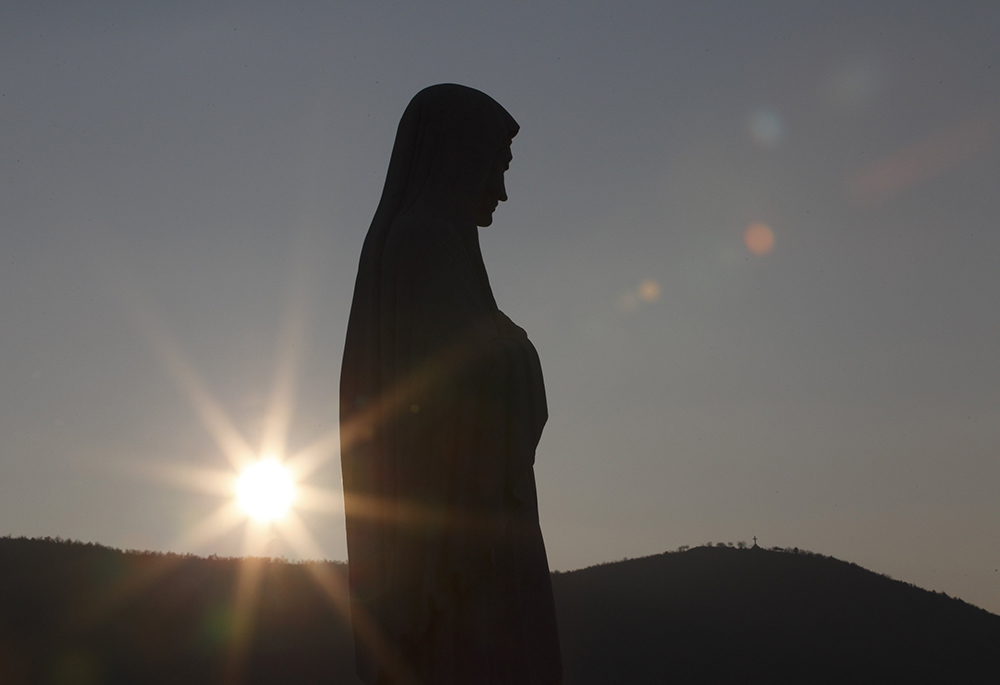
The sun sets behind a statue of Mary on Apparition Hill in Medjugorje, Bosnia-Herzegovina, in this Feb. 26, 2011, file photo. (CNS/Paul Haring)

by Marissa Papula
Join the Conversation
Send your thoughts to Letters to the Editor. Learn more
When asked how I found my way into Catholic ministry, why I am and remain Catholic, I often circumvent a vulnerable response with a comedic detour: "Oh, it was inevitable," I shrug. "I swallowed a Miraculous Medal from Medjugorje as an infant." Cheekier even, I might smile and say, "I swallowed Mary."
The story is true, drama notwithstanding. My family has an enduring devotion to Medjugorje, the site in Bosnia-Herzegovina where devotees believe the Blessed Mother appeared to children in June 1981. My aunt and uncle began making pilgrimages to the apparition site in the 1980s. Cradle Catholics whose faith faced tumult when one of their children was diagnosed with leukemia, they learned of the visions at Medjugorje from a distant relative, a religious sister, who mailed along prayers and a Miraculous Medal for my cousin.
Medjugorje might as well have been on the moon, so improbable seemed the prospect of traveling there for my upstate New York family, but prayer softened the path. My aunt and uncle found themselves there during the 10th anniversary of the apparitions of the Blessed Mother in rural Eastern Europe, and returned home from their pilgrimage with a medal for their niece who had been born while they were abroad. Me.
The Irish East Coast Catholicism of my upbringing is material, textured, touched, embodied. We have tiny holy water fonts affixed beside the door, palms tucked behind picture frames, photos displayed of the pope. Statues of Mary stand in our yards; rosary beads dangle from rearview mirrors. I never questioned why the mothers pin medals on their children's clothes; of course we wore our prayers. My aunt did so for my cousin, and my mom did so for me, thanking God for her long-awaited miracle baby by safety-pinning the medal to my ruffled onesies.
I don't recall the day the medal went missing; I know the story only because it has been relayed time and again throughout my life. Our home had shag carpet, a mid-century relic that provided both a soft landing for a wriggling baby and an ideal snagging spot for a safety pin fastened to her outfit. I wasn't yet crawling when, one afternoon, my mother noticed that the pin and medal were gone. She searched frantically, only to discover, to her horror, the open safety pin in my mouth. The medal was nowhere to be found.
She suspected I had swallowed it and brought me to the pediatrician. The doctor was reluctant to order an X-ray, but she insisted. Lo and behold, there on the film, nestled in my belly, was the Blessed Mother.
The medal would pass through my diaper days later, and after thorough disinfecting, was eventually secured to a necklace I would wear throughout my childhood.
Advertisement
When I tell the story, people laugh. I laugh too. And in the laughter, I can stiff-arm the question the story permits me to skirt. I'd rather share the myth of how I swallowed Mary, crack the joke about a medal lodged in my stomach, than explain why I have spent my adult life captivated by the strange intersection of mystery and matter that Catholicism summons me to.
The apparitions at Medjugorje have been contested, even within Catholic circles, since they were first reported 45 years ago. Who would fling themselves across the world toward such uncertainty? Who would devote themselves to a belief in things unseen? Who would make themselves vulnerable before the controversial, before the ineffable, and turn themselves over to it with abandon?
I would, but I'd rather entertain you than explain why this is.
The friction, the accountability, the wrestling that Catholicism demands are not easily digested. I relieve myself of the responsibility of choosing this faith when I default to a story of inheriting it. If I rely on an infancy narrative to distance myself from my own agency, I can avoid appearing a fool for a scruffy, skinny Jewish carpenter who lived continents away and millennia ago. But I am accountable to this. My faith was not just passed to me (and, ahem, through me) but held, cherished, fought with, fought for, fumbled over, by me.
I wept recently when my aunt reminded me of the medal's origins: her, in Medjugorje, praying during my birth, her words a benediction as I was welcomed into the world. Who would I be if not for those prayers? Who would I be if I didn't heed their call? Perhaps I really was marked for ministry, but to respond to the mark is a decision all my own: a mystical one, a mysterious one, one not easily explained even as it lives through me.
Ask me about it. I just might tell you.