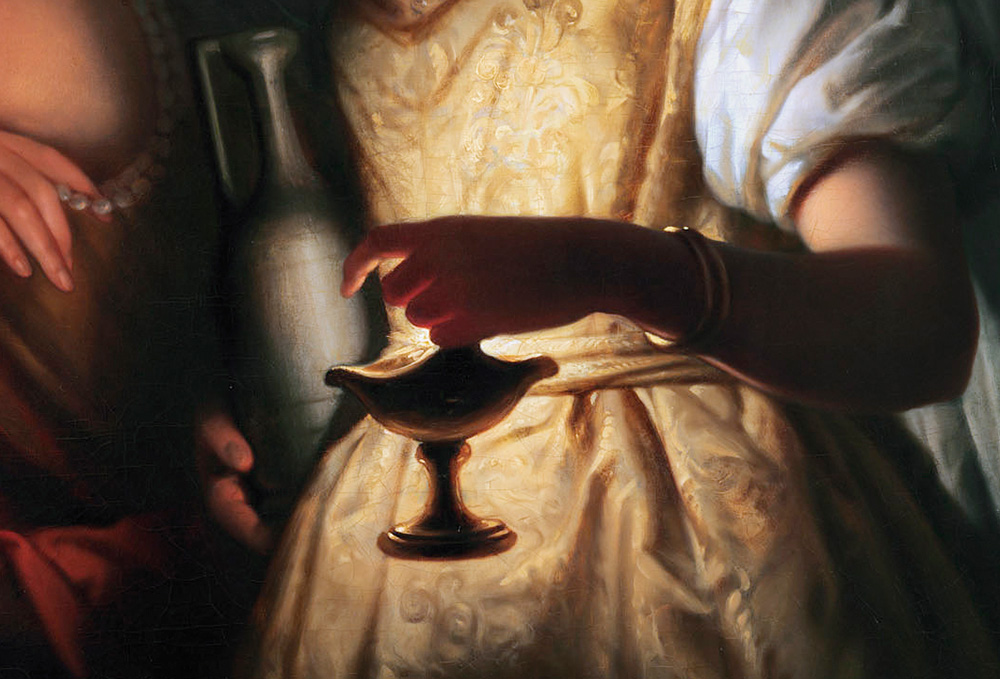
Detail from "The Wise and the Foolish Virgin" (1848), by Dutch painter Jan Adam Kruseman (Wikimedia Commons)

by Sr. Mary M. McGlone
Join the Conversation
Send your thoughts to Letters to the Editor. Learn more
As Matthew nears the climax of his Gospel, he depicts Jesus almost begging people to prepare for the coming tests of their commitment and his own final trial. Matthew describes how the humble Jesus led a procession that mimicked and made fun of the way a triumphal dictator would enter a conquered Jerusalem. He retold Jesus' parables to awaken his people's lethargic expectations, his critique of religious leaders for being more hypocritical than helpful, and his announcement about the dire events to come.
The enigmatic parable of the wise and foolish bridesmaids fits perfectly with the warnings and promises Jesus preached about in his final days.
What were those 10 virgin bridesmaids thinking and talking about as they waited for the groom to arrive with his procession of friends? Surely there was some talk of the fellow himself: rating him on his good looks, kindness, future prospects, piety and faithfulness. They were probably laughing, speculating who would be next and wondering why it was taking so long. Were the groom and the bride's father arguing about details of the marriage arrangement? Surely, he hadn't gotten cold feet! Their hours of waiting finally gave way to sleep.
Then the cry, "Behold the bridegroom! Come forth to meet him!" With that, they scrambled, pinching their cheeks, arranging their veils and robes, and grabbing the lamps that would light their way in the wedding procession.
None of them had expected such a long wait. Five of them had gambled everything on their participation in the feast. Extravagant as it seemed, they went overboard in every aspect of their preparation: dress, hairdos, the adornment of their veils, and their supplies of lamp oil.
They believed that this celebration was worth all they could give. The others teased them about that, commenting that wise people don't put all their eggs in one basket.
Those who thought themselves wise had held back, including on the amount of oil they purchased. They were too smart to count so heavily on this one marriage feast. What if it wasn't as good as they hoped? They prepared what they thought was just enough. All alike, they were awakened by the call, "Come forth!"
The ones who had prepared with carefully measured moderation discovered that their oil had run out. They turned to the ones they had seen as foolishly overdoing it and asked for help.
The problem was that their real shortage had little to do with oil. The oil was merely a symbol representing long-haul dedication. They lacked the wholeheartedness of the others. They were cautious with their commitment, much like a person who wouldn't bother to wear a wedding gown to a feast. They invested for less than what a wedding between heaven and Earth demands.
Advertisement
The truly wise, the extravagant and unstintingly committed ones, were not being selfish or smug when they refused to help. They had absolutely nothing they could give to the others when their time ran out. Commitment like theirs is built on accepting grace and practicing generous love; nobody can lend or buy it.
The tragedy in the parable came from a serious lack of understanding on the part of the restrained and self-protective ones. They kept themselves carefully in a transactional world. From their point of view, the other five appeared excessive, imprudent, even reckless.
Somehow, the reckless ones had comprehended and embraced the cost of participation in the feast of heavenly generosity. They could have summed up their lives with Psalm 62: "My soul thirsts for you, I seek you, I pine for you. Through the night I meditate on you. Thus, I will bless you all the while I live. You will satisfy me with a banquet and in the shadow of your wings I will rejoice."
As Paul would say, the wise bridesmaids held nothing back because they believed that they could "always be with the Lord."
With the backdrop of the story of these two groups, Jesus' parable directs the same call to us. "Come forth!" The initiative is not ours. As with the 10 virgins, everything begins with God's invitation to enjoy the banquet of true life. Every day, we are invited to perceive God's presence through the Spirit who "hastens to make herself known in anticipation of our desire."
What does this mean for us on this Sunday? In the U.S., we've just had elections that some see as a sign of God's working and others not so. No matter our thoughts about the outcome, today's liturgy urges us to heed the advice of Ignatius of Loyola to "find God in all things."
The Lord is at the gates, calling for all who are willing to ready themselves for the bountiful feast of life that never ends.
COME FORTH!