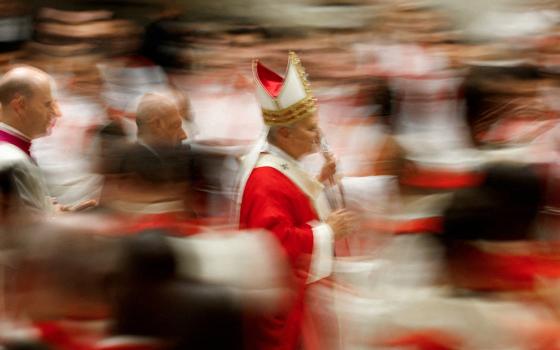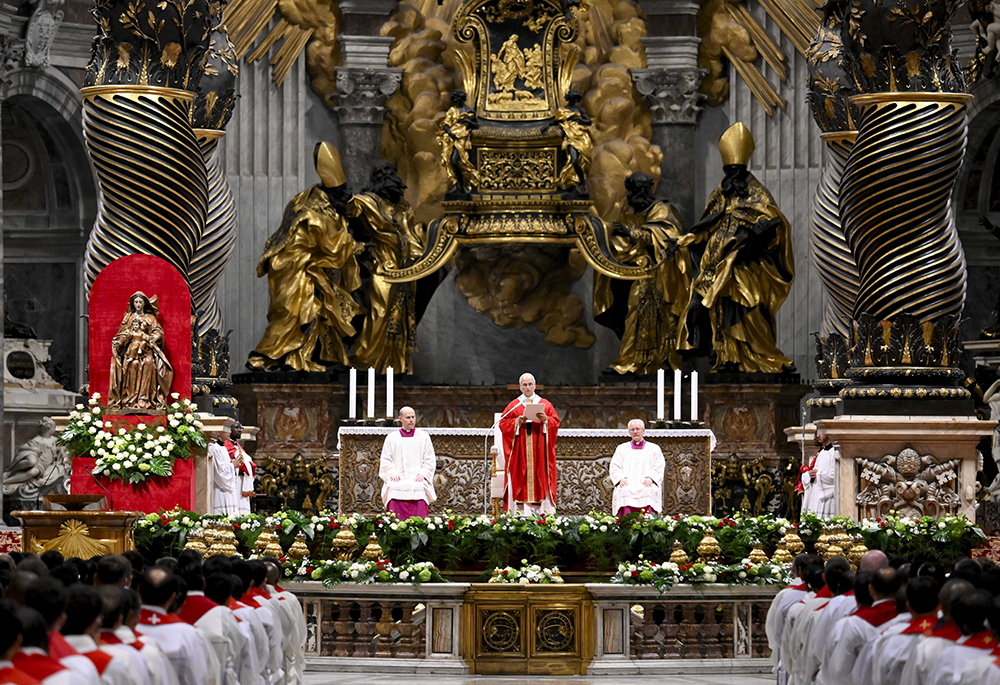
Pope Leo XIV gives his homily as he celebrates Mass with students from the pontifical universities in Rome in St. Peter’s Basilica at the Vatican, Oct. 8, 2026. (CNS/Vatican Media)

Join the Conversation
Send your thoughts to Letters to the Editor. Learn more
Pope Leo XIV delivered a beautiful sermon on Oct. 8 to open the academic year in Rome, calling the special Mass "a truly ecclesial moment in which gathering around the Lord's table nourishes our shared mission."
By coincidence, a group of Catholic college and university mission officers met the week before at Sacred Heart University for a gathering organized by the Way Forward, a group of which I am a part. We, too, focused on the ecclesial dimension of Catholic higher education and, specifically, how our wonderful new pope is so ideally suited to help Catholic schools navigate the fraught times in which we live.
The pope set forth the importance of education for the life of faith.
"Dear friends, consider study as a service to faith and truth: for your own good and for the good of so many brothers and sisters for whom the Lord gave his life," he said. "For while the encounter with him indeed brings joy and enthusiasm, it is never a matter of being 'bewitched' or 'enchanted' [Galatians 3:1]. Reason, posing questions in light of God's word and the church's tradition, is an essential part of the journey of faith in following Jesus Christ."
After citing Paul's letter to the Galatians — "Are you so foolish? Having started with the Spirit, are you now ending with the flesh? Did you experience so much for nothing?" (Galatians 3:3-4) — the pope explained how human memory differs from technology:
The mind must not simply compile data — as an algorithm now does more quickly than we can — but recall lived experiences, which contain depths of meaning that only the human soul can recognize, and connect more deeply with the goodness of these experiences. Everything that is good begins "with the Spirit" and thus possesses a breath, a dynamism and a sense of communion that, once experienced, are engraved upon the heart. Routine, ambitions, rivalries and other negative factors can, over time, divert our attention and energy, leaving us exhausted and listless, quarrelsome and sad. We must therefore return to the heart.
And Leo explained that our studies must be related to real life, and vice versa.
"Bring life into your studies and your studies into life, following the logic of the Incarnation, apart from which Revelation falls silent," he said. "Indeed, the further we stray from the complete reality that the Son of God took on and lived with infinite love, the less we will have to say and the fewer opportunities we will have to understand." It was a beautiful sermon, both encouraging and challenging.
The mission officers at our conference occupy a unique piece of cultural real estate in the academic world. In an organization that is organized vertically, with the college or university president at the top, vice presidents and a provost leading different parts of the organization, deans leading each school, etc., the mission officer's brief is horizontal, and he or she is empowered to examine the breadth of the school's many tasks and pose the question: Does this particular work cohere with our mission?
Our task at Way Forward is not to solve the many challenges church leaders face. It is, instead, to get them away from their desks for a couple of days and bring a deeper, and more specific, focus: What is the ecclesial dimension of any particular issue or problem? This framing does not ignore any fraught issues, and several arose during the conversations, but by starting with what you might call the 35,000 foot view, the discussions were more creative and less defensive than might usually be the case.
Advertisement
Way Forward conferences follow Chatham House rules, so I am not at liberty to quote any particular thing that was said. What emerged in almost every discussion, however, was very clear: Pope Leo XIV breaks through all the cultural noise in ways no previous pope has done, at least here in the United States, and that fact is a great opportunity for all Catholic organizations to put some of his wind in our sails.
The discussion surrounding Magnifica Humanitas, and the summer of largely frightening news about the capabilities of artificial intelligence, has been a four-month long advertisement for the value of a Catholic education. At a time when the people who create AI do not even know how to articulate the deep questions AI raises, our Catholic intellectual tradition brings a language and a logic to those questions that allow us to focus on the principal, defining concern about AI: How do we humanize it?
Turns out, our Catholic colleges and universities have this thing called the humanities, and swimming in those intellectual waters brings insight and clarity, not just to how we do and do not use AI in the classroom, but how we help form students to grasp their own uniqueness as human beings, and contribute as humans to the domestication of this new technology in ways that are just and humane. I believe every participant walked out of the conference with more confidence in the unique ability of Catholic higher education to help our society navigate the sometimes treacherous waters in which we find ourselves as a culture and as a society. As one participant noted, Catholic colleges define who they are most obviously in their core curriculum which largely remains more substantive and robust than at secular counterparts.
Catholic colleges can and should do more than excel in the classroom. As I wrote previously, Catholic higher education engages in the moral formation of students, not just their intellectual formation. Perhaps it is better to say that one of the themes that emerged from the mission officer gathering was the awareness that intellectual formation is an integral party of moral formation, but not the only part.
Finally, it is because Catholic intellectual life is Christocentric that we come to know and appreciate the human person. Catholic higher education is where we tease out the implications of the Second Vatican Council's claim "only in the mystery of the incarnate Word does the mystery of man take on light."
The darkness of post-modernity, post-liberalism and AI overreach require a vibrant Catholicism, one that engages the culture but is not complicit with the culture. That engagement is certainly not limited to colleges graduates but it is vital that Catholic higher education follow Pope Leo's approach: holistic, attuned radically to human dignity, and safeguarding our unique human ability to believe in a transcendent God who has, in the person of Jesus Christ, revealed not only himself to us, but has revealed us to ourselves.