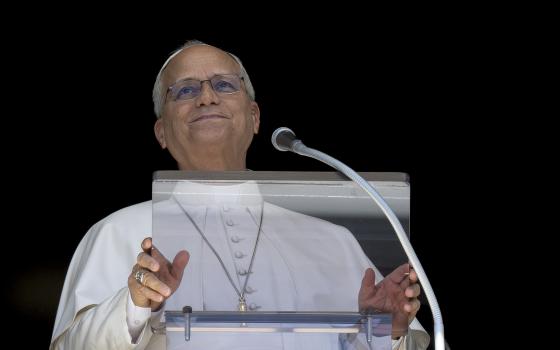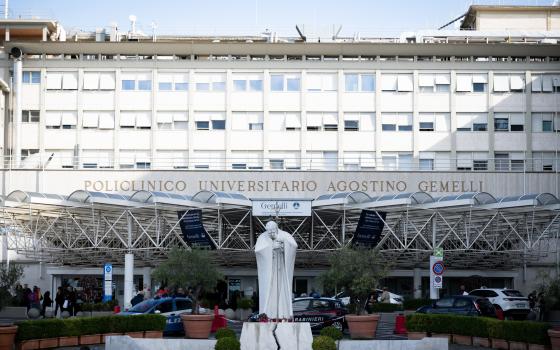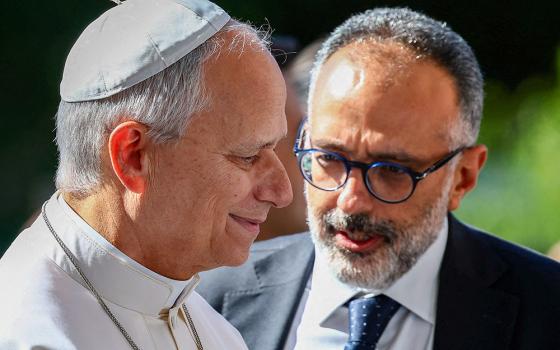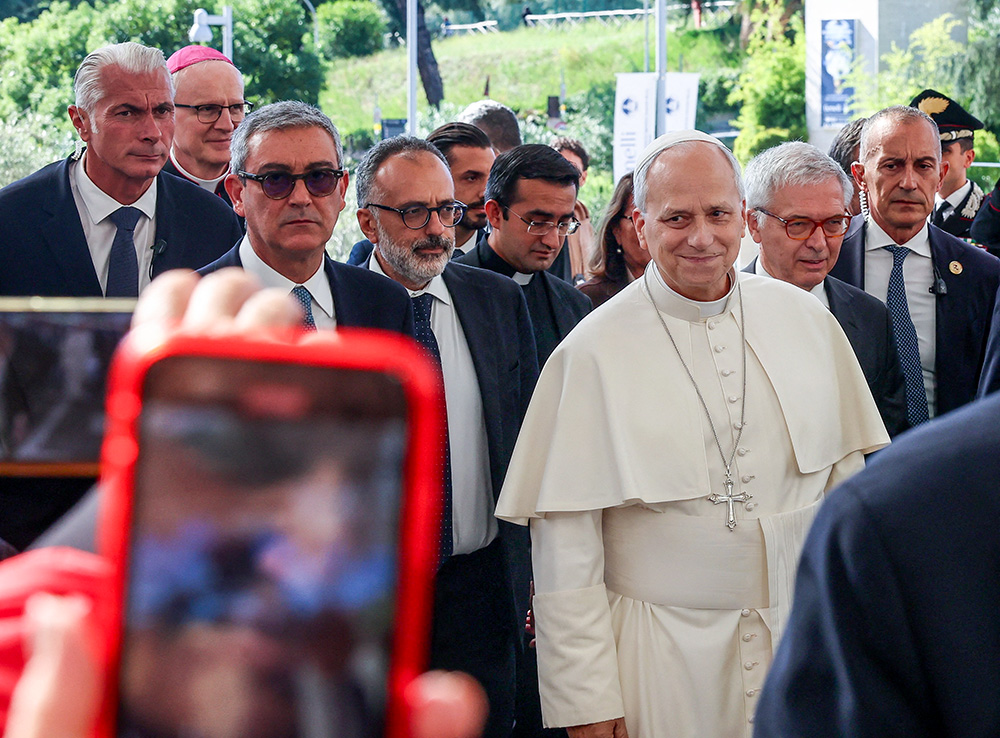
Pope Leo XIV smiles as a person takes a cellphone photo as the pontiff arrives at Rome's Gemelli Hospital Oct. 13, 2026, ahead of his surgery that afternoon. (OSV News/Reuters/Ciro De Luca)

Join the Conversation
Send your thoughts to Letters to the Editor. Learn more
For journalists scarred from covering 38 days of Pope Francis' hospitalization, followed by his surprise death on Easter Monday, the election of a 69-year-old tennis-playing pope with no visible health issues was welcome relief.
That's why it was such a shock when the world's media found itself again huddled in the Vatican press hall late into the evening to await a "medical bulletin" on Pope Leo XIV's condition fewer than 18 months into his pontificate.
As of now, the pope remains in stable condition in the hospital after undergoing a successful operation that removed the lower lobe of his right lung to remove a small growth. But doctors found what they had feared when they took a look inside the pope's chest cavity: a malignant tumor.
Further tests are needed to determine whether any cancer remains in his body after the operation, but for a pope who lost both of his parents to cancer, and whose older brother was diagnosed in 2017 with multiple myeloma, a rare form of blood cancer, the diagnosis casts a long shadow over what was expected to be a long pontificate.
Where Leo formerly broke into the news cycle for his retorts against U.S. President Donald Trump, his prescient declarations on artificial intelligence, and the massive crowds he has drawn on international trips, the image of his pontificate could now be shaped by something much quieter in the face of his surprise diagnosis: his calm.
Leo's longtime friends have described him as a "very balanced, measured kind of person who deals well with crisis." His calm was on full display when he announced his upcoming operation Oct. 11 from the window of the Apostolic Palace overlooking St. Peter's Square, breaking with the culture of secrecy that has long shrouded the health of the popes — St. John XXIII's stomach cancer and St. John Paul II's Parkinson's disease were both long kept from public view.
Cardinal Pietro Parolin, Vatican secretary of state, told reporters that those in the Curia "were all impressed by the serenity with which he spoke when announcing this intervention." And Cardinal Víctor Manuel Fernández, head of the Vatican's doctrine office, praised the pope's reaction in comments to EWTN News pointing out how the pope had personally acknowledged "the frailty of his flesh" and demonstrated "serene confidence."
Speaking to reporters outside the Vatican, Oklahoma City Archbishop Paul Coakley, president of the U.S. bishops' conference, said he anticipates Leo will take his diagnoses "in stride [and] in faith"
Advertisement
Leo's calm "has been his style for many, many years," Coakley said. "I don't think he is going to change overnight."
Cancer has now given the world a reason to talk about the pope outside of any conflict with a political leader or debate over a global trend. In doing so, it may have provided a platform to showcase something more fundamental about Leo and his spirituality.
After his first international trip as pope, Leo was asked about how he felt during the conclave that elected him. He cited a 17th-century book written by a lay Carmelite brother in France that lays out "a type of prayer and spirituality where one simply gives his life to the Lord and allows the Lord to lead."
"If you want to know something about me, that's been my spirituality for many years," he said aboard the papal plane.
That insight into how the pope understands his relationship with God reads differently in light of a cancer diagnosis, as does a portion of a recent speech he gave just before his hospitalization.
Opening a Vatican summit dedicated to discussing Amoris Laetitia, Francis' 2016 pioneering document on Catholic family ministry, Leo said that the principle of fragility must be studied in how it impacts family life.
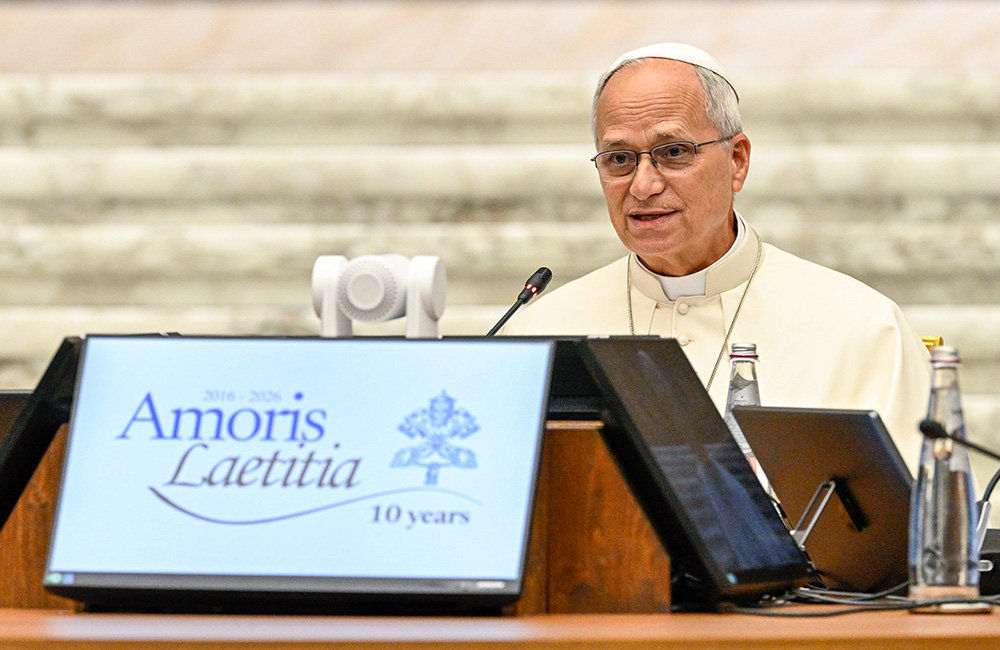
Pope Leo XIV speaks Oct. 7, 2026, as he opens the weeklong Vatican meeting of presidents of bishops' conferences marking the 10th anniversary of Amoris Laetitia. (OSV News/Vatican Media/Simone Risoluti)
"Fragility deserves special attention," the pope told the senior bishops and theological experts gathered for the summit, "for it can profoundly shape the way people see themselves, their future, and even their relationship with God and with the church.
"The experience of fragility raises the question of whether we are able to remain close to one another when life no longer corresponds to what had been hoped for, and whether we can recognize the work of grace even in situations marked by limits, wounds and apparent failure."
Four days after that address, the pope himself embraced the fragility he had preached about, surprising the world by announcing that doctors had found a small but "well-localized" lump in his lung.
Though the world does not yet know what the status of Leo's cancer is, or how he will go about his recovery, the pope may draw inspiration from recalling how his mother battled cancer for several years.
A recent biography of Leo revealed a letter the future pope had written to friends six years before his mother's death from cancer: "She's a tough lady and handles it all well, which makes it a little easier for me being so far from Chicago."
The National Catholic Reporter's Rome Bureau is made possible in part by the generosity of Joan and Bob McGrath.