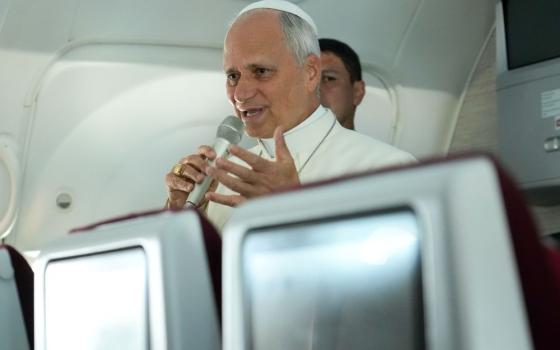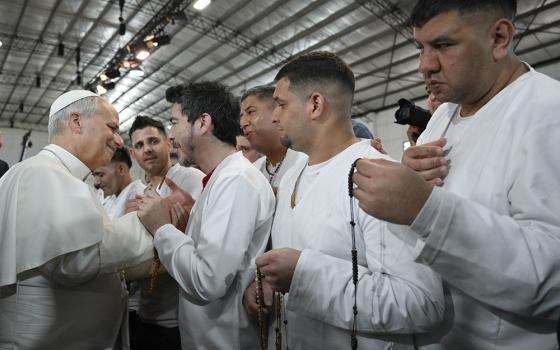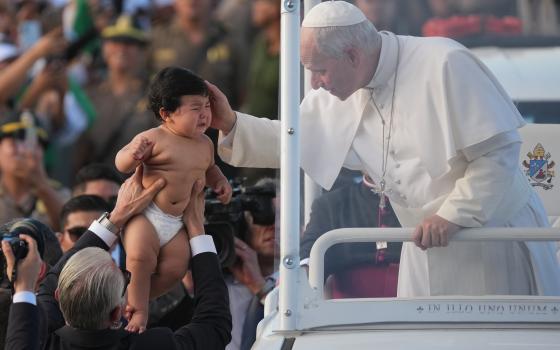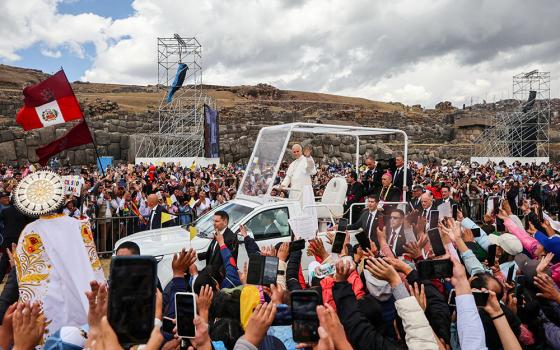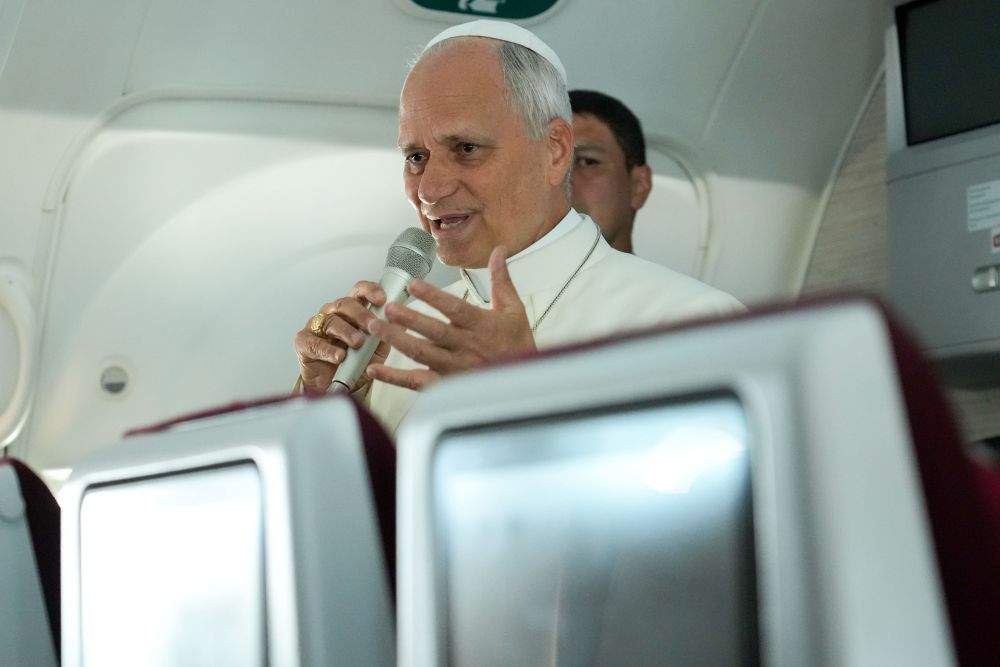
Pope Leo XIV speaks with journalists aboard his flight back to Rome Nov. 16, 2026, after concluding his apostolic journey to Uruguay, Argentina and Peru. (CNS/Lola Gomez)
Join the Conversation
Send your thoughts to Letters to the Editor. Learn more
In his longest airborne press conference yet on an international trip, Pope Leo XIV showed that he is not a pope in a hurry.
He has no plans to further open the door to allowing married men to be ordained priests nor to change the current restrictions on the celebration of the pre-Vatican II Latin Mass imposed by Pope Francis, he said in a nearly 45-minute press conference Nov. 17 on his return flight to Rome following his marathon tour of South America.
Leo took 13 questions from the group of 83 reporters who had traveled with him through Uruguay, Argentina and Peru beginning Nov. 6. Some were political, some related to church issues and some were personal. In nearly all his responses he consistently returned to the theme of unity and his desire to work against polarization both in the church and society at large.
Leo intends to stay the course on church issues
Two days after visiting the Peruvian Amazon, Leo said that the proposal to ordain married men to the priesthood, which was a central topic of debate during a 2018 Vatican summit on the Amazon, is "a solution which in certain areas of the church can cause division."
"There is not universal, if you will, acceptance of that concept," the pope said in response to a question from senior Vatican correspondent for America magazine, Gerard O'Connell, reiterating that among his priorities as the successor of Peter is "first to promote unity and communion among us as members of the church."
Though Leo's predecessor left the door open to ordaining married men as priests in the future, Francis ultimately rejected a call to create a framework for ordaining married men to the priesthood in the most remote regions where the church is present. The idea had been approved by members of the 2018 Vatican Synod of Bishops on the Amazon.
During the penultimate day of his South America trip on Nov. 15, he discussed the need to promote vocations in the Andean highlands while visiting Cusco. Meeting with Indigenous communities in the Amazonian town of Pucallpa he noted how the region's vicariate "as large as entire countries, has only twenty-five priests."
On his flight to Rome, Leo said that while the Holy Spirit may be suggesting the ordination of married men to the priesthood, "the pope doesn't change church doctrine — we all have to listen, the bishops have to listen."
"It may be in the future that some things will change, however for right now, what I believe, an important part of my ministry to the church is to heal, bring people together," he said. Just as in responding to polarization on political issues, the church, too, must first come together to "consider what we believe the priorities need to be, and then we'll see how we walk forward from there," he said.
"I'm very well aware [that] many people are not in agreement with that approach. That's alright," Leo continued. "I'm here, and that's what I am offering as part of my ministry, and I suppose that's enough right now."
The pope was also asked by French newspaper Le Figaro whether he intends to loosen Francis' 2021 decree which placed greater restrictions on the celebration of the pre-Vatican II Latin Mass, a cause which has become a rallying cry among Catholic conservatives.
Leo responded that the decree, entitled Traditionis Custodes, was "a decision of Pope Francis, and we will continue to follow that."
That decree holds that priests and communities seeking to celebrate the pre-Vatican II Latin Mass must seek dispensations from their local bishop to do so, and that explicit Vatican approval is required to allow the old form of the Mass to be celebrated by priests ordained after the decree's publication or in parish churches.
"For the unity of the church, the vast majority of Catholics around the world, we celebrate the rite of Vatican II, of Paul VI, and we will continue to do that, and there is an avenue available for those who wish to apply for the dispensation," Leo said.
Advertisement
And even on the subject of creating new cardinals, which Leo has yet to do in his 18 months as pope, he merely said "no comment" before expanding on his answer.
"There's still enough of them there," the pope said, referring to the 116 cardinal-electors who are under 80 years old and currently eligible to vote for his successor. "I will eventually get around to that."
Pope avoids politics and pushes back on polarization
Just as with his answers on church topics, Leo's replies to more pointed political questions also revolved around his desire to foster unity and reduce political polarization.
Asked about his speech to Argentine leader Javier Milei, read by some as a jab against the extreme austerity measures advanced by the libertarian president, the pope said that the message he seeks to share "is not political."
"Although there are some in certain countries who try to force me toward the right or the left, that critique or don't critique, I speak of the Magnifica Humanitas, Leo said, referencing the title of his recent encyclical, which translates to "Magnificent Humanity.”
"That is what I discussed with President Milei: speaking of respect for human beings, encouraging greater consideration especially for those who are the most needy in Argentine society," he said.
"There was a mutual understanding regarding the value of life, the value of the human being at every stage of life; we have to find ways to work together on that," the pope continued..
Asked what advice he had for the people of Argentina, the country he visited for four of the 12 days of his trip, Leo emphasized the issue of polarization.
"We are all realizing how we have let ourselves be taken hold of by algorithms, and a polarization that is not an accident, that in many cases was intentionally provoked," he said.
"Personally, I strongly believe that the message of Jesus Christ — although I have the utmost respect for those who are not Christian and who choose a different path — contains a call to build bridges and seek reconciliation, so that we can rediscover that there are aspects of humanity that are far greater and far deeper than the things that so often cause division, hatred, and polarization," Leo said.
Papal insights
While none of Leo's unscripted in-flight responses provided a breaking news moment as those of his predecessor sometimes did, the pope did reveal several insights into how he understands his papal office and his own identity.
Following a cancer diagnosis and operation to remove a malignant tumor from his right lung, questions again arose about what should happen if the pope is incapacitated for a long period of time, such as in a coma. Francis had revealed that shortly after his election in 2013, he signed a conditional resignation letter should he be incapacitated from carrying out his duty.
Asked if he had signed such a letter after taking up the papal office, Leo responded with a resounding "no."
"For now, I don't see the need, thank God. Canon law already has various points that cover this issue," the pope said. "Eventually I will do it, I think, but for now I don't see the need."
The pope conceded that he's "not at 100%" following his operation, "but I'm rather well," he said, despite showing no visible fatigue over the course of his grueling trip.
"Endurance is one of the gifts the Lord has given me," he said.
Though he demonstrated that endurance throughout his 12-day tour of South America, Leo did not confirm any future trips for 2027 beyond a visit to Seoul, South Korea, in August for World Youth Day. The event has long been on the papal calendar.
He did not answer when explicitly asked about a potential visit to the United States, but the U.S.-born pope said after his homecoming tour of Peru, where he served as a missionary priest and bishop for 20 years, that in many regards he remains a "gringo" — the term used by Latin Americans to refer to people from North America.
"I think that in general I am direct, I say things as they are. On the subject of my health, including saying 'this is happening to me,' that would not be typical in many countries or in many cultures," Leo said. "In the United States it's more common, and so that happens."
And after revelations that the pope had voted in the U.S. midterm elections, the first known instance of a sitting pope voting in civil elections, the pope stated that his "profound belief in democracy, democratic participation, is also part of being American."
Following six days in Peru, a country which he had called his "homeland," Leo noted how his American upbringing and Peruvian experience had both influenced his understanding and practice of faith.
"My way of living the faith, of course, was very affected, very, let's say transformed, in Peru, but I grew up in a family in the United States — multicultural yes, but where the faith was lived out — so I think there are a lot of things there from being formed in that culture."
The National Catholic Reporter's Rome Bureau is made possible in part by the generosity of Joan and Bob McGrath.