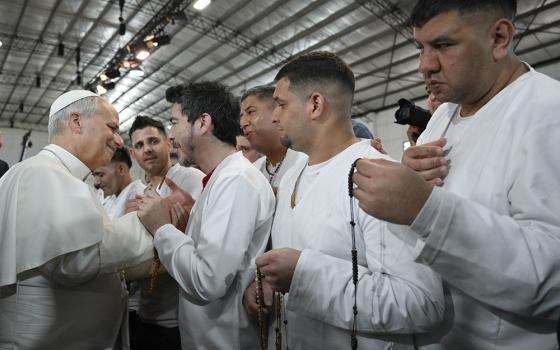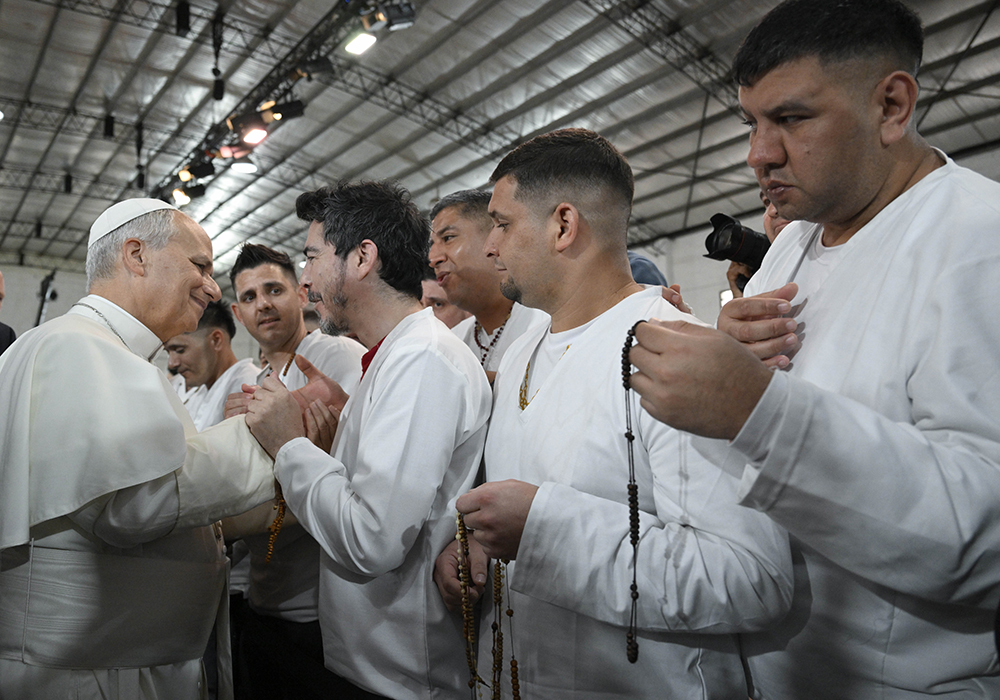
Pope Leo XIV greets inmates during his visit to the federal prison complex in the Villa Devoto neighborhood of Buenos Aires, Argentina, Nov. 11, 2026, during his Nov. 6-17 apostolic journey to Uruguay, Argentina and Peru. (OSV News/Vatican Media/Simone Risoluti)

by Eduardo Campos Lima
Join the Conversation
Send your thoughts to Letters to the Editor. Learn more
Pope Leo XIV's visit to a prison in Argentina on his South American trip highlighted not only the dignity of prisoners but also the role of prison pastoral ministers.
And over the past few months, a network of prison pastoral ministries from several Latin American countries has been gaining momentum, with the support of the Latin American and Caribbean Episcopal Council, or CELAM.
A highlight for this group was the pope's visit to the Villa Devoto federal penitentiary in Buenos Aires, Nov. 11.
Leo's prison visit was an opportunity to demonstrate his closeness to prisoners, but also to show that he is aware of their suffering. The prison, commonly known as Devoto Prison, closed the day after the pope's visit and prisoners were sent to other facilities.
One of the pope's contacts with the reality of prison life is Archbishop Jorge García Cuerva of Buenos Aires who had been one of the leaders of prison pastoral ministries in Latin America and was appointed pontifical delegate for the International Commission of Catholic Prison Pastoral Care last December.
The pope also received information about the Latin American prison system in late 2025, when German-born Sr. Petra Pfaller, head of the Brazilian bishops' prison pastoral ministry, handed him a report during a meeting at the Vatican.
Brazil's penal system faces many of the same problems found in other Latin American countries, Pfaller told NCR. The militarization of prisons is a nationwide issue, with prison officers who are in fact police personnel trained in military tactics. At the same time, penitentiaries have been privatized in a few states.
Pfaller said it is impossible to implement educational programs in facilities of such enormous size.
"Building more and more prisons is not enough. The real problem is mass incarceration," she said.
Fr. Luis Carlos Aguilar, a priest in Costa Rica, has been coordinating efforts to consolidate the Latin American network of prison pastoral ministries. During these meetings, participants realized how they faced similar challenges. Across Latin America, teenagers are being recruited by criminal gangs at an early age, violence is tearing apart the social fabric and mass incarceration has become the model some countries have adopted in response.
"It's a dehumanizing chain of events. We realized that we need to work on prevention," Aguilar told the National Catholic Reporter.
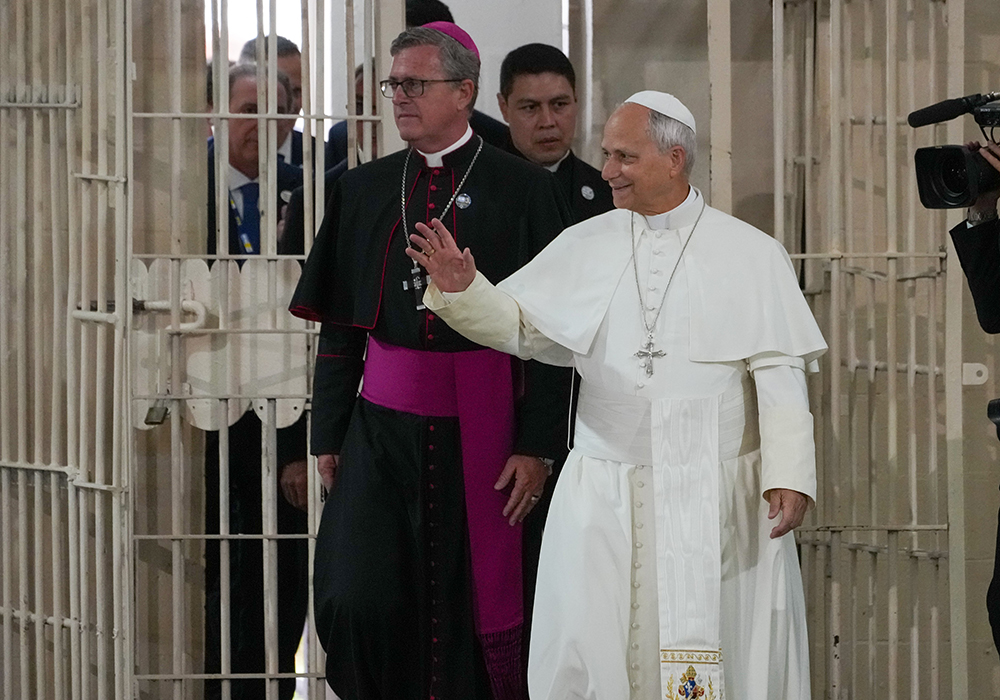
Accompanied by Archbishop Jorge Ignacio García Cuerva of Buenos Aires, Pope Leo XIV visits the federal prison complex, commonly known as Devoto Prison, in Buenos Aires, Argentina, Nov. 11, 2026, during the final day of his apostolic visit to the country. (CNS/Lola Gomez)
But the circumstances are challenging. In recent years, so-called penal populism — the idea promoted by politicians that detaining more and more people and stripping them of their rights in prison will reduce crime — has been gaining ground across Latin America.
A big supporter of this trend is El Salvador President Nayib Bukele. A close ally of U.S. President Donald Trump, Bukele has kept the Central American country under a state of exception – an emergency rule that suspends citizens' rights — since 2022, using it to detain more than 90,000 people suspected of belonging to criminal organizations and sending them to prisons, including a mega-prison.
Bukele's policies have reduced the homicide rate in the country but human rights organizations stress that numerous violations have been committed in the process, including the detention of innocent people and the failure to inform detainees' families about their whereabouts.
"Many countries have been adopting Bukele's model to combat violence. But the structural problems that lead people to crime are not being addressed," Aguilar said.
Racialized teenagers — both Black and Indigenous — who have never been given opportunities to develop their potential end up getting involved in crime and being thrown into prison, "with no rights at all; even their parents are not allowed to visit them or receive information about them," the priest said.
A similar trend is unfolding in Argentina. Since Sept. 5, adolescents as young as 14 have been eligible for arrest and criminal proceedings and convictions. The policy, adopted under the government of far-right President Javier Milei, has been widely criticized by human rights organizations.
"Prisons are already overcrowded with adults. Now that boys are also being detained, we can only imagine the conditions inside," Maria Patricia Alonso, executive secretary of Argentina's prison pastoral ministry, told NCR.
Advertisement
In 2024, Argentina's prison population reached 133,585, a 68% increase over the previous decade. At least one recent report indicates intensifying structural problems. Alonso said many prisons lack basic hygiene and cleaning supplies.
"People want to hear politicians say that they will detain all criminals. But that's just sweeping the problem under the rug," Alonso said.
In Peru, mass incarceration has also become a major issue. Silvia Alayo, head of the Criminal Justice and Penitentiary Program at the Episcopal Commission for Social Action (CEAS), told NCR that penal populism and mass incarceration have pushed overcrowding.
"This critical overcrowding means that it is impossible to promote their proper reintegration into society," Alayo said.
The growing militarization of prisons has also led to further restrictions on the work of prison pastoral agents, she added.
"Our work is not seen as a fundamental part of the resocialization process," she lamented.
Alayo said that consolidating a Latin American network of prison pastoral ministries would help workers from different countries address the common challenges facing the region.
The idea is to continue supporting people like one woman from Brazil (whose name has been withheld for safety reasons). Now out of prison after being detained for nearly four years for a crime she said she did not commit, she said that, initially, Catholic Church ministers were allowed to visit only once a year. She came close to becoming evangelical, particularly since their pastors frequented the prisons.
"But, in my second year in prison, the [Catholic] pastoral ministry began visiting us," she told NCR.
She said there were 30 inmates and only six beds in her cell. The lack of water was another serious problem. "And then there was the loneliness. Most women in prison have nobody who comes to visit them," she said.
The weekly visits by pastoral ministers changed her life. She decided that she wanted to do similar work as soon as she was released.
"I was on the other side, and I know their problems. Despite the restrictions on our work, we keep fighting to be there for them," she said.