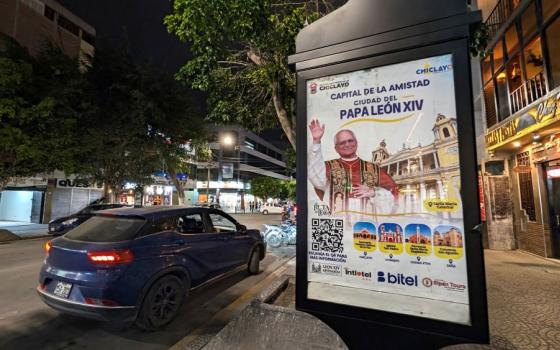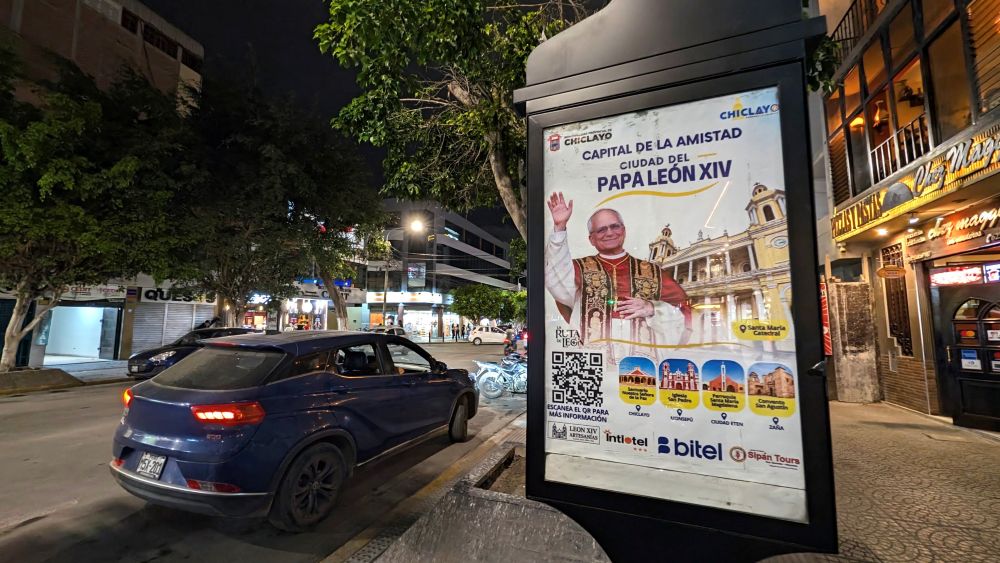
A sign welcomes Pope Leo XIV to the "Capital of Friendship" in Chiclayo, Peru, on November 9, 2026. Leo, the former "Padre Roberto," was bishop of Chiclayo from 2015-2023. (OSV News/Junno Arocho Esteves)
by Abby Strelow
Join the Conversation
Send your thoughts to Letters to the Editor. Learn more
While Pope Leo XIV has been proudly hailed by Catholics in the United States as the first American pope, his first visit home as leader of the Catholic Church isn't to his native Chicago.
As part of his Nov. 6-17 trip to Latin America, the pope is visiting Peru, where he holds citizenship and spent over two decades as a priest and bishop before Pope Francis called him to Rome in 2023.
Though his return to Peru began in Lima Nov. 11 and will end with stops in Cusco and Pucallpa, the real homecoming for the former "Padre Roberto" will be his Nov. 13-15 visit to Chiclayo, where he was bishop from 2015-2023.
Leo fondly referred to Chiclayo as his "beloved diocese" in his first speech as pope from the balcony of St. Peter's Basilica. His return visit will include a prayer at a chapel dedicated to St. Oscar Romero that began its reconstruction under his episcopate and an open-air Mass expected to draw upwards of a million people.
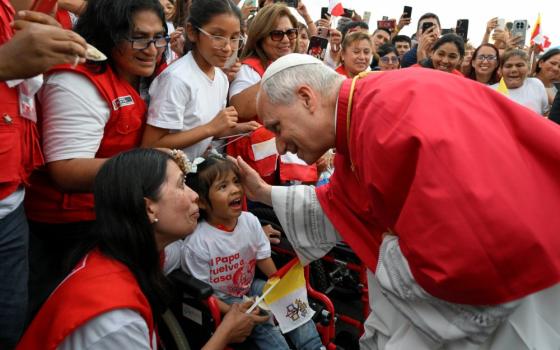
While Leo's visit to Latin America also includes stops in Uruguay and Argentina, his return to Peru has sparked a unique excitement among Peruvian Catholics eager to welcome their former bishop home. And since Leo's recent hospitalization for lung surgery had caused doubts about whether the visit would take place, the anticipation has only grown.
Peruvians have good reason to celebrate Leo's return, especially since Francis never returned to his homeland of Argentina after departing for the 2013 conclave where he was elected pope. While many Argentinians waited eagerly for Francis' return and the pope himself said he was "open to the opportunity" to visit, a homecoming never materialized despite his nearly 50 international trips.
Leo's return to Peru is the continuation of a much longer papal tradition of homecoming. Pope Paul VI, who served as pope from 1963-1978, is credited with normalizing international papal travel, was a native Italian, but his nine extensive visits around the world set a precedent of the globetrotting papacy that his successors would enthusiastically follow.
Pope John Paul I, another Italian, never left his home country after being elected; he died just 33 days after the conclave ended Aug. 26, 1978. But Pope John Paul II, who made more than 100 international trips, returned home to Poland nine times during his pontificate from 1978-2005. His historic first visit in 1979, which was seen as a sign of support for the Polish people amidst the country's communist regime, is considered one of the primary causes of the eventual downfall of the Iron Curtain.
While John Paul II often faced resistance from the government during his visits to Poland, his reception by the people was always enthusiastic, drawing large crowds who were inspired by his famously charismatic speeches. Bogdan Borusewicz, a former democracy activist under Poland's communist regime who was later elected to the Polish Senate, recalled in an interview with the George W. Bush Center that John Paul "spoke to us, to the remnants of those who continued our activities, to Poles who should not give up hope. He had a marvelous command of the current Polish situation."
Advertisement
The next pope, however, was not always received with as much enthusiasm by his countrymen. Pope Benedict XVI returned to his home country of Germany four times, but despite his affection for his native land, his first official state visit home in 2011 included thousands protesting in Berlin over the church's sex abuse scandals and teachings on homosexuality. Multiple MPs also boycotted his speech to the German parliament.
Germany's identity as the birthplace of Martin Luther and a historically Protestant stronghold dampened Benedict's reception, but also shaped his messages to politicians and the population. His speeches urged a renewed appreciation for Christianity and its moral system amidst growing secularism in Germany. The pope even met with Lutheran leaders in the same monastery where Luther studied before breaking from the Catholic Church in 1520.
But Benedict's purpose in calling Germany back to the Catholic faith was inseparable from his affection for his country: During a 2006 personal homecoming visit, he returned to his homeland of Bavaria, where he was greeted with cheering crowds. He told German news outlets: "The purpose of the visit is precisely because I want to see again the places where I grew up, the people who touched and shaped my life. I want to thank these people."
Coming after the many homecoming trips of John Paul II and Benedict, Francis' break from the papal tradition surprised many. While he never gave an explicit reason for the absence that disappointed many Argentinian Catholics, experts speculate that the polarized political climate would have made a return trip too controversial. Francis' avoidance of Argentina kept a return visit from potentially being weaponized or seen as an endorsement by the far left or right.
Francis was no stranger to the tensions in Argentina's political system: The country faced multiple economic and political crises both leading up to and during his papacy. Multiple Argentinian presidents on both sides of the political spectrum clashed with Francis about issues including the legalization of abortion, same-sex marriage and economic policy.
While there are no current plans for Leo to visit the United States, many have speculated about a potential visit after the pope said he was looking at visiting "soon" or in "the next couple years." Asked about a future trip, Leo told NBC interviewers that, while no official American homecoming is on the calendar yet, "I certainly hope to be there soon."
A bipartisan group of over 90 U.S. lawmakers recently signed a letter urging House Speaker Mike Johnson to invite Leo to address the U.S. Congress in January when it convenes for its 120th joint session.
The request, spearheaded by Catholic lawmakers Representatives Mike Thompson of California and Brian Fitzpatrick of Pennsylvania, emphasized that an address from Leo would be "especially timely" after divisive midterm elections and that "as the first ever American-born Pope, his unique perspective, and ties to our country, would serve as a unifying force for members of Congress."
The National Catholic Reporter's Rome Bureau is made possible in part by the generosity of Joan and Bob McGrath.