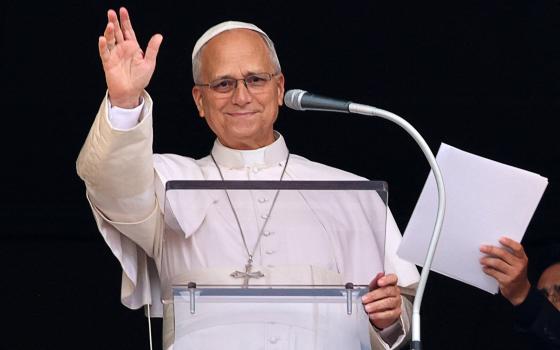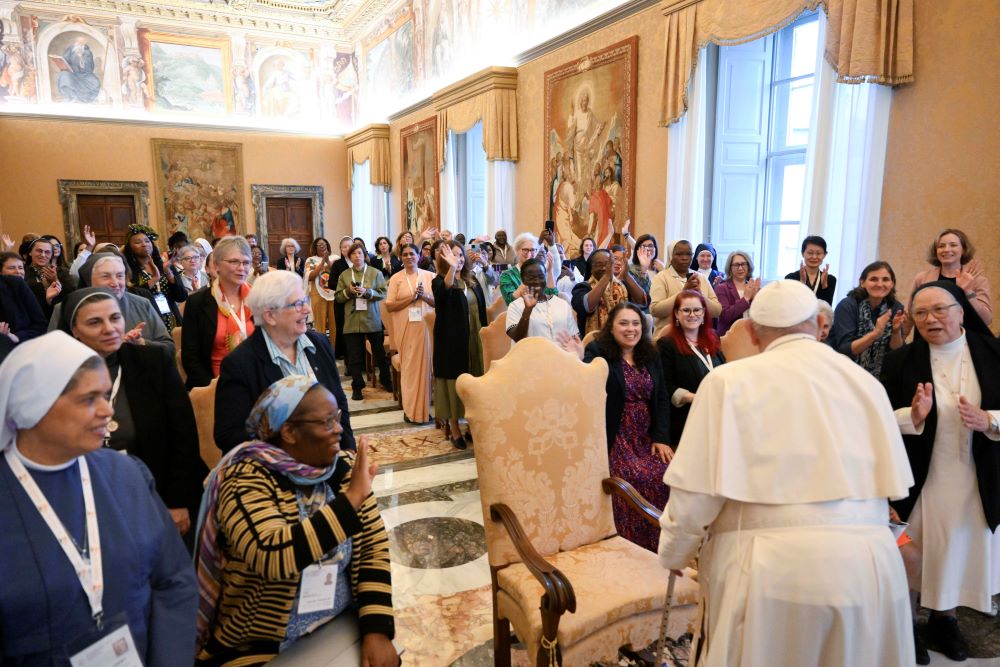
Pope Francis meets with women participating in or assisting the Synod of Bishops in the Apostolic Palace at the Vatican Oct. 19, 2024. (CNS/Vatican Media)

Join the Conversation
Send your thoughts to Letters to the Editor. Learn more
In a frank assessment of the complex role of women in the Catholic Church and its leadership, a Vatican study group called for broader access to positions of authority for Catholic women worldwide and for the church to confront what it described as persistent patterns of clericalism and "machismo."
The unsparing analysis, rare for a Vatican document, came from a study group created as part of the Synod of Bishops on synodality tasked with examining women's participation in the life and leadership of the church. Its final report was published March 10.
The church must move beyond a view of women limited to certain characteristics "such as motherhood, tenderness or care" that can "leave little room for other equally important feminine qualities, such as leadership, counsel, the capacity for teaching, listening and discernment," the report said
"An obsession with ensuring that everything becomes structure, rule, rite, or norm is not faithful to the free dynamism of the Spirit."
The group, established by Pope Francis and whose work was carried out by the Vatican's Dicastery for the Doctrine of the Faith, said the church must grapple honestly with cultural and institutional obstacles that continue to affect women's participation in ecclesial life.
"There exists within the contemporary ecclesial mentality a certain pattern of thought and behavior identifiable as 'clericalism' or machismo,' " the report said, adding that such attitudes create "distrust and, not least, distance among women."
The document defined clericalism as "the tendency to transfer automatically the authority and unique role that properly belong to the priest in the celebration of the Eucharist into all other areas of community life."
The study group was originally anticipated to take up the question of women's access to the diaconate, but that task was later entrusted to a different commission established in 2020. That group voted against admitting women to the diaconate at this time.
Though less than 20 pages, the report includes 54 pages of appendices tracing the historical contributions of women to the church, testimonies from women in church leadership, theological debates about church authority and the contributions Francis and Pope Leo XIV have made to promote the role of women in the church.
Recognizing the progress still needed to promote the role of women in the church has "generated a specific discomfort among many women concerning their participation in the life of the communities to which they belong," the synod report said. As a result, it noted that some women have left the church, disengaged from parish life or called for a review of existing forms of leadership.
The report acknowledged the increasing presence of women in positions of responsibility within the Roman Curia and diocesan structures. Creating "greater spaces for female participation in institutional roles enables decision-making processes to be enriched with diverse perspectives, to challenge social stereotypes that have now been surpassed, and to create an environment in which all may feel they have equal opportunities to realize their vocation," it said.
Under Francis' 2022 reform of the Curia, Praedicate Evangelium, leadership roles in Vatican offices are no longer reserved exclusively for ordained clergy. Because curial officials exercise authority delegated from the pope, the report noted, leadership can also be entrusted to lay Catholics.
"The possibility of a woman holding the office of head of a Dicastery or another Vatican Office should not be questioned: it is a reality already foreseen by an Apostolic Constitution," the report said.
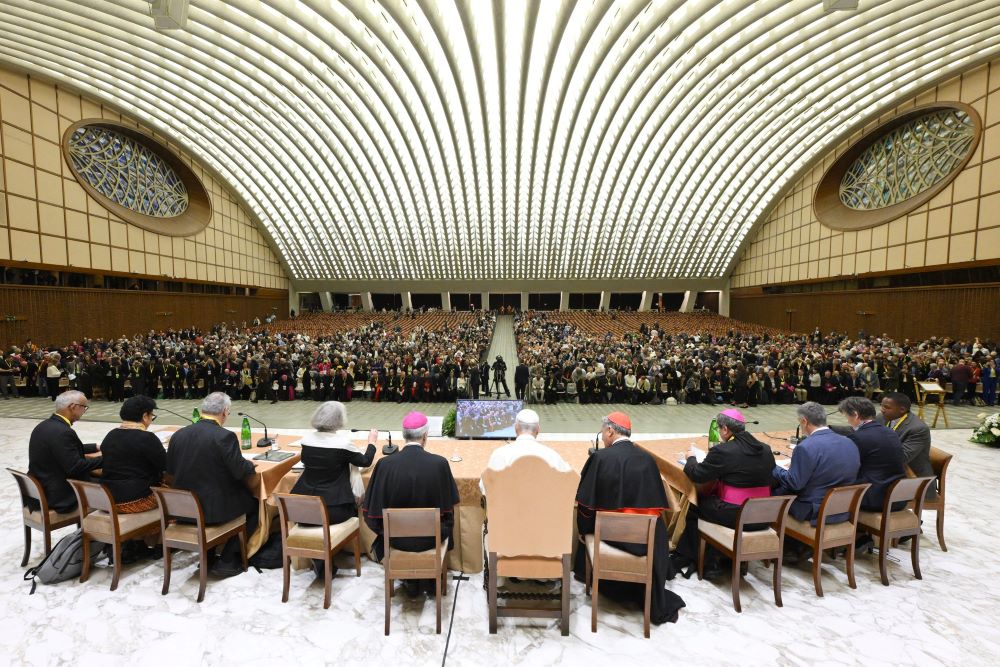
Pope Leo XIV, with regional representatives of synod teams, listens to and answers questions from participants in the Jubilee of Synodal Teams and Participatory Bodies in the Vatican audience hall Oct. 24, 2025. (CNS/Vatican Media)
In February, Cardinal Marc Ouellet, former prefect of the Dicastery for Bishops, publicly defended the principle that laypeople can exercise governance in the Curia, arguing that such authority flows from the pope's delegation rather than ordination itself. Ouellet's unprompted argument suggested that such a view still encounters resistance around the Vatican.
The study group said the same dynamic applies on the diocesan level and called for bishops to appoint more women to positions of leadership and responsibility.
"Alongside the sacramental path and distinct from it, there is also a charismatic path that can be fruitfully pursued to open new spaces of participation for the lay faithful, particularly for women," the report said.
"The discernment of such charisms is the responsibility of the Bishop," it said, noting that "the lay faithful do not participate in Holy Orders but rather in the exercise of the Bishop's ministry."
The report also called for expanding women's access to existing instituted ministries, such as the ministry of catechist or lector, and for the creation of new roles that could recognize women's contributions to church life.
The document also warned against reducing women's participation to formal structures alone.
"Remaining solely within the framework of formally instituted ministries — when it comes to women's participation in the leadership of the Church — confines and impoverishes us," it said. "An obsession with ensuring that everything becomes structure, rule, rite, or norm is not faithful to the free dynamism of the Spirit."
"There exists within the contemporary ecclesial mentality a certain pattern of thought and behavior identifiable as 'clericalism' or 'machismo' … [that creates] distrust and, not least, distance among women."
In the appendices examining theological debates about authority in the church, the report offered a critical look at the so-called Marian and Petrine principles of the church popularized by the late Swiss theologian Hans Urs von Balthasar.
That framework associates the Marian dimension of the church with a receptive and spiritual identity, as modeled by Mary, whereas the Petrine dimension is linked with exercising authority, as modeled by Peter.
While the report notes that recent popes have employed the framework in their teaching, it also acknowledges criticism that the Marian principle may rely on gender stereotypes that are "too reductive in relation to the concrete experiences of women and men." Other critics, the document noted, point to Mary's authority in the Christian community as evidence of women's leadership in the early church.
In a statement reacting to the report, the Women's Ordination Conference, a nonprofit advocacy group working to ordain women, said "women's access to Holy Orders is a natural response to their equal dignity and to the open invitation of the Holy Spirit to fully live out their vocations."
"The hierarchy must take some of the courage it recognizes in the women it lifts up as examples in this report and boldly chart a single path where all people, regardless of gender, can discern and live out all of the vocations the church offers," it said.
The National Catholic Reporter's Rome Bureau is made possible in part by the generosity of Joan and Bob McGrath.
Advertisement