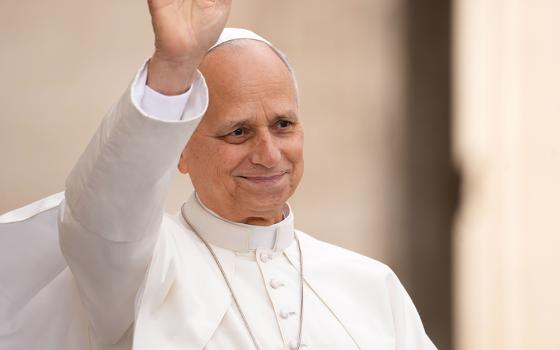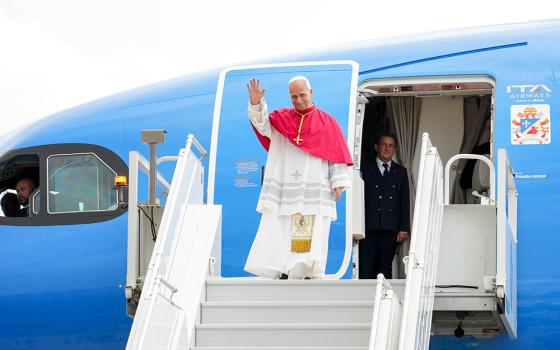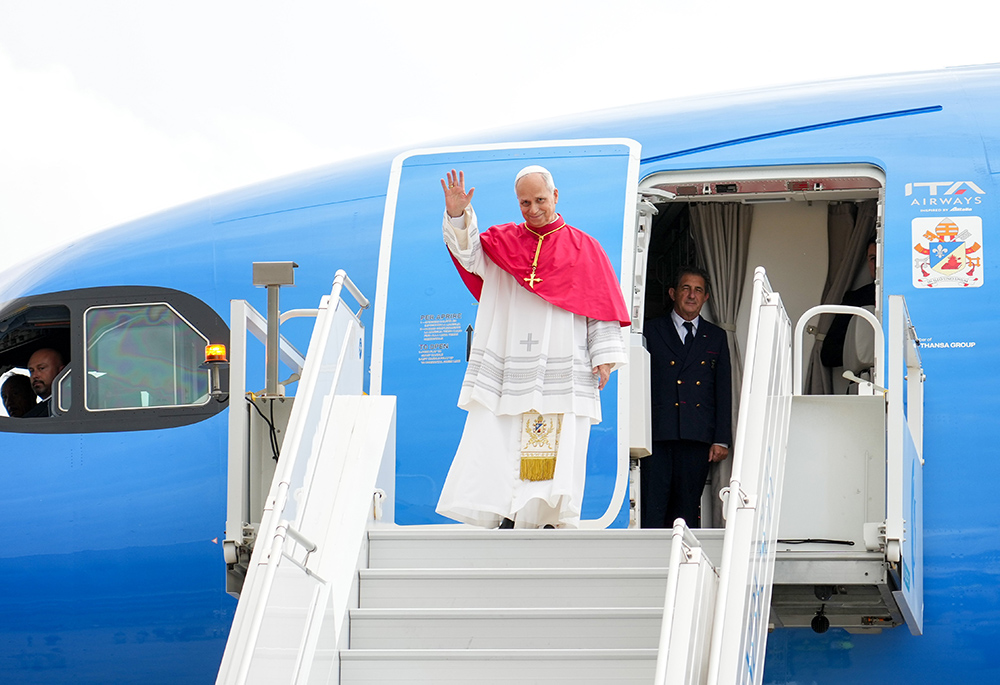
Pope Leo XIV greets people as he descends the stairs of the papal plane upon arriving at Montevideo-Carrasco International Airport in Uruguay Nov. 6, 2026, at the start of his apostolic journey to Uruguay, Argentina and Peru. (CNS/Lola Gomez)
Join the Conversation
Send your thoughts to Letters to the Editor. Learn more
Even with a portion of his lung removed less than four weeks ago, Pope Leo XIV began his 12-day, three-nation tour of South America by stating that he never thought the longest trip of his pontificate was truly in jeopardy.
"I know some people were doubtful about this trip taking place," the pope told journalists on Friday aboard the 14-and-½-hour-flight from Rome to Montevideo, Uruguay — the first leg of his South America trip which also includes visits to Pope Francis' native Argentina and Peru, where Leo spent more than two decades of his priestly ministry. "I confess that from the first day, I had no doubt and was convinced that this trip had to go forward."
Though the pope spent four days in the hospital after a malignant tumor was removed from his right lung on Oct. 13, the Vatican confirmed two weeks later that the trip would go ahead as planned, including a stop to high-altitude Cusco, Peru.
Leo had appeared in full vigor in the days leading up to his departure on Nov. 6, even singing fervently during an All Souls' Day Mass he celebrated in a Rome cemetery four days prior. Regardless, his surgery had transformed his South America trip into a public test of stamina for the otherwise sporty 71-year-old pontiff.
Asked about his operation and recovery on the flight to Uruguay, Leo told reporters that his illness had cultivated "a sense of commitment of wanting to continue to be close to those who are sick" and to affirm his belief that "healthcare should be a right of all people."
The pope said that the secret to his recovery was "faith in God, good doctors and a healthy lifestyle," in response to journalists' questions. When asked if he feels as good as he looks, the head of the Catholic Church replied, "Maybe better."
Leo says accessible healthcare is a duty for every society
Leo was quick to reference his own health after arriving in the Uruguayan capital for the country's first papal visit since St. John Paul II traveled there in 1988.
"Recently I experienced firsthand the limitations imposed by illness and I received care for which I am deeply grateful," the pope said during a welcome ceremony in Montevideo's central plaza alongside Uruguayan President Yamandú Orsi. "That experience makes me think of the many men and women who lack the means to obtain a timely diagnosis or receive the treatments they need. Ensuring that healthcare is accessible to everyone, regardless of their resources, is a duty that confronts every society."
Uruguay's mixed public-private healthcare system is widely regarded as one of the more robust and universal health systems in Latin America. Healthcare was a central topic in the U.S. midterm elections which the Vatican confirmed that Leo had voted in from Rome.
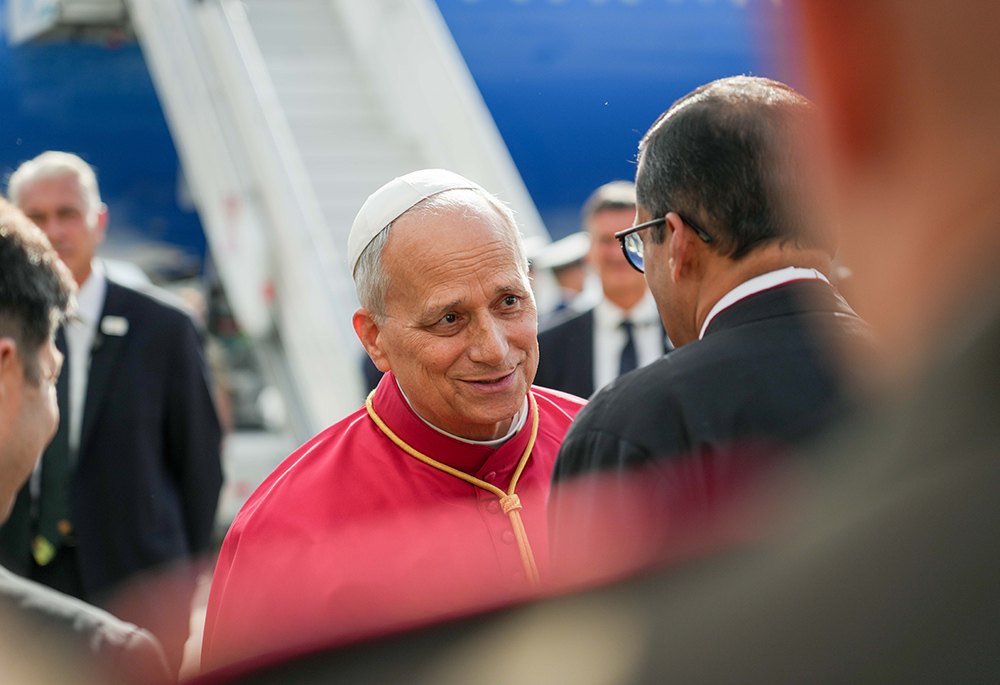
Pope Leo XIV greets members of the Uruguayan delegation during an official welcome at Montevideo-Carrasco International Airport Nov. 6, 2026. (CNS/Lola Gomez)
Asked on the flight about the significance of his decision to vote, Leo told journalists: "I am proud to be American and to exercise the right."
Some 30,000 filled Montevideo's Plaza Independencia and lined the streets leading up to the capital's central square to see the pope pass by in the popemobile, according to Uruguayan authorities. Some groups of children played rugby and volleyball on the beaches alongside the coastal streets where the pope was due to pass.
In his first address in South America, delivered in one of the continent's most secularized countries where only about 35% of the country's 3.5 million people identity as Catholic (compared to around 60% in several other Latin American countries), Leo also underscored the need to protect the unborn and said the secular nature of the state "does not require that the religious dimension be confined to the private sphere."
Advertisement
Though Leo's public Masses in Argentina and Peru are expected to attract over a million people, his debut in Latin America operated on a smaller scale in small, secular Uruguay. But just as when Leo visited secular France and surprised organizers and church officials alike with the massive turnout at his events, the church in Uruguay is hoping his message cuts through to an audience that may have been formerly resistant to religion.
"The pope is respected and beloved and his influence extends beyond the boundaries of the church," Cardinal Daniel Sturla of Montevideo told the magazine Ecclesia ahead of the pope's visit. "Furthermore, I believe that, in a world where there is a severe lack of leaders, the pope is a global figure whose voice is heeded."
The cardinal, who participated in the conclave that elected Leo in May 2025, said he had been planting the seeds for that visit since the day of the election when he asked the new pope to come to Uruguay.
"When you're a small country, you know that when you have the chance to speak up, you have to do it right away," the cardinal said.
The National Catholic Reporter's Rome Bureau is made possible in part by the generosity of Joan and Bob McGrath.