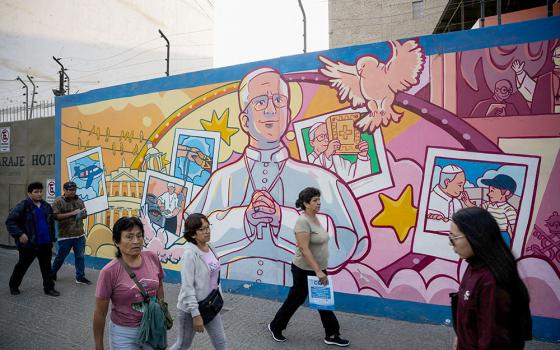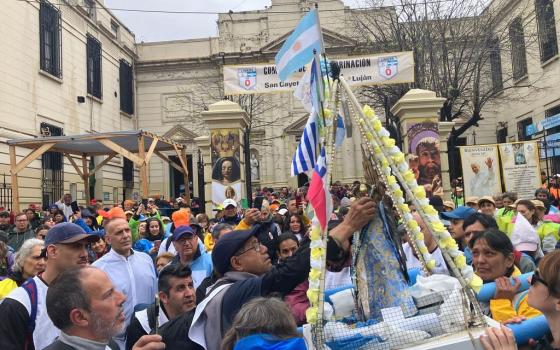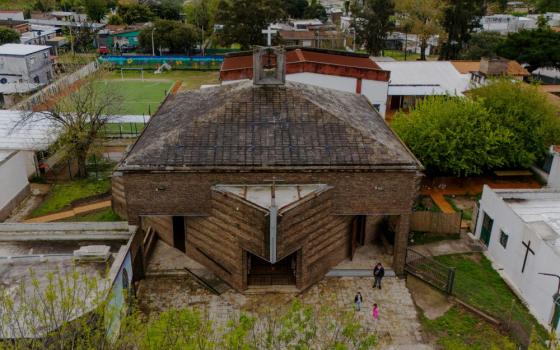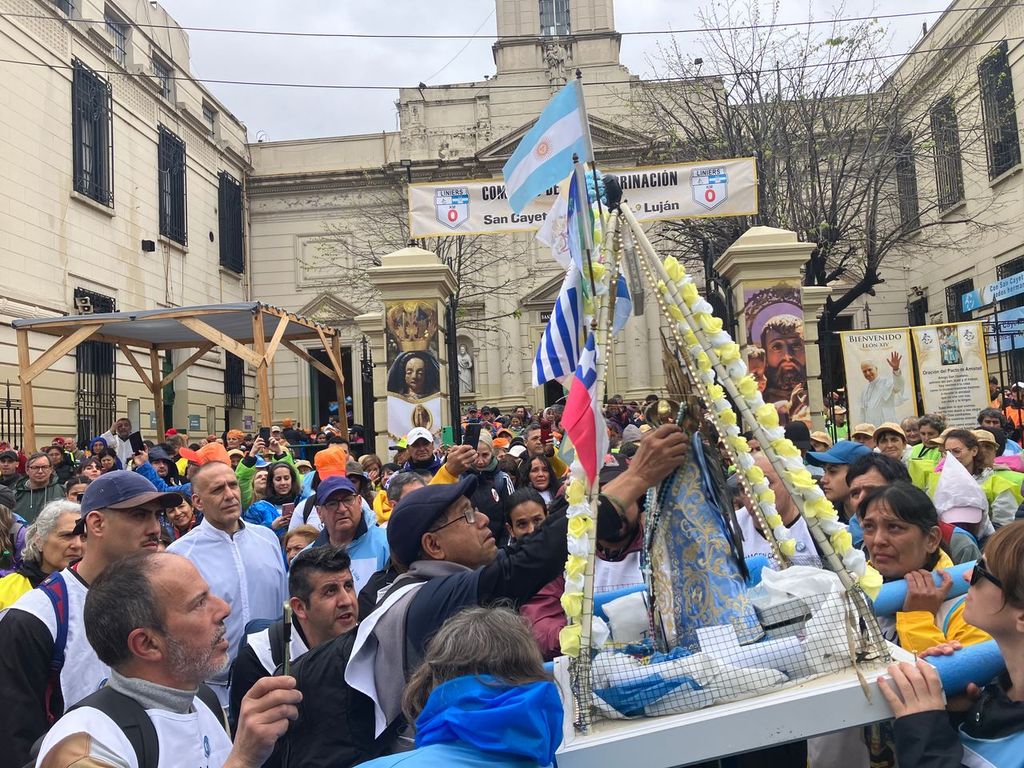
Pilgrims depart in the pouring rain Oct. 3, 2026, from the St. Cajetan shrine in Buenos Aires on the annual pilgrimage to Luján, home of the national patroness and where Pope Leo XIV will visit Nov. 11. (David Agren)

by David Agren
Join the Conversation
Send your thoughts to Letters to the Editor. Learn more
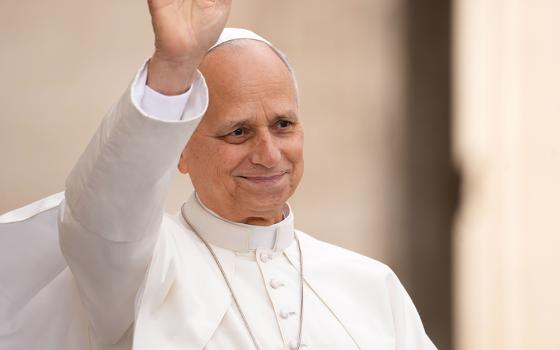
Pope Leo XIV arrives in Argentina, the homeland of Pope Francis, Nov. 8, the middle stop of an 11-day trip to South America that starts today (Nov. 6) in Uruguay and ends Nov. 17 in Peru. The trip marks a homecoming of sorts for the U.S.-born pope, who served twice as an Augustinian missionary in Peru and was later appointed bishop of Chiclayo.
Francis never made a homecoming to Argentina after his 2013 election, though he twice flew over the national territory on trips to Paraguay and Chile. He also never explained his reasons for not returning, though priests and pundits attribute his absence to a preference for avoiding the country's deep social divisions and messy politics.
"He was a pope who, unfortunately and unintentionally, got caught up in our notorious social and political divide," said Sergio Berensztein, an Argentine pollster and political analyst. "He likely paid a political price for that. The fact that Francis decided not to visit Argentina has, in turn, contributed to people losing some of the initial fervor they once felt for him."
Opinions about Francis seemingly depend on social status, political orientation and geography — with many Argentines seeing the pontiff as much a political actor as a pastor and failing to appreciate the gravity of Archbishop Jorge Mario Bergoglio being elected the first Latin American pope.
"He is remembered with great affection. In general, ordinary people, those who truly hold values, appreciate him," said Fr. José María di Paola, a prominent cura villero, the description given to priests backed by Francis, who work in the country's shantytowns. "This is true all over the world. People who seek war are selfish; naturally, they are unable to appreciate his message."
Signs of the enduring affection for Francis and his legacy were on display at the Oct. 27-28 meeting of popular movements that took place in suburban Buenos Aires. Participants hailed from groups that included parish soup kitchen staff, cartoneros (who pick recyclables from municipal trash bins) and a ministry working on drug addiction in the country's shantytowns.
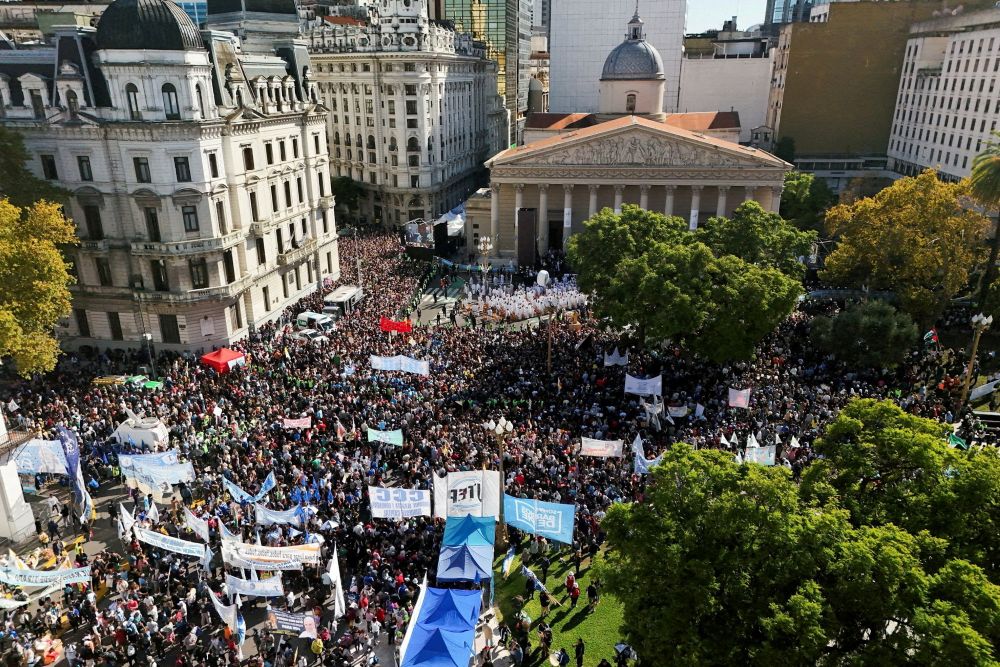
A drone view shows people gathered outside the Buenos Aires Metropolitan Cathedral in Argentina April 26, 2025, for a memorial Mass for Pope Francis, formerly Argentine Cardinal Jorge Mario Bergoglio, who died April 21 at age 88. (OSV News/Reuters/Stringer)
The participants ambled along bumpy roads through a shantytown in Ciudad Evita, a suburb named for the former Argentine first lady, Evita Perón, wife of former President Juan Domingo Perón, whose Peronist movement spoke of social justice and labor rights.
The event ended with a pilgrimage to the aptly named "Ciudad Papa Francisco," (Pope Francis City), a community center founded by the curas villeros.
Many recalled the inspiration and support provided by the Argentine-born pope, who prioritized the poor and peripheries as archbishop of Buenos Aires and later as leader of the universal church.
"In working-class neighborhoods, (soccer star Diego) Maradona acts as a unifying symbol; similarly, Francis fosters unity. However, among the more affluent, this image of Francis does not carry the same weight," said Ariel Malvestiti, a staff member of Familia Grande Hogar de Cristo, a ministry that supports addiction recovery.
"Perhaps he didn't change their lives as significantly as he did for the poor because he spoke to the poor in their own language, and he spoke directly to them," Malvestiti added.
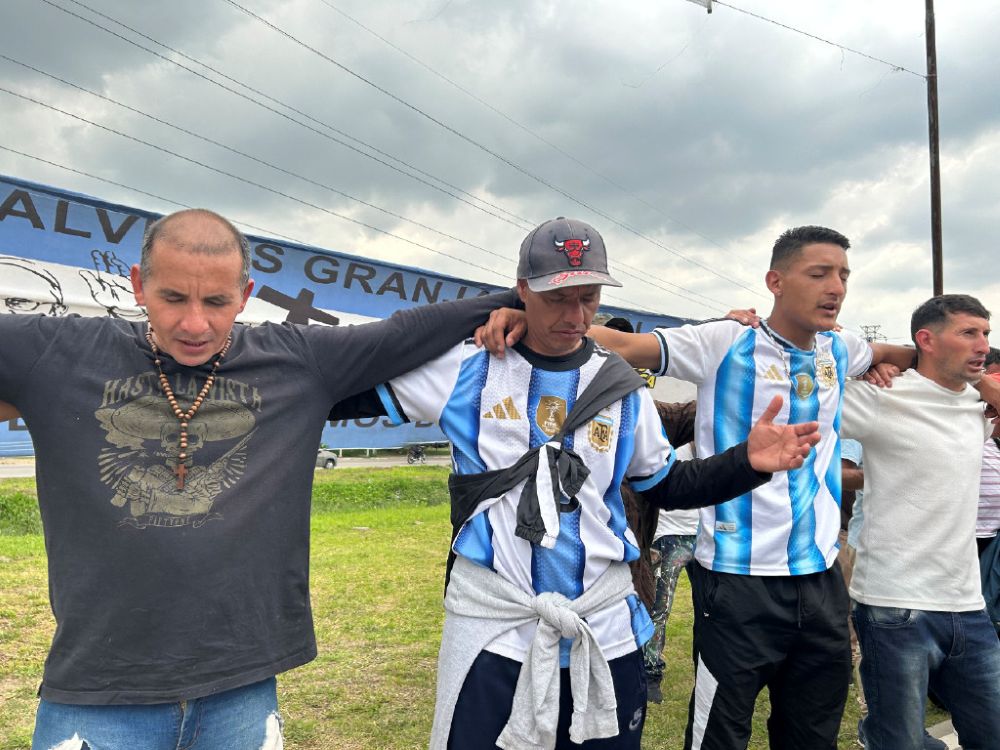
People pray at a Mass celebrated Oct. 28, 2026, to conclude the Regional Meeting of Popular Movements in suburban Buenos Aires. Pope Francis championed the gathering of grassroots organizations, which work in downtrodden parts of Argentina. (David Agren)
It's another story in more affluent parts of Buenos Aires, where images of Francis are rarely spotted — unlike the murals of Maradona and Lionel Messi, who led Argentina to World Cup success. Francis' message of social justice and support for the curas villeros — who are perceived as being aligned with Argentina's national-populist movement known as Peronism (something they deny) — caused many to see the late pope as much a politician as a pastor, according to observers.
"Almost all of his gestures and actions … were instead interpreted through the lens of local politics and social dynamics. It was as if (he) was still the archbishop of Buenos Aires, rather than Pope Francis," Fernando Domínguez Sardou, professor at the UNIE University in Spain, said in a 2025 interview. "His gestures and deeds were, above all, rooted in the spirit of 'turning the other cheek' and engaging in direct acts of charity, rather than being driven by the logic of local politics."
He added, "The pope was unable to bridge the 'grieta' — the political divide and social polarization in Argentina — "nor was he able to transcend it."
Advertisement
"La grieta" or the crack, splits Argentina politically into Peronist and non-Peronist camps.
Its existence was immediately visible after Francis' election, when the ruling Peronists and then-President Cristina Fernández de Kirchner — who the then-Archbishop Bergoglio of Buenos Aires criticized for alleged corruption and mismanagement of poverty issues — failed to immediately congratulate the new pope. Peronists, however, quickly blanketed the city with posters of Bergoglio reading, "Argentine and Peronist." Francis and Fernández de Kirchner became friendly — a gesture angering non-Peronists, who later seethed when the pope appeared glum in a 2016 photo with non-Peronist President Mauricio Macri.
Argentina's president Javier Milei, who won in 2023 despite badmouthing Francis, has enthusiastically embraced Leo's upcoming visit. The president is expected to greet the pontiff on the tarmac as the papal plane arrives in the afternoon Nov. 8. The federal government has declared a statutory holiday nationally for the pope's arrival and locally in the cities and provinces he visits.
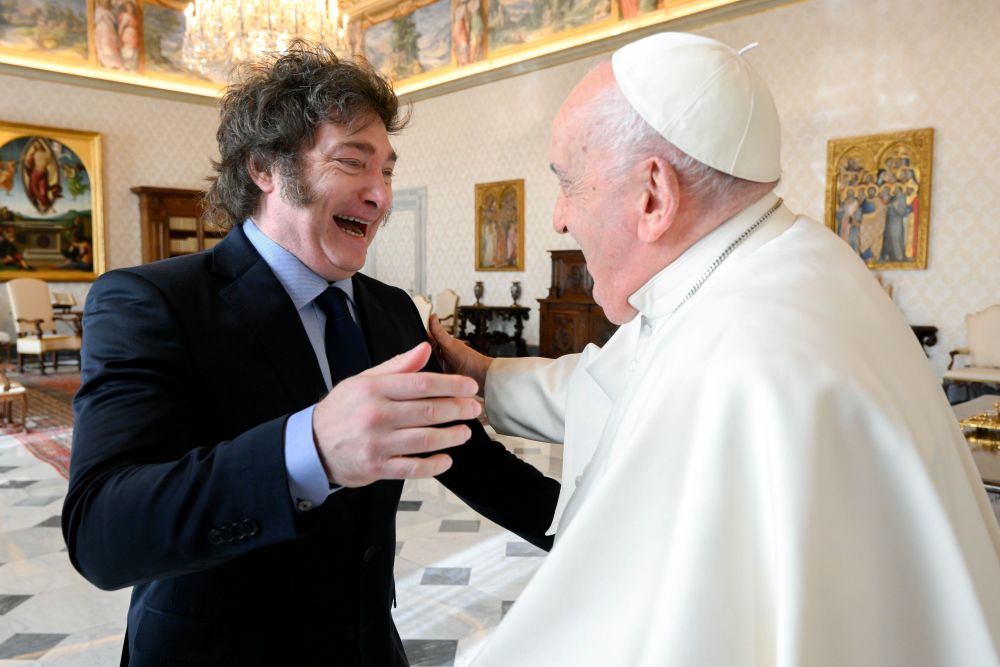
Pope Francis and Argentine President Javier Milei share a laugh during a private audience at the Vatican Feb. 12, 2024. (CNS/Vatican Media)
But signs of the "grieta" have surfaced — with local media obsessing over which politicians were invited or omitted from Leo's visit to the Casa Rosada, the president's office. The Peronist government of Buenos Aires Province, a Peronist stronghold containing the capital's working-class suburbs and many shantytowns, is also mobilizing people for the pope's visit to Luján, home to the shrine to the national patroness, Our Lady of Luján.
"They are convinced … the pope will deliver a message centered on social justice, not just in Luján, but throughout his various visits," said Mariano De Vedia, who writes on the intersection of politics and religion for the Argentine daily, La Nación. "They're looking to contribute by helping to ensure a massive turnout, thereby providing greater support and wider exposure for the pope's appearance."
Priests point to signs of a strong social interest in Leo's visit to Argentina. An annual pilgrimage last month from Buenos Aires to Luján drew an estimated 2.7 million participants.
"People possess a faith and a spirituality that extend beyond the institutional sphere," said Fr. Roberto Ferrari, who is part of the group Priests for the Option for the Poor. "During times of crisis, people turn to the church or take part in pilgrimages," he added.
But the politics surrounding the visit remain messy, along with attempts to appropriate the pope's legacy. Archbishop Jorge García Cuerva of Buenos Aires has called for unity ahead of the papal visit.
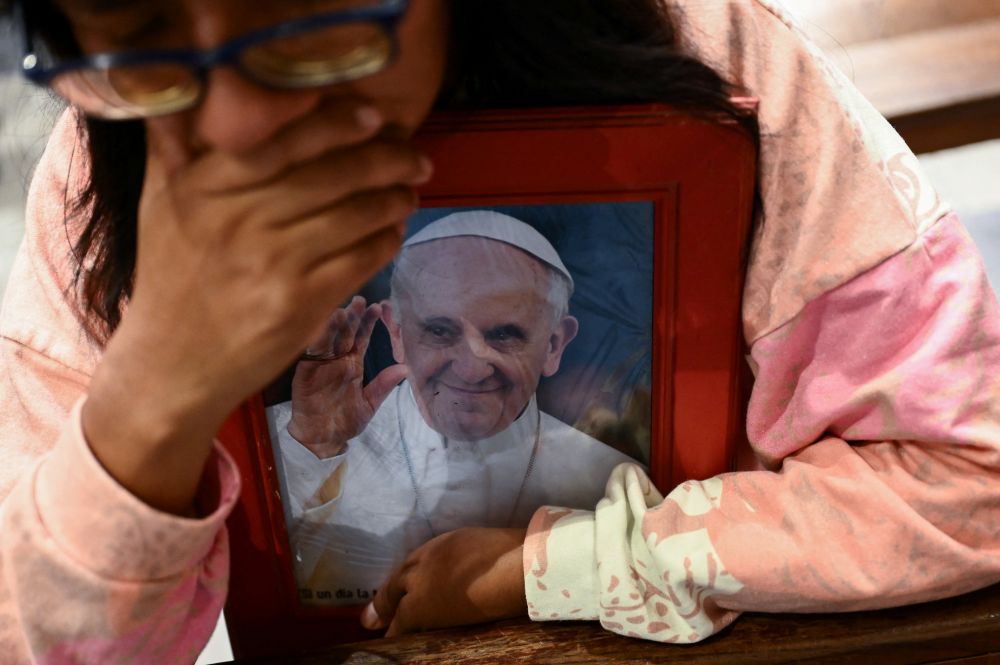
A woman clutches a portrait of Pope Francis during a Mass at the Basilica of Lujan in Argentina April 21, 2026, in honor of the pontiff on the first anniversary of his death. (OSV News/Reuters/Pedro Lazaro Fernandez)
But events such as a service in April remembering the one-year anniversary of Francis' death showed the depth of the grieta and drew a rebuke from the archbishop, who said of the politicians in attendance: "We're not even able to sit in the same church pew."
Priests say they will be focusing on Leo's message, while appreciating the symbolism of the trip.
"We feel as if it's a continuation of what Pope Francis started," di Paola said.
"Within the church, the prevailing sentiment is: 'He's coming to accomplish what Francis could not,' " Ferreri added. "I hope that he surprises me with something he says … just as Francis would surprise people with phrases, with expressions, with invitations."