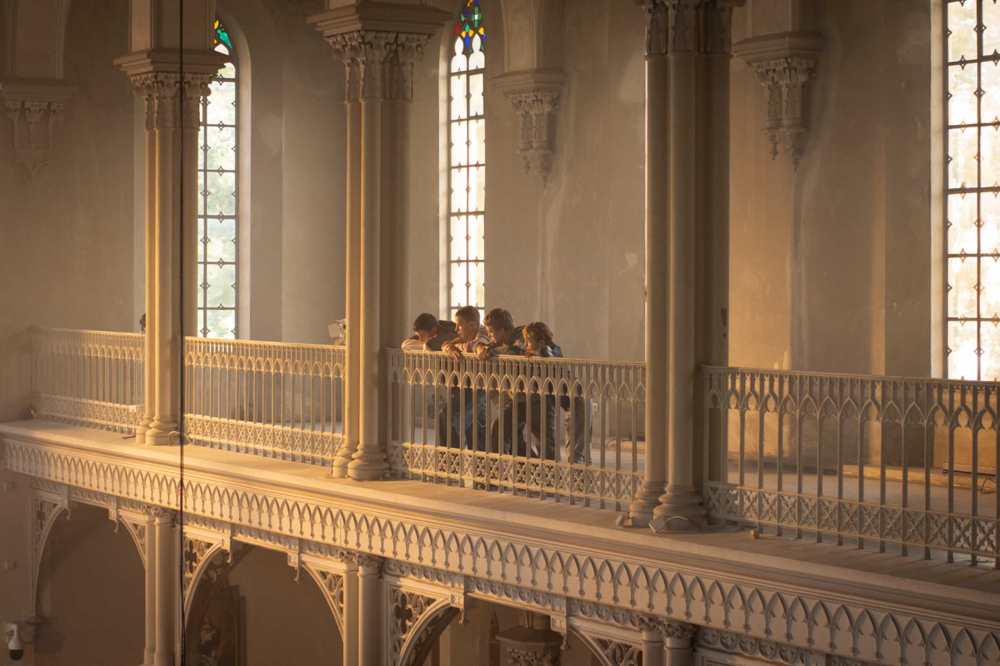
Frustrated by a church that rewards appearances over goodness, four Polish altar boys take justice into their own vigilante hands in "The Altar Boys." (Aurum Film)

Join the Conversation
Send your thoughts to Letters to the Editor. Learn more
As a child, I would sit on the floor of my great-grandmother Mariana's pulpería, a small neighborhood grocery store, the kind found on nearly every corner in Honduras, and say Mass. My congregation was made up of bars of green soap, which I would line up in rows. I couldn't tell you now what my homilies were about, but I would do this for hours. I never became an altar boy; I never knew the option existed for me.
Watching Piotr Domalewski's tender and quietly devastating "The Altar Boys," I kept thinking about that boy and his bars of soap, and about a question this film asks: What formalities determine belonging in a church — and who gets to decide what they are?
The film opens on an archdiocese competition, teams of altar boys racing through tasks that turn devotion into a scored event: finding the correct scripture for a given date, lighting candles in the right order, swinging the thurible correctly. Filip Grabowski (Tobiasz Wajda, in a performance of quiet ache) and his friends win on the merits. Then the jury hands extra points to another group, the ones who stand straighter, speak softer, look more like what a parish wants an altar boy to be. Filip's team is loud and unpolished and entirely sincere — and that is precisely the problem.
Frustrated by a church that rewards appearances over goodness, and by a scripture their catechism too loosely applies to their own lives, the boys wire a confessional booth to learn who around them actually needs help.
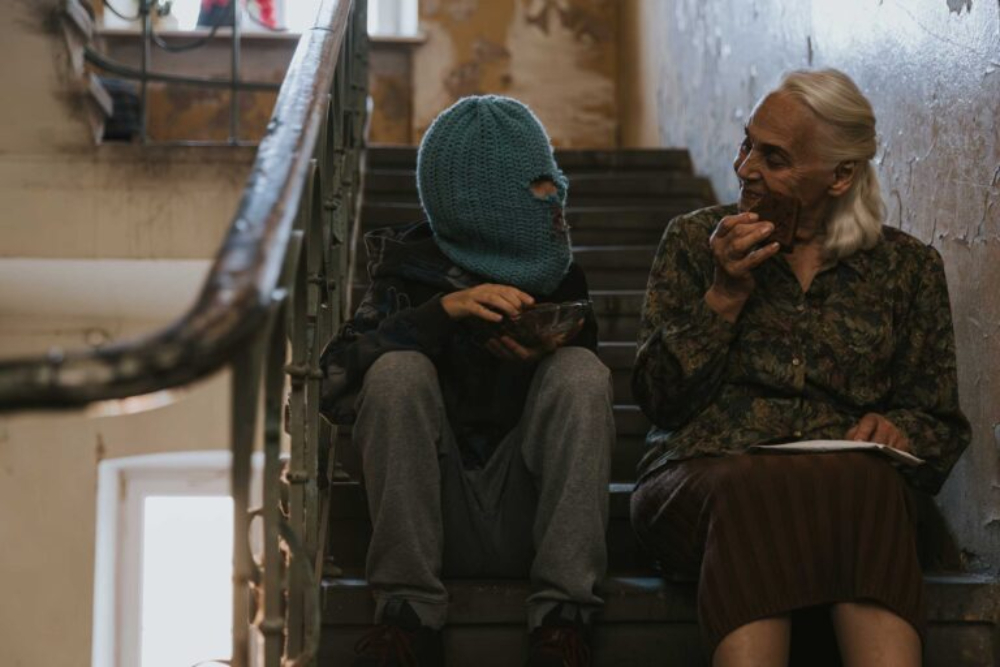
When one startled recipient asks who these masked kids are, the answer is simple but chilling in its confidence: "God rewards the good." (Aurum Film)
Masked, they start redistributing money that the parish priest (Sławomir Orzechowski) has been stealing from, delivering cash in envelopes to the desperate. The masks look less like Zorro or Robin Hood, and more like Pussy Riot's balaclavas, a strange and pointed image of childhood mischief borrowing the visual language of protest.
When one startled recipient asks who these masked kids even are, the answer is simple but chilling in its confidence: "God rewards the good." It is a child's theology, absolute and unbothered by consequence, filled with beauty and danger at once.
Domalewski, with cinematographer Piotr Sobociński Jr., shoots this world like a religious painting with a door left slightly ajar. Light falls through windows into places it has no business reaching. Filip's home is kept in near darkness, his mother Joanna (Kamila Urzędowska) worn down by depression and drink. Filip's face is often the only lit thing in the frame, a boy carrying his own light into a house that has none to spare him. We only see Joanna step into real light when she leaves that house, which says something quiet and lovely about where grace actually lives in this story. Contrast that with the home of his friend Gucci (Bruno Błach-Baar), a place blazing with windows, and his mother (Dominika Bednarczyk) scrolling listings for homes abroad because she wants out of Poland.
Ephesians 5:9 tells us the fruit of the light is in goodness. The boys, and eventually the film itself, treat that goodness as something endlessly negotiable.
One of the kids explains to the others that drinking kombucha is not a sin because it is only 0.5% alcohol. The boys' pretend confessions in the booth always find a loophole before absolution is even needed. Later, one references David's charge to Solomon, "be strong and do it, God is with you" (1 Chronicles 28:20), as license for a plan that has clearly passed any reasonable definition of good. Scripture has always been bent for whatever a person needs to justify, and nobody bends it further than four children convinced they are doing the Lord's work.
Advertisement
But when the confessional reveals that Dominika (Daria Kalinchuk), a girl the boys treat with reverence, is being hurt by someone close to her, that conviction curdles. Their vigilante instinct cannot save her, and the film is unflinching about how badly it fails.
But there is, elsewhere, also real joy. Filip watches a swimming instructor appear to walk on water and tries it himself, with the unguarded faith of a boy raised on a diet of war footage and climate dread, hungry for a messiah because every adult around him seems too exhausted to be one. He sinks, obviously, and is pulled out, and Gucci's response — "please don't try to walk on air next" — might be the funniest line in the film.
The consequences of the boys' scheme eventually catch up with them. When the parish priest casts out Filip, he does so invoking a betrayal worse than what 17th century invaders did to Poland, a grown man measuring a child against history's cruelest chapters. What Filip finds waiting for him afterward says everything about this film's heart; what survives is what these boys built between themselves; and Domalewski ends it with more tenderness than judgment.