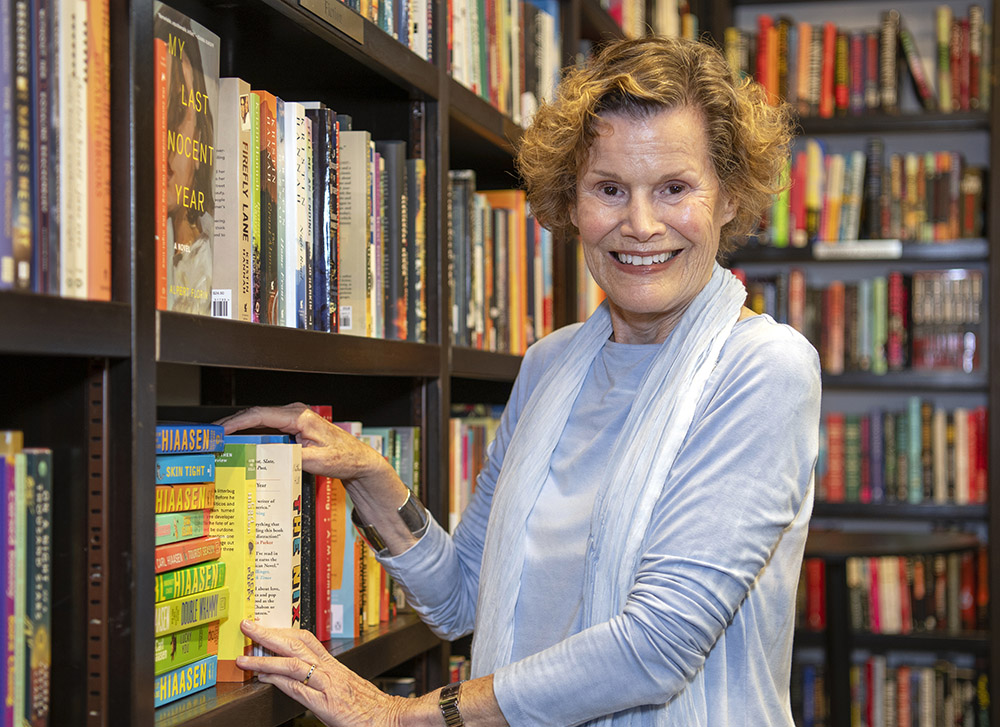
Writer Judy Blume poses for a portrait in 2023 at Books and Books, her nonprofit bookstore in Key West, Fla. (AP/Mary Martin)

by Tom Deignan
Join the Conversation
Send your thoughts to Letters to the Editor. Learn more
Long before the main character in her most famous book asked "Are you there God?", Judy Blume was on her own journey of faith.
As a young child in the 1940s, Blume was forced to reckon with her beloved father's health problems. "I worried terribly that he'd die young. I had to pray so hard with my little prayers ... to protect him," the celebrated author said in the 2023 documentary "Judy Blume Forever." In the book Letters to Judy, Blume said that during this time in her childhood, "I became ritualistic" and "made bargains with God."
Around the same time, Blume's family, who are Jewish, were also reckoning with the realities of the Second World War. "I knew that Adolf Hitler ... wanted to kill all the Jews in the world," Blume has written. "And I was a Jew."
This is not the kind of material that made Judy Blume one of the 20th century's most beloved authors.
In grade school classics like Superfudge and Freckle Juice, Blume mixed raucous comedy with a dash of absurdity and a pinch of realism. And in novels for young adults such as Forever or Tiger Eyes, Blume confronted puberty, love and sex with a bold frankness that both reflected and shaped the changing times.
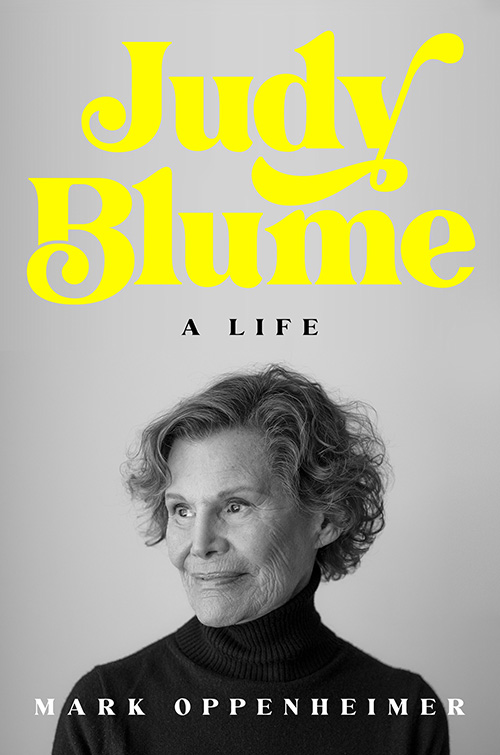
Through the course of her career, the now 88-year-old Blume has sold tens of millions of books and "rewired the English speaking world's expectations for literature for young people," according to a new biography written by religious journalist and author Mark Oppenheimer.
In Judy Blume: A Life, Oppenheimer, a former New York Times "Beliefs" columnist who teaches at Washington University's Danforth Center on Religion and Politics, offers readers an opportunity to examine the role that faith has played in Blume's illustrious and enduring career.
Oppenheimer's 400-plus-page biography chronicles Blume's evolution from suburban housewife and "children's author" to generational spokeswoman for feminism and against censorship. Judy Blume: A Life takes readers right up to the author's most recent successes: The 2015 bestseller In the Unlikely Event and the 2023 movie adaptation of Are You There God? It's Me, Margaret, starring Kathy Bates and Rachel McAdams (currently streaming on Netflix).
"I'm going to temple today — with Grandma. ... I'll look for you God," Blume's most famous narrator says during one of her many bedtime prayer sessions. "My father thinks it's a mistake and my mother thinks the whole idea is crazy, but I'm going anyway."
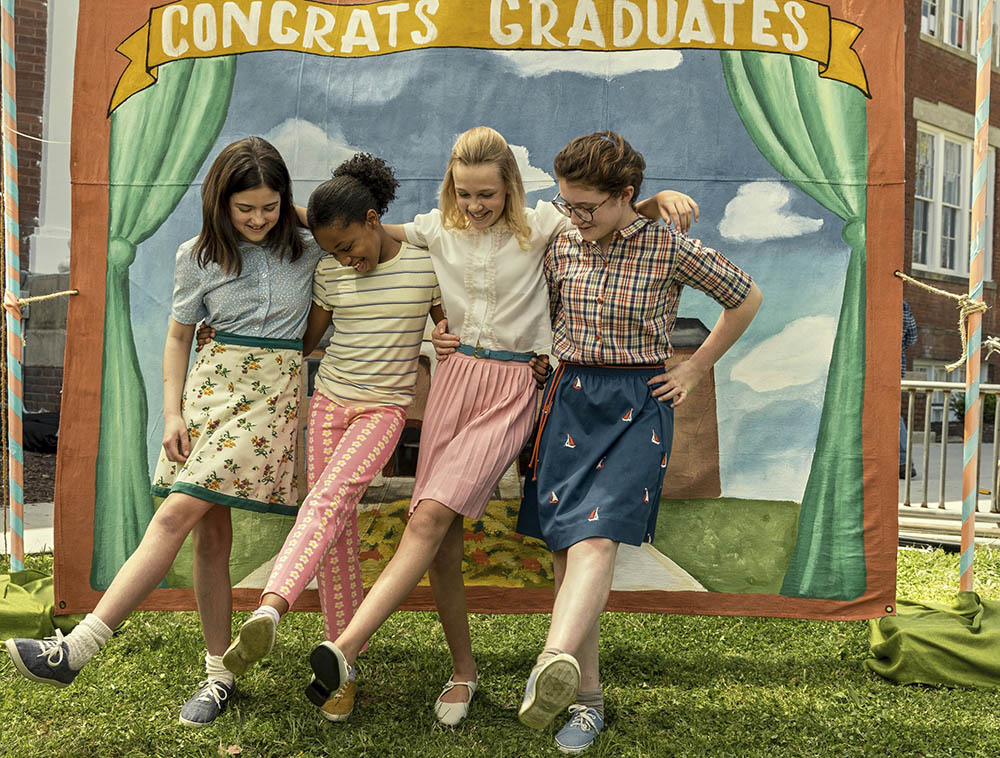
Abby Ryder Fortson as Margaret Simon, Amari Price as Janie Loomis, Elle Graham as Nancy Wheeler, and Katherine Kupferer as Gretchen Potter in "Are You There God? It’s Me, Margaret," a 2023 movie adaptation of Judy Blume's novel. (OSV News/Lionsgate/Dana Hawley)
Margaret's mother and father — raised Christian and Jewish, respectively — personified a certain 1960s skepticism toward organized religion that left it up to Margaret to claim her own faith, if any. She turns the whole process into an existential school research project.
Are You There God? is, of course, "better known for its treatment of sexuality and body development," but Oppenheimer notes the underrated importance of Blume's having "a healthy well-adjusted child of an interfaith couple, struggling with her in-between status but not deformed by it."
As bestselling author Mary H.K. Choi put it in "Judy Blume Forever": "It's so huge, actually. ... Of course [Margaret] can navigate huge questions about the existence of God, while also wanting her period. And doing daily bust exercises. And also feeling some type of way about her friends. Of course!"
Blume went on to explore similar conflicts and tensions from the point of view of an Italian Catholic boy named Tony Miglione in her 1971 novel Then Again, Maybe I Won't. Like Margaret, Tony's body and life are changing. After an older brother is killed in Vietnam, Tony joins a Catholic youth group run by Father Pissaro, a cousin of the Miglione's family priest. Tony's new friends — and, really, religion itself — are enlightening one minute, frustrating the next.
The similarities between the two adolescent narrators, Oppenheimer writes, is that they are both trying to figure out some relationship to religion [and] ... God that had strayed from their ancestors' traditional observance."
Years before intellectuals like Christopher Lasch or Robert Bellah noted the drift from houses of worship to psychiatrists' offices, Blume dramatized the social and emotional pressures behind these cultural shifts. And like any number of canonical (male) literary giants — from Philip Roth to Mario Puzo — Blume explored conflicts and anxieties particular to the children and grandchildren of Ellis Island.
Judy Marcia Blume (née Sussman) was well positioned to do this as the grandchild of immigrants who came to the U.S. from Russia and Lithuania in the late 1890s. Her parents met at Elizabeth, New Jersey's Batten High School. Her doting father became a successful dentist, while Judy's mother looked after the home and two children.
Advertisement
Young Judy Sussman loved taking regular trips to the Elizabeth public library, where she was so smitten by Ludwig Bemelmans' Madeline books she refused to return them. Judy also became a fan of L. Frank Baum's fantastical Oz books, an ironic choice for a writer famous for realistic characters and language. She thought about becoming a teacher or librarian, but she always knew she'd be a wife and mother.
Blume gave birth to one son and one daughter in the early 1960s, but the affluent suburban life (Blume's husband was a lawyer) did not lead to complete fulfillment. That, for Blume, came through writing, a skill she "would not begin to nurture ... until she was nearly 30 years old," Oppenheimer writes.
Blume's first book, Iggie's House, explored 1960s racism in the integrating suburbs. It was quickly followed by Margaret, then Tony, who, like "their author, [were] trying to figure out if there is meaning beyond the well-manicured lawns."
Oppenheimer's biography offers illuminating insights into Blume's writing process. Editor Dick Jackson, we are told, "clearly helped Judy see the importance of Margaret's religion project," which becomes "something private, between her and God, capped off by her rebellious choice to write the teacher a heartfelt letter." The short note is bittersweet, even angry. Yet one of the book's final lines is: "I know you're there God."
Blume ultimately emerged as a wildly popular artist because, as one librarian put it: "Kids want realism." Some adults, on the other hand, were increasingly concerned by Blume's more explicit writing.
"The rise of conservative Christian politics in the 1970s ... created the framework for the moral panic," Oppenheimer writes of various controversies surrounding Blume's books. He adds: "When one looks at the challenges to Blume's books, a complicated picture emerges; it was not purely the concern of evangelical Christians. ... The challenges were coming from across the political spectrum."
Despite the critics and controversies, Blume continued to challenge herself in the 1980s and 1990s by writing for older audiences (Smart Women in 1983, Summer Sisters in 1998) as well as her loyal fan base (two more Fudge books).
Oppenheimer also explores Blume's long, frustrating history with TV and movie executives, who never quite figured out how to adapt her work for the big or small screen. That finally changed in 2023, with director Kelly Fremon Craig's film adaptation of Are You There God? The film concludes with the song "The Wind" by Yusuf Salem (formerly Cat Stevens), the opening lyrics of which might speak for Judy as much as Margaret:
I listen to the wind
To the wind of my soul
Where I'll end up well I think,
Only God really knows.