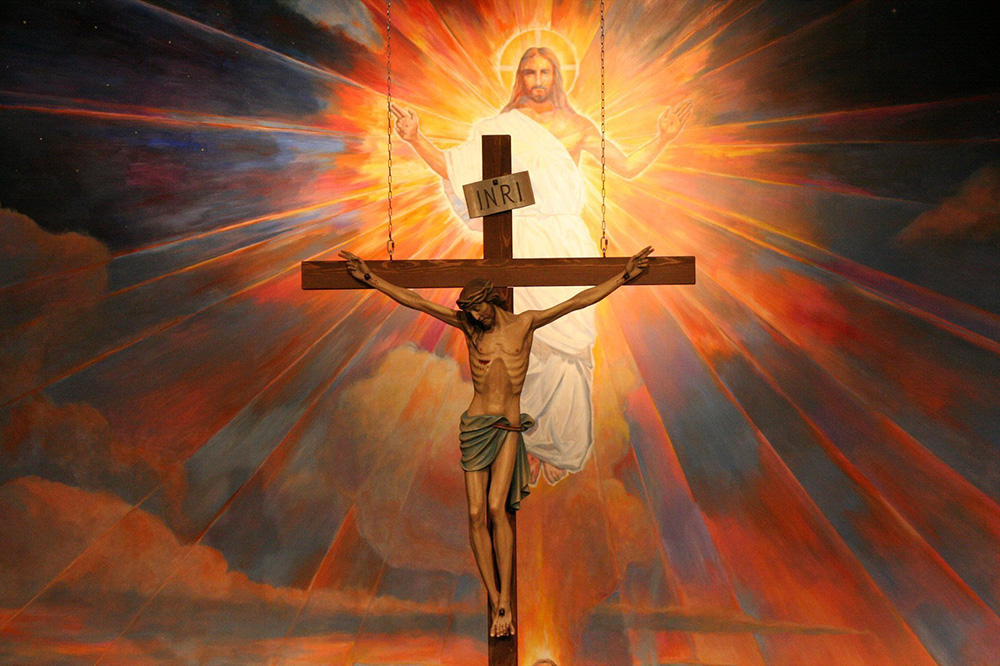
A crucifix hangs before a mural depicting the Resurrection in the sanctuary at St. Timothy Parish in Mesa, Ariz., in this undated file photo. (OSV News/Catholic Sun/J.D. Long-Garcia)

by Daryl Grigsby
Join the Conversation
Send your thoughts to Letters to the Editor. Learn more
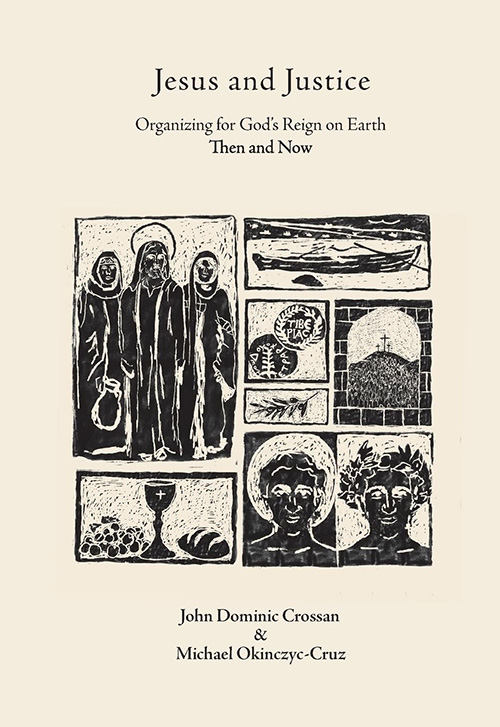
In the recently released book Jesus and Justice: Organizing For God's Reign On Earth Then and Now, co-authors John Dominic Crossan and Michael Okinczyc-Cruz combine lifetimes of study, reflection, organizing and service to provide us a framework for analysis and action. The result is a text that should be required reading for anyone wrestling with the role of Christian faith in our times of cruelty, division and violence.
Crossan, a former Roman Catholic priest in the Servite order, is an expert on historical and archeological records of New Testament times. Among his many published books are God and Empire, The Birth of Christianity, The Historical Jesus, Jesus: A Revolutionary Biography, The Greatest Prayer and The Power of the Parable. Okinczyc-Cruz is a community organizer and executive director of the Coalition for Spiritual and Public Leadership, a multi-racial and multi-generational coalition of parishes, religious orders, universities and grassroots leaders working to transform systems of racial, economic and social injustice.
In this their first publication together, the authors draw from a wide range of leaders: Sitting Bull, Fr. Richard Rohr, Desmond Tutu, Ella Baker, Dolores Huerta and Fr. Gustavo Gutierrez all confirm the relationship of religious faith and justice-making.
The authors masterfully unveil the meaning of Jesus' ministry, execution and resurrection in the cultural and political context of the Roman Empire. That unveiling is not a historical artifact, for understanding Jesus' mission is the source of our own response to the cruelty, racism and violence of the American Empire. Three chapters set the framework and call us to rethink much of what we have been taught about Christianity: "The Vision of Jesus," "The Execution of Jesus" and "The Resurrection of Jesus."
Advertisement
For example, the authors note that in order to ingratiate himself to the Roman Empire, Herod Antipas moved his capital from inland Sepphoris to Tiberias along the shores of the Sea of Galilee, enabling him to enrich the empire (and himself). His exploitation of the fishing industry impoverished the area's fisherman, who prior to Herod's move depended on the Sea of Galilee for survival.
Jesus' move from Nazareth to Capernaum at the edge of the Sea of Galilee, then, countered the ruthless destruction of the fisherman's lives. Meaning, Jesus' call of fishermen to the reign of God was a political act. The book outlines the "genius" of nonviolent resistance and relates how Bayard Rustin, Dorothy Day, Mahatma Gandhi and others have modeled Jesus' courageous teachings of resistance. One section of the book, titled "How to Love Your Enemies," provides tools for standing against the cruelty of dominant powers.
For Jesus — or anyone — to be called the Son of God was an act of political defiance. Augustus Caesar was not just emperor; his military victories and brutal suppression of his enemies gained him the titles Son of God, Savior of the World and Creator of a New World. All of Rome and its colonies were reminded of this through coins, portraits and images. To not recognize that confirmed you as a dangerous threat and enemy of the state.
The chapter on "The Execution of Jesus" gives us insight into crucifixion as a tool of state terror and intimidation: the public display of violence and humiliation was to demonstrate the futility of resistance to the empire. The authors remind us that lynching in the United States carried the same horrific message, as victims were dragged through the streets, beaten, stabbed, castrated, shot and hung. The obvious message being, "this is the fate of those who oppose us."
"To be a resurrected person involves committing oneself spiritually to a profoundly countercultural process of transformation."
—Jesus and Justice: Organizing For God's Reign On Earth Then and Now
Regarding the resurrection, Jesus and Justice argues that while some ancient images of the resurrection portray Jesus rising alone, there is another perspective: ancient icons and images wherein Jesus rises with all of humanity. Thus, Jesus' universal resurrection lifts us all from the grip of injustice, our collective failures and the empire's brutality. As collaborators with the risen Jesus, we are called to live as resurrected people.
The authors note, "To be a resurrected person involves committing oneself spiritually to a profoundly countercultural process of transformation." Jesus rose from a death inflicted by the forces of evil, and God raised Jesus to live in solidarity with those engaged in the struggle for love and justice. The early church understood this life as demonstrated in Acts 2:44-45, where the believers had all things in common and gave to those in need. Such solidarity, mutual support, generosity and selflessness is dramatically counter to the ethics of Rome then — and the United States now.
The authors urge us to join Jesus, not as mere believers, but as active participants in the divine project of human liberation. They paint a picture of Jesus as "the Cosmic Liberator," and his work of nonviolent resistance, love of enemies, prayer and service as continuing on in those who follow him. The authors affirm Jesus was not just another revolutionary, but one who gives us a new way of life to confront the forces of death as we journey toward the fullness of life God intends for all humanity and all creation.
The book concludes with concrete ways for us to be engaged with active faith communities and to cultivate a vibrant life of prayer and contemplation. Given the events of our time, and the times to come, Jesus and Justice is a book that deserves our attention. Read, study and discuss with others — and see where Jesus takes you.