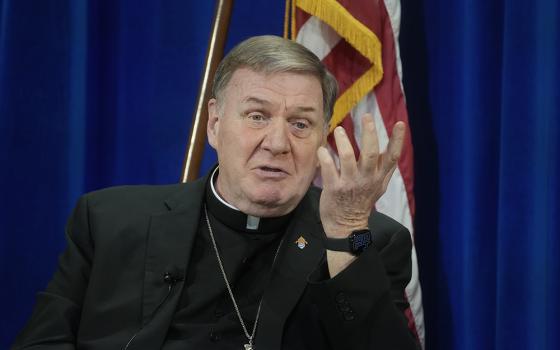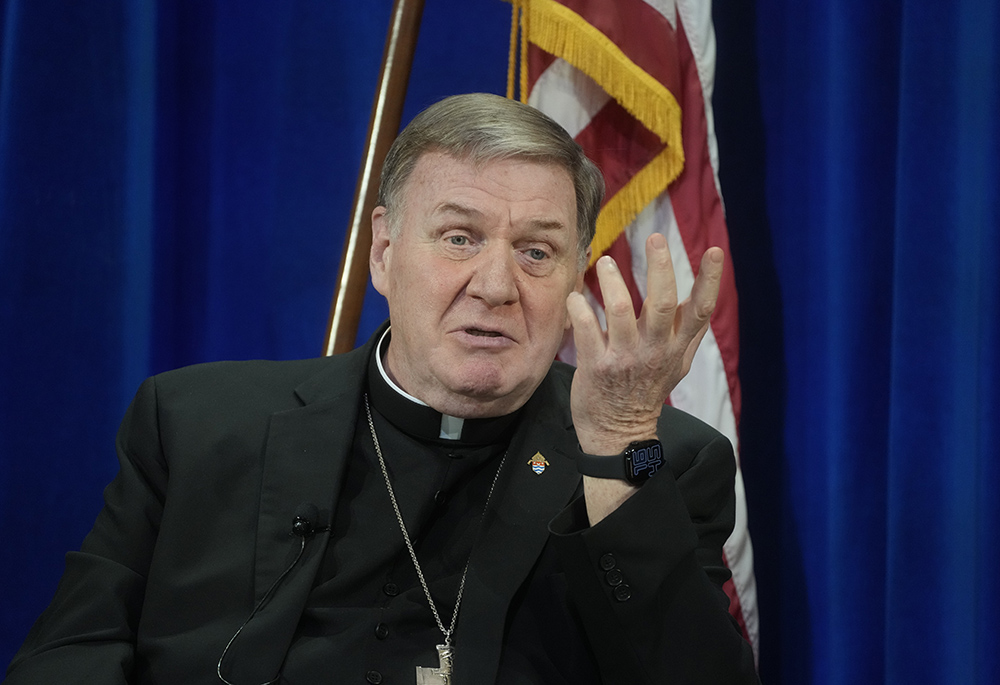
Cardinal Joseph Tobin of Newark attends a press conference at the North American College in Rome, May 9, 2025. (AP photo/Gregorio Borgia)
The recent statement by Cardinal Joseph Tobin declaring that "war is always evil, even when it is undertaken out of necessity for the defense of humanity" is at once as old as Christianity itself yet strikingly new in the context of the Catholic church in the United States.
Tobin's statement, published July 23 on the Archdiocese of Newark's website, is the latest sign that some U.S. church leaders today, with the support and prompting of the first U.S. pope, are willing to speak out more boldly in refuting the American presumption that our war making and military actions always are noble and have a just cause.
The comments take their place in a stream of hierarchical statements of concern about U.S. militarism and quick resort to war and elevates those concerns to a new level. In questioning not only a particular war, but strongly objecting to the glorification and celebration of all war, a distinct American characteristic, Tobin drives the issue to the brink of existential questions.
It is a highly unusual countercultural stand for an American cardinal. But it's not the first time Tobin has signaled his opposition to American militarism. Earlier this year, he joined Cardinals Blase Cupich of Chicago and Robert McElroy of Washington, D.C., in issuing strong condemnations. In a highpoint, the three appeared together in a "60 Minutes" interview which prompted an incoherent tirade from President Donald Trump against Pope Leo XIV.
We are witnessing a pivotal moment in Catholic response to the activities of the most militant and powerful nation on earth.
Leo himself has repeatedly and insistently condemned Trump's war in Iran, calling the president's threat to annihilate "a whole civilization" a "truly unacceptable" remark.
Archbishop Timothy Broglio of the Archdiocese of the Military Services, meanwhile, not only characterized U.S. actions in Iran and the Caribbean — and a potential U.S. invasion of Greenland — as unjust, but he went so far as to say that Catholic military personnel would be justified in disobeying unjust orders if their consciences so demanded.
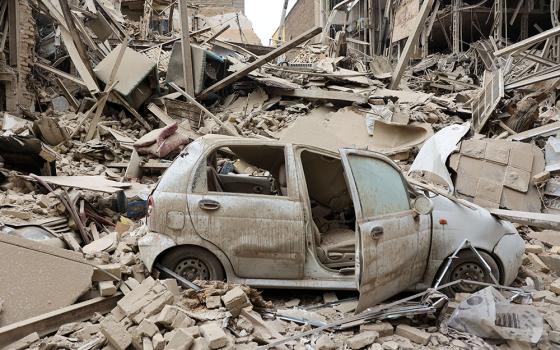
Yet Tobin's statement is uniquely broad and bold, and well-timed to Leo's recent magisterial clarification of just war theory in Magnifica Humanitas as "outdated." Even when unavoidable, wrote Tobin, war is "always reprehensible because of the damage it inflicts on human life (especially the innocent) and property (especially homes, businesses, hospitals, schools, and places of worship)."
In what appears unmistakably aimed at U.S. culture, and building on Leo's words, Tobin addresses our fascination with displays of military might.
"Belligerence and warmongering are the opposite of peacemaking," he said. "That's one reason Pope Leo insists that we stop romanticizing the act of war and its symbolic activities. War is not glorious, and while we are right to honor the heroism of those who have fought against tyranny and injustice, we should never pretend that the acts of war are themselves worthy of celebration."
That culture of celebrating war was especially prevalent earlier this year, when the White House shared videos on social media depicting war as a video game. As Cupich lamented in a March 7 statement, war for Americans has too often become a "spectator sport or strategy game."
Advertisement
Perhaps such celebratory views of war are inevitable given the inordinate amount of our treasury dedicated to military pursuits.
According to the Peter G. Peterson Foundation, the U.S. military budget in 2025 was $954 billion, more than any of the other G7 countries and by some measures, more than the next six countries combined. The war of choice against Iran has, according to Pentagon estimates, already cost more than $37 billion. Defense Secretary Pete Hegseth went before a Congressional committee last week (July 21) to ask for an extra $67 billion, which would be in addition to the $1.5 trillion being sought by his department for next year's budget.
U.S. military interventionism feels endless. We keep invading and attacking, full-scale, and for decades, as in Afghanistan and Iraq. There have been quick hits such as Libya and Syria among dozens of other uses of violence including drones and special operations forces. More recently, the overthrow of the leader of Venezuela, ongoing threats to Cuba, the wish to invade Greenland and the war of choice in Iran demonstrate the addiction is raging.
Catholic leaders here have spoken out in favor of peace, but unevenly and not with the rigor the issue deserves.
In 1983, U.S. bishops released a powerful peace pastoral, focused on the nuclear threat. Years of consultation with a range of experts resulted in a thoughtful and somewhat influential contribution to the national conversation. Leading up to the 2003 U.S. invasion of Iraq, bishops approved a statement saying the war would be unjust and Pope John Paul II took the unusual step of sending a personal envoy, Cardinal Pio Laghi, former Vatican ambassador to the U.S. and a friend of the Bush family, to argue the case in person. Bush wasn't persuaded.
As in so many other areas, the Trump era has brought us to extremes, eliminating any expectations that moral concerns might be heard or even that a civil dialogue might be possible. Trump, cavalier about the use of deadly force and dismissive of not only international law but also of ethical norms that are meant to guide military operations, reduces everything to a duality.
Against this reality, the message from the church is increasingly pointed and unvarnished.
In its calls for revision of the just war theory and its opposition to quick resort to war, the church is not naive. It understands, as Tobin noted, "there are times when war is unavoidable — precisely in order to protect human lives or to restore peace" but it is "never welcome" and should always be a last resort, not a first choice.
In his statement, Tobin takes us back to difficult biblical reality and paradox:
True peace demands that we surrender egoism, false pride, and vengeance. It asks us to be gentle, humble, and forgiving even when everything in us cries out for strict justice or revenge against those who have insulted or injured us. Jesus teaches us the counter-intuitive truth that love overcomes all evil, whereas aggressive action simply causes further enmity.
Tobin's staunch condemnation of war in any and all cases is a powerful witness to Jesus' "counter-intuitive" truth — a truth that has become increasingly countercultural. As our church becomes bolder in its preaching of the gospel of peace, it is up to Catholic Christians in the United States to face that gospel's demands. While our culture and government ask that we assent to the trivialization and spread of violence, we must insist by word and deed that war is indeed "always evil."