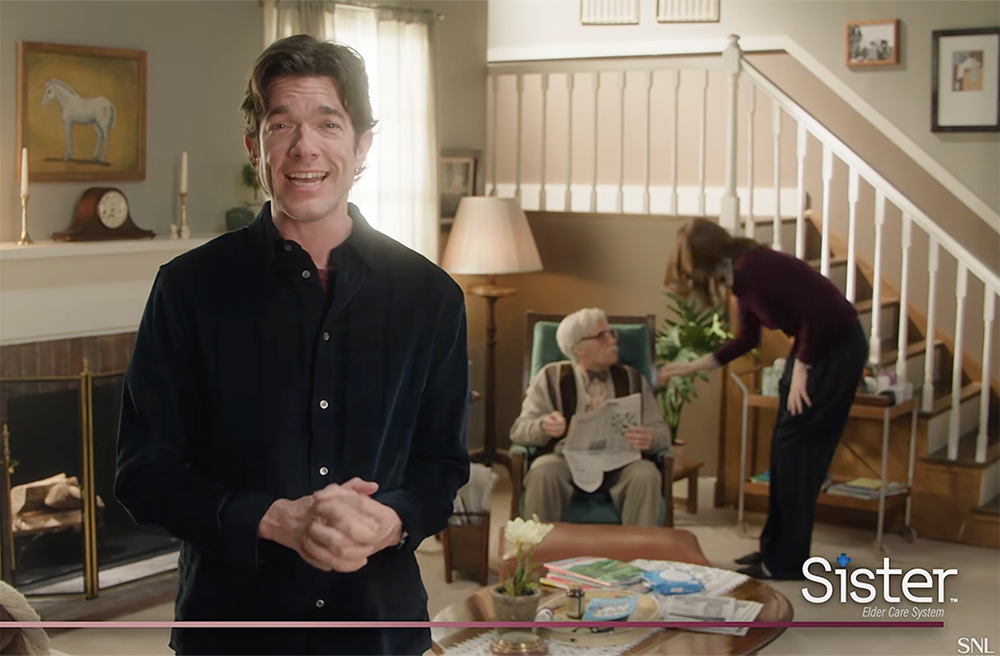
Comedian John Mulaney appears in the "Sister" sketch, aired on "Saturday Night Live" Nov. 14, 2026. (NCR screenshot/YouTube/Saturday Night Live)

by Karen E. Park
Join the Conversation
Send your thoughts to Letters to the Editor. Learn more
The recent "Saturday Night Live" sketch "Sister" has struck a nerve with millions of women across the country.
In the Nov. 14 sketch, a fake commercial for elder care services, comedian John Mulaney plays a man advertising an ingenious and cost-effective solution to the problem of caring for his aging father. Nursing homes are expensive, and home health aides can cost thousands of dollars a week. But there is an alternative that is absolutely free, requires no insurance, and is available around the clock: your sister.
Mulaney says cheerfully, "Now I don't have to worry about Dad getting the care and attention he needs, because my Sister will do it. And I can get back to my life and the stuff I like to do."
"Here's how it works": A physician who is identified as the author of "Not It!" A Son's Guide to Elder Care explains, "Years of internalized sexism warps Sister's brain into thinking caretaking is her responsibility and somehow not yours. Next, your text arrives ["dad fell"], instantly activating her. And that's it. You're done for life. See ya at the funeral!" The accompanying graphic shows a man speeding off on a Jet Ski.
The "Sister" skit has gone viral, with more than 5 million views on the SNL YouTube site by Wednesday. It's being shared everywhere — in Facebook groups for daughters who have lost their mothers, and Reddits about caring for aging parents. It is also making the rounds in group texts and family chats.
One friend told me, "My brother sent this to me this morning with a laugh emoji — he knows I do everything. At least he's self-aware."
Another friend responded, "My brother would be furious if he knew I was even talking about him this way. He takes himself very seriously."
And indeed, the sketch goes further than humorously noting the unfair and gendered division of labor in so many families. It also exposes the way that even the Sister's selfless caretaking can be used against her, as the brother and father sit at the kitchen table during one of the brother's infrequent visits, bonding over the Sister's supposedly controlling ways.
What is fascinating about this viral moment is that liberals and conservatives, religious women and women who have no use for religion, women of different races and ethnic backgrounds, even women who love their brothers and women who can barely stand them, all recognize their own lived experience in the sketch.
Mulaney grew up in a large Irish Catholic family in Chicago, attended Catholic schools, served as an altar boy, and minored in theology at Georgetown University. Although he no longer identifies as Catholic, his upbringing has provided him with a seemingly inexhaustible supply of comic material. He knows the particularities and rhythms of Catholic family life, the expectations, the guilt, the rituals. And it's possible that he knows that the Catholic Church has quite a lot to say about the obligations of adult children toward their aging parents.
Paragraph 2218 of the Catechism of the Catholic Church reminds adult children that they have a responsibility to provide material and moral support to their parents in old age, illness, loneliness and distress. Paragraph 2219 explicitly extends the discussion to relationships between brothers and sisters, insisting that family life requires mutual charity, patience and humility.
In fact, the catechism goes so far in Paragraph 2231 to say, "Some [adult children] forgo marriage in order to care for their parents or brothers and sisters, to give themselves more completely to a profession, or to serve other honorable ends. They can contribute greatly to the good of the human family." Note that the catechism does not assign any of these family responsibilities to daughters, but to both daughters and sons equally.
Yet the responsibility of men toward their sisters and parents is all but absent from the rhetoric of the contemporary Christian and Catholic masculinity movement, which has devoted enormous energy to instructing men in the virtues of being good husbands and fathers, and almost none to being good brothers and sons.
Consider The Catholic Gentleman, a popular Catholic men's apostolate whose motto is "Be a Man. Be a Saint." Its website offers extensive instruction in "authentic Catholic masculinity" with near exclusive attention to marriage and fatherhood, In articles such as "Biblical Masculinity: Why a Husband Must Protect His Wife and Family," men are told:
A husband is like the center on a football team's offensive line. More than merely snapping the ball to the quarterback, his duty is to sacrifice his body to protect the quarterback from the defensive linemen. ... Like the offensive center, a husband defends his wife and children.
Fraternus is a Catholic men's mentoring organization that seeks to form boys and young men in Catholic virtue through relationships with adult male mentors. Their stated purpose is to "stand as the steady, relentless voice defending the dignity of fatherhood, the necessity of fatherly leadership, and the hope of restoring stable households." Although Fraternus is an organization formed around the concept of brotherhood, it understands brotherhood solely as a relationship between and among men — a brotherhood without sisters.
In fact, in a search of prominent Catholic men's blogs, podcasts, websites and social media platforms, instruction on husbands and fathers was abundant, while instruction on men's responsibilities to aging parents and sisters was almost entirely absent.
And yet the Christian tradition is filled with examples of men whose holiness was expressed through mutual responsibility, respect and care for women. Francis of Assisi was neither a husband nor a father but his relationship with Clare of Assisi was one of the defining relationships of his life. Clare was not a woman over whom he exercised any kind of domestic authority. She was instead his spiritual sister, a woman whose vocation he supported and whose dignity he recognized.
John of the Cross was likewise neither husband nor father. But his collaboration with Teresa of Ávila helped to transform the Carmelite order. Teresa was older, more experienced, and a formidable religious leader in her own right. And she teased him like a big sister might, calling him "half a friar" because of his diminutive stature.
These relationships suggest that men, and their sisters, would be well served by a model of Christian manhood that is more expansive than the one currently being promoted by Catholic influencers and advocates of "traditional masculinity."
Advertisement
Imagine if the Christian or Catholic masculinity movement told men that being a good brother matters every bit as much as being a good husband or father. Or if it reminded them that their obligations to their parents are not discharged to the women of the family as soon as they have wives and children of their own. So-called authentic Catholic masculinity could insist that the responsibilities of caring for aging parents belong equally to sons and daughters, even when the daughter seems more competent, more available or just more accustomed to doing the work.
Of course, there is no obvious masculine glory in managing medical appointments and prescriptions, spending an afternoon on the phone with an insurance company, or helping an elderly person use the bathroom — as the sketch demonstrates. The contemporary rhetoric of Christian masculinity prefers sacrifice when it is attached to a vision of male identity that involves imagining the man as a powerful protector and head of the household.
Being a good brother to one's sister often doesn't involve strength or dominance — in fact, sisters often put their brothers in their place. An alternate model would instead require humility, and that a man recognize that his sister's time is as valuable as his own — and that her career, hobbies and priorities in life deserve respect.
Of course, there are countless men who care devotedly for their aging parents, just as there are families in which brothers assume the greater share of responsibility. The point is not that every brother is selfish and disengaged, or that every sister is a selfless martyr. Yet the expectation that daughters will naturally assume the physical and emotional responsibility for aging parents remains deeply embedded in American family life, which is why the sketch has become such a phenomenon.
The Christian and Catholic masculinity movements have plenty to say about what it means to be a man. These movements ought to consider reminding men that they were brothers and sons before they became husbands and fathers, and that honoring their obligations to their families of origin is also essential to being a good man and a good Catholic.
Otherwise, as the sketch makes clear, we are left with the alternative.
See ya at the funeral!