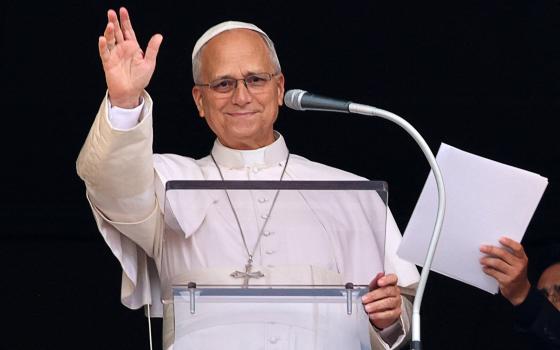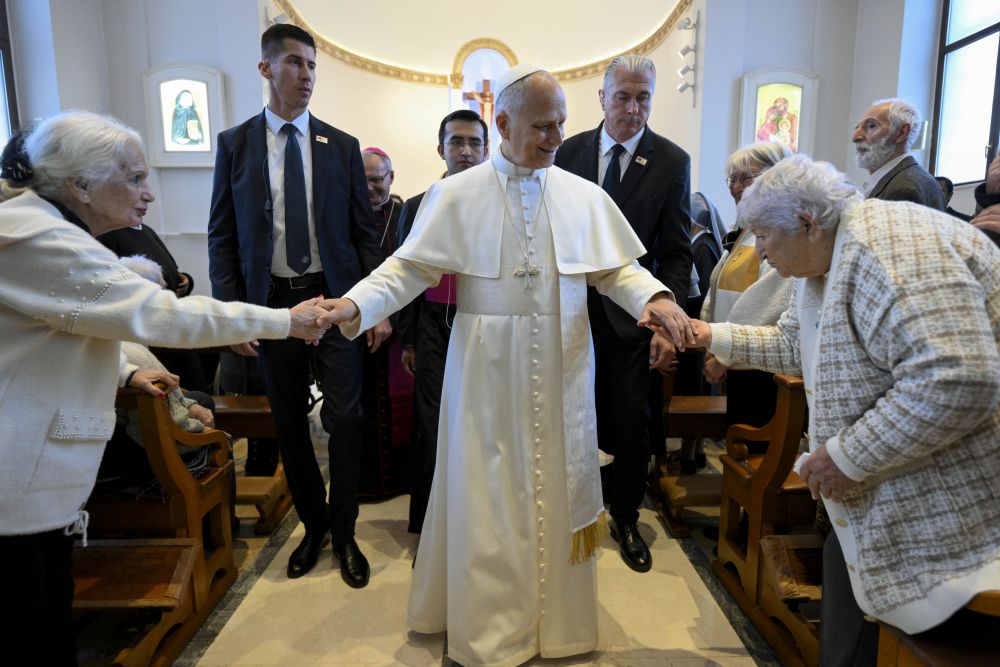
Pope Leo XIV greets residents of a home for the elderly run by the Little Sisters of the Poor in Istanbul during his visit Nov. 28, 2025. (OSV News/Catholic Press/Vatican Media)

by James A. Lomastro
Join the Conversation
Send your thoughts to Letters to the Editor. Learn more
One of the least discussed realities in American public life today is who is showing up. Watch demonstrations against immigration crackdowns, Medicaid cuts, reductions in food assistance or attacks on public institutions, and older Americans are often standing there, day after day. Retired teachers. Former nurses. Veterans. Grandparents. Clergy. People old enough to remember earlier struggles over civil rights, poverty, war, labor and human dignity.
This matters more than politicians and policy analysts may yet understand, and it matters especially this fall, because the institutional crisis in long-term care for the elderly is quietly becoming a midterm issue in its own right.
Long-term care is the daily help people need when age, illness or disability makes it hard to bathe, dress, eat or get through the day safely, whether at home, in assisted living, or in a nursing home. Most Americans turning 65 will need some of it. Medicare, which many families assume will pay, generally does not cover it. Medicaid is the primary payer for roughly 6 in 10 nursing home residents, which is why cuts to Medicaid land directly on nursing homes.
Much of the rest falls on families: Some 63 million Americans now provide unpaid care, often at the cost of their own jobs, savings and health. Facilities struggle to hire and keep the aides who do the hands-on work, and many nursing homes are owned through layers of investment funds and affiliated companies, shell structures that make it hard to see where public money actually goes. The result is a system that costs a great deal, runs on underpaid and unpaid labor, and answers to almost no one.
That is why I believe a reckoning is coming, and it is not the one the campaign ads are selling. Both parties are now running on eldercare as if the only question were which side cares more. The harder question is whether either will govern for the people who live inside this system: the frail elder in an understaffed nursing home, the daughter who leaves her job to fill the gaps, the aide paid too little to stay.
Older adults are often portrayed as politically cautious or disengaged. But many are becoming morally unsettled, not by ideology alone but by accumulated observation. They have watched institutions become more technologically sophisticated while becoming less relational. They have watched the language of dignity expand while the material conditions necessary for dignity erode. Brookings has begun calling this the caregiving crisis heading into the 2026 midterms, and for good reason: The baby boom generation is now old enough, large enough and civically experienced enough that long-term care can no longer be treated as a private family burden invisible to public moral consciousness.
Catholic social teaching has long warned against precisely this kind of separation between economic systems and the human person. From Rerum Novarum through Fratelli Tutti and Laudato Si', the church has consistently argued that societies are judged not by efficiency alone but by how they treat the vulnerable: workers, migrants, the poor, the disabled, the elderly and those pushed to the margins of economic life.
Pope Leo XIV has extended that tradition directly. In Angola this year, visiting a nursing home, he told those gathered that the elderly "need to be listened to," a simple sentence that is also a governance standard, since listening is precisely what shell-structured ownership and understaffed facilities make structurally difficult. His message for the World Day for Grandparents and the Elderly returned to the same theme: God's love "forgets no one," including those our systems are most tempted to forget. And his first encyclical, Magnifica Humanitas, has made subsidiarity and institutional accountability a named criterion for how any system, technological or eldercare, should be judged — not an aspiration but a governance test.
There is also a deeper Augustinian warning beneath this tradition, one I have come to appreciate differently after 40 years running these kinds of institutions. Augustine of Hippo understood that societies are shaped by what they love most, and that he himself would have had nothing durable to write had he not first been responsible for a real community, its poor, its disputes, its daily administration. In The City of God, he argued that political communities become disordered when power, wealth, domination or self-interest replace the common good as their organizing moral center. Institutions may continue functioning outwardly while becoming spiritually and morally fragmented inwardly. Long-term care now sits at the center of that test, and this year has supplied the evidence in unusually concrete form.
Consider what has surfaced this year, and how directly it now runs into the midterm campaign itself. Medicaid cuts tucked into last year's Republican reconciliation bill emerged early as a flashpoint for 2026, and by summer both parties were running ads about them: Republicans defending their vote with healthcare-themed spots after cutting the funds, Democrats attacking the cuts as a betrayal of rural hospitals and nursing homes that depend on Medicaid reimbursement to stay open. Fact-checkers have spent September untangling dueling claims about exactly how much rural healthcare capacity those cuts will cost, which is itself a sign of how central the issue has become, since campaigns do not fight this hard over ads nobody is watching.
Congress has separately debated barring Medicare participation by private-equity-owned nursing homes outright, states have begun targeting private equity's role in ownership structures too financially complex to defend, and Senate Democrats are already positioning to revive federal staffing mandates and expand home-care benefits once the votes are counted, which tells its own story about which party expects this issue to keep moving voters past November. AARP polling has found older voters positioned to play a decisive role in several of this cycle's most contested races.
None of this is abstract theology. It is the same disordering Augustine described, now showing up in campaign ad buys, Medicaid spend-down requirements, staffing waivers and quarterly ownership filings, all in the same election year.
Advertisement
What should trouble anyone who has spent a career inside these institutions, as I have, is how little of this campaign argument is about care. It is about blame for a funding cut, not about whether a resident down the hall is being listened to. Ads can correct a talking point faster than a system can correct a staffing ratio. The reckoning I am describing will not be settled by whichever ad wins the fact-check; it will be settled by whether either party, once in office, treats a frail elder's dignity as a governing obligation rather than a seasonal talking point. That gap between campaign attention and administrative will is, in miniature, the entire argument of this essay: The problem in long-term care is rarely that we do not know how to do better. It is that doing better has not yet been treated as a moral emergency rather than a line item, neither in an off year or an election year.
What happens when older Americans who currently march for immigrants, democratic norms and social protections begin recognizing that the same logic of disposability is increasingly shaping aging itself? For years, long-term care remained hidden from public moral consciousness. Families entered the system quietly, often exhausted and isolated. That is changing, and not only demographically. Even members of Congress now openly refer to "profit-hiding shell games" in nursing home financing, language that would have been politically unthinkable a decade ago, and that this year's legislative activity suggests is becoming actionable rather than merely rhetorical.
Catholic social teaching offers a vocabulary for why these matter beyond policy mechanics. Human dignity is not contingent upon productivity. The preferential option for the poor and vulnerable is not charitable sentiment; it is a structural moral obligation. Solidarity is not abstract compassion or charity but recognition that social systems bind human beings together in mutual dependence and responsibility, a theme the U.S. bishops emphasized decades ago in "Economic Justice for All" and that Leo has now placed at the center of his own governing document. The danger facing long-term care is not only inadequate funding or workforce shortages. The deeper temptation is to reorganize frailty itself around managed cost and institutional efficiency, keeping the public language of compassion and charity while listening to no one, and still insisting, in the encyclical's own words, that we are guided by human dignity.
That is why the coming reckoning around long-term care may become far larger than healthcare policy and why it belongs in the conversation heading into the midterms alongside Medicaid, housing and immigration rather than separate from them. It concerns the kind of society Americans are becoming and whether institutions still recognize elderly people as bearers of dignity rather than liabilities to be managed. Matthew 25 asks nothing about doctrine, liturgy or party affiliation; it asks only how we treated the least among us. Systems can absorb criticism for a long time. They struggle far more when private suffering becomes public moral consciousness, and this year, in statehouses, in Congress, and from Rome itself, that consciousness is finally becoming harder to defer.