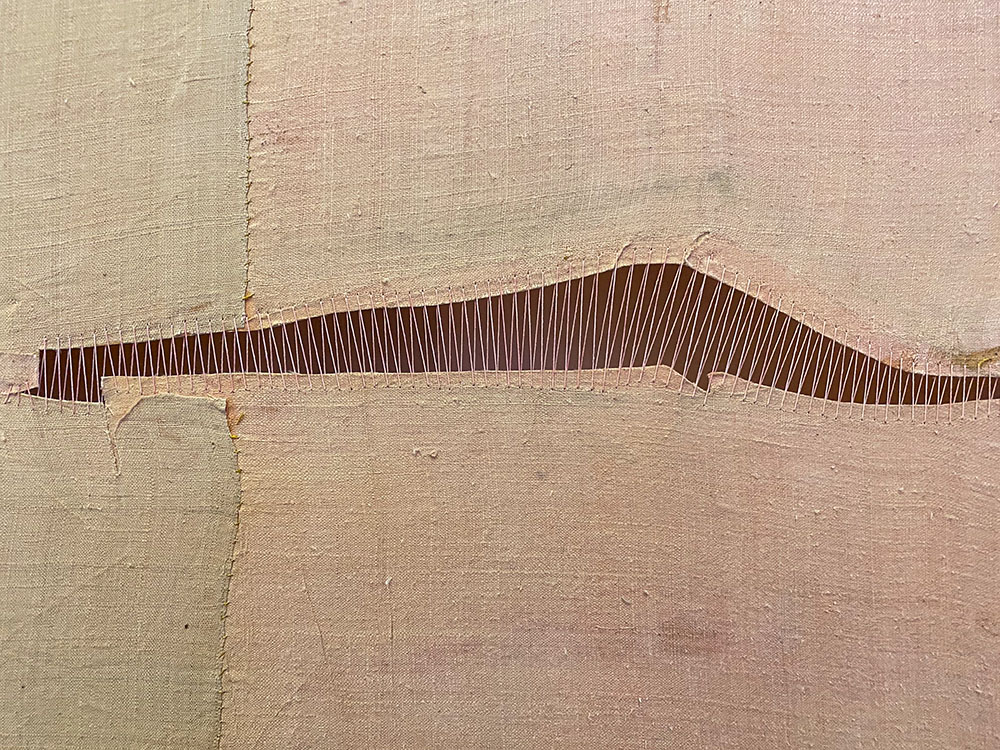
Franciscan friar Sidival Fila’s "Senza Titolo 14 serie SINDONI" summons the spirit of his order with its subtle ecological message. The artwork is featured in the "ART CUT: Exercises in Empathy: Accompaniment" exhibition on display at the Burns Library at Boston College through Nov. 15, 2026. (Michael Centore)
by Michael Centore
Join the Conversation
Send your thoughts to Letters to the Editor. Learn more
"I think that what has to change today is not reason, rationality or religion, but the imaginary."
So says the French poet and philosopher Édouard Glissant in Manthia Diawara's 2010 film "Édouard Glissant: One World in Relation," featured in the "ART CUT: Exercises in Empathy: Accompaniment" exhibition on display at the Burns Library at Boston College through Nov. 15.
Glissant's observation could serve as an interpretative key for the exhibit. Curators Nuno Crespo and Sheila Gallagher have expertly assembled a series of works that invite viewers into "sustained contact with the imagination of another," as Gallagher writes in her catalog essay.
"Exercises in Empathy: Accompaniment" is part of the Catholic Universities Art Triennial ("ART CUT"), an international initiative promoted by the Dicastery for Culture and Education of the Holy See. In addition to Boston, exhibitions are being mounted at universities in six cities spanning three continents throughout the fall.
A guiding text of the triennial is Pope Leo XIV's Magnifica Humanitas, particularly the encyclical's call to safeguard human empathy against the leveling trends of artificial intelligence.
Upon entering the exhibition space, I was greeted by the woven baskets of Passamaquoddy artist Jeremy Frey. With their sculptural qualities and precise plaiting of ash and sweetgrass, they counterpoint feelings of delicacy and strength. Looking at them alongside Frey's framed, mandala-like weavings, I thought of the Desert Fathers and Mothers for whom the braiding of rushes was both a means of meditation on and connection with the earth.
Advertisement
I turned next to Sidival Fila's "Senza Titolo 17 serie SINDONI," a large composition constructed of dalmatic lining and other discarded fabrics. The liturgical provenance of the lining lends added meaning to its cruciform pattern. Fila is a Franciscan friar based in Rome, and the work summons the spirit of his order with its subtle ecological message. In a world where landfills teem with disused textiles, he has found a way to redeem these castoffs by incorporating them into the forms of his art.
But the response to the work goes even deeper. The graceful stitches across the seams of the fabric, so carefully executed, are like sutures binding a wound. This gesture of repair is also a gesture of empathy toward the material world itself, a resonance strengthened by the suggestion of the cross.
If Fila's work invites the question of how we might empathize with objects and their multilayered histories, photographer Lisa Elmaleh asks us to attend to the stories of asylum seekers. Images from her series "Promised Land/Tierra Prometida" document her time living and working with humanitarian aid organizations at the U.S.-Mexico border.
"Para la suerte, Casa de la Esperanza," a cropped shot of a person's hand holding pendants of Jesus and Mary, retains a sense of mystery. It invites us to engage in the work of imaginative empathy by envisioning the subject's background. We are called to move beyond the border in a dual sense, both the border of the image that is hemmed in by its frame and the political border that severs our shared human narrative.
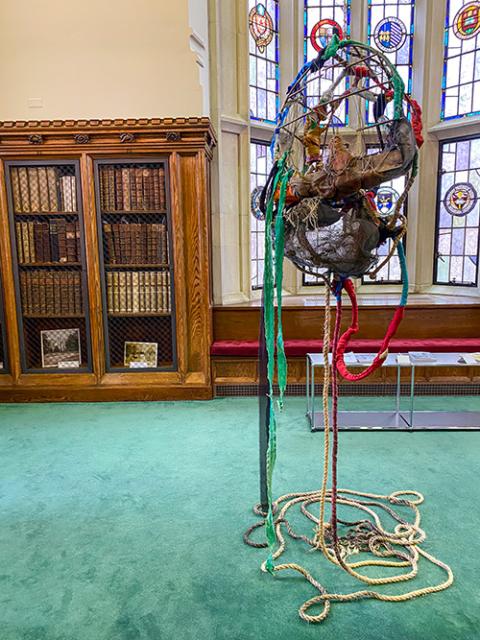
"Um lugar, um corpo" ("A Place, a Body") by Sonia Gomes (Michael Centore)
The Brazilian artist Sonia Gomes is represented with a series of mixed-media pieces that incorporate metals, shells and stones. As in Fila's work, fabrics and textiles are the figurative — and sometimes literal — threads that bind these constructions together.
Her "Um lugar, um corpo" ("A Place, a Body") hangs from a metal scaffold, festooned with ropes and ribbons that coil to the floor. Its twisting wire form is equal parts bird and cage, seemingly wanting to break free of itself while remaining anchored.
That thrilling tension is replayed in "Untitled (cages)," a series of seven cage-like structures suspended on wires at various heights. Each cage holds a stone wrapped in fabric, with some of the cages ornamented in lace. The juxtaposition of hard and soft materials becomes a fusion of two kinds of time: the geologic, represented by the stones that float within their containers in space, and the human scale of shaping and adorning the world.
Fila also contributes two hanging sculptures, "Senza Titolo Scultura in Legno 23 and 24," that dialogue with Gomes' wending, wired assemblages and his own two-dimensional pieces.
The longer I studied these bracketed wooden beams, sheathed in fabric and hand-painted thread, the more they seemed to emerge from the world of his "Senza Titolo 14 serie SINDONI" that is displayed adjacently. The surface of that composition could read as an aerial view of a desert, with the sculptures as steles within the imagined landscape.
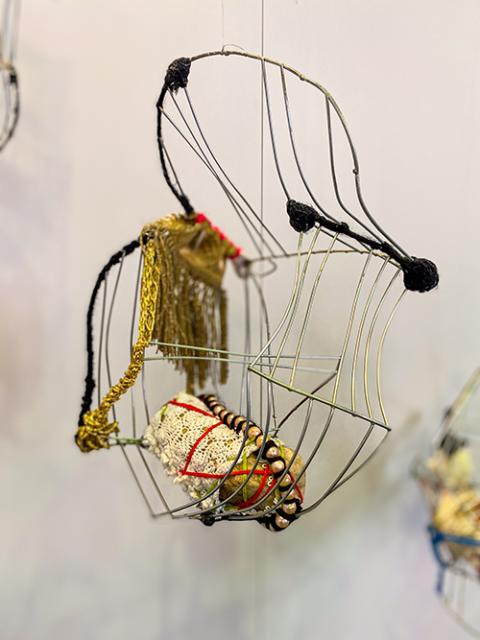
"Untitled (cages)" by Sonia Gomes (Michael Centore)
"RISE," a 20-minute video by Bárbara Wagner and Benjamin de Burca, is notable for the artists' compositional methods. Wagner and de Burca involve the subjects of their films in the shaping of their narratives, so that the line between director and performer is blurred.
In "RISE," this collaborative practice is present in the way the action moves, as a variety of young African and Caribbean Canadian musicians and poets weave in and out of each other's performances. As I followed the seamless, gliding transitions, I was made aware of how my own role as an audience member contributed to this shared creative project.
"Final Meals," by the Chicago-based arts collective Lucky Pierre, is a video collaboration in a more mournful key. The eight-hour loop, excerpted from a 122-hour video, consists of single overhead shots of volunteers eating recreated final meals requested by Texas Death Row inmates. It is jarring in its stillness. Even a brief experience of its duration forced me to ponder the eternity on the other side of each humble meal.
Rounding out the video installations is "Mary's Day," a portrait of beloved pop artist Sr. Corita Kent directed by Baylis Glascock. Kent is seen in conference with her students, offering directives that harmonize artistic freedom with the discipline of consecrated life.
Kent's work is also displayed in a printed monograph from 1966. Visitors are invited to leaf through it alongside a copy of multidisciplinary artist Deb Todd Wheeler's Book of Walks. Part memoir, part guided meditation, Wheeler's evocation of the healing power of nature and walking as a way to process grief brought me back to another of Glissant's aphorisms: "We understand the world better if we tremble with it."