Kristin Grady Gilger did not understand the calling that led her son, Patrick Gilger, to become a Jesuit priest. She saw only "a lifetime of poverty, chastity, and obedience," prompting her to wonder "what college kid in his right mind would sign up for that?" (Courtesy of Gilger family)
Join the Conversation
Send your thoughts to Letters to the Editor. Learn more
For generations of Irish Catholic mothers, few phrases packed more parental pride than "my son, the priest." But for Kristin Grady Gilger, the prospect of her son, Patrick, joining the Jesuits felt less like a blessing and more like an unwelcome challenge.
Gilger, who spent two decades as a journalist, questioned the story of her son's vocation with the stance of an editor determined to get at the truth. The result is the new book My Son, the Priest: A Mother's Crisis of Faith, a lively and layered memoir that braids several stories around the journey promised by her subtitle. Throughout her account of her son the priest and his mom the skeptic, she offers running commentary on a church that left her outside, shaking her head.
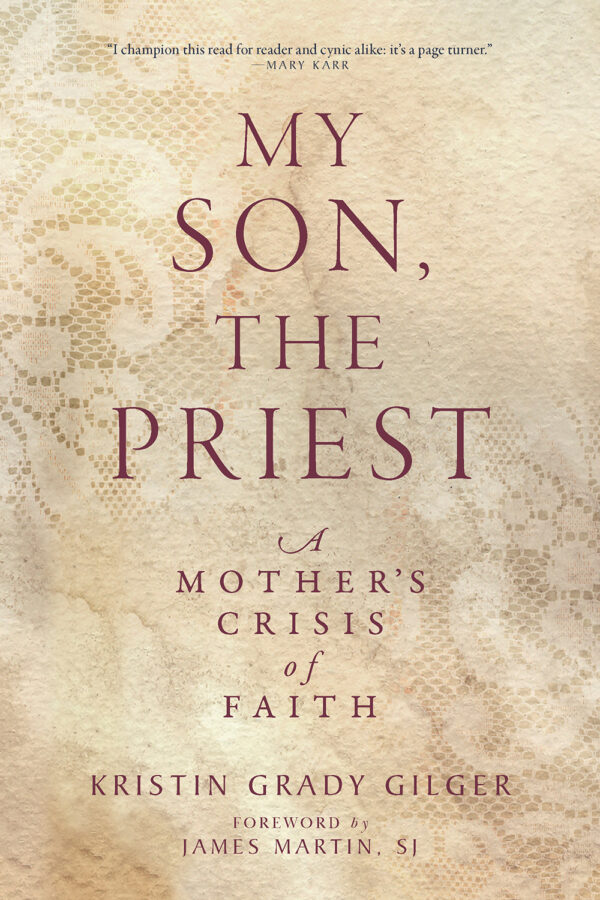
In a foreword, Jesuit Fr. James Martin describes the author's examination of Jesuit life and the priesthood as the first that he's read "from the point of view of a woman, a feminist and a mother." He awards high marks for her "refreshing account of everything from the highly unusual Jesuit (training) process … to what happens when a priest falls in love … "
The book concludes with an epilogue by Gilger's son, the Jesuit Fr. Patrick Gilger, who expresses cheeky dismay at his mother's decision to publish excerpts from a journal he kept in high school, but thanks her for hanging in there as he pursued a dream she found utterly baffling.
The author grew up the second oldest of eight kids in an Irish Catholic family in Cedar Rapids, Iowa, where her father coached basketball and baseball in exchange for the children's tuition at St. Ludmilla Elementary School. The two priests who ran the school and parish often spent Friday evenings at her family's home, "bearing a bottle of Jim Beam and playing cards late into the night."
'I'm beginning to accept what I can't possibly know, yet deeply feel.'
—Kristin Grady Gilger
The author recalls a pious childhood that included thoughts of one day becoming a saint, inspired by the movie "The Song of Bernadette." Gilger and her husband Gary, also raised Catholic, were married in the church and baptized their three children as Catholics — but left the church shortly after their son, Patrick, made his first Communion.
Gilger recalls: "I couldn't tolerate the Catholic Church's stand on social issues like abortion and birth control. I couldn't condone how the church treats women. There was just so much I didn't agree with, and it didn't seem right to go on pretending that it was okay. It wasn't okay. It still isn't." The family joined the ranks of lapsed Catholics who became casual Episcopalians.
Patrick graduated from high school and entered Creighton University in Omaha, and by his junior year, the Jesuits had made quite an impression.
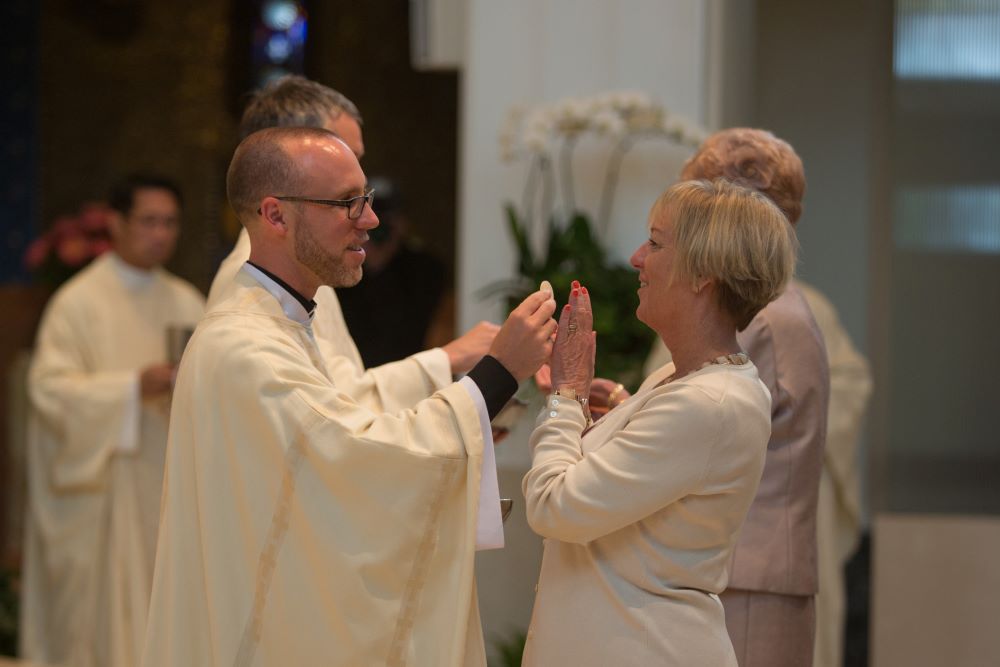
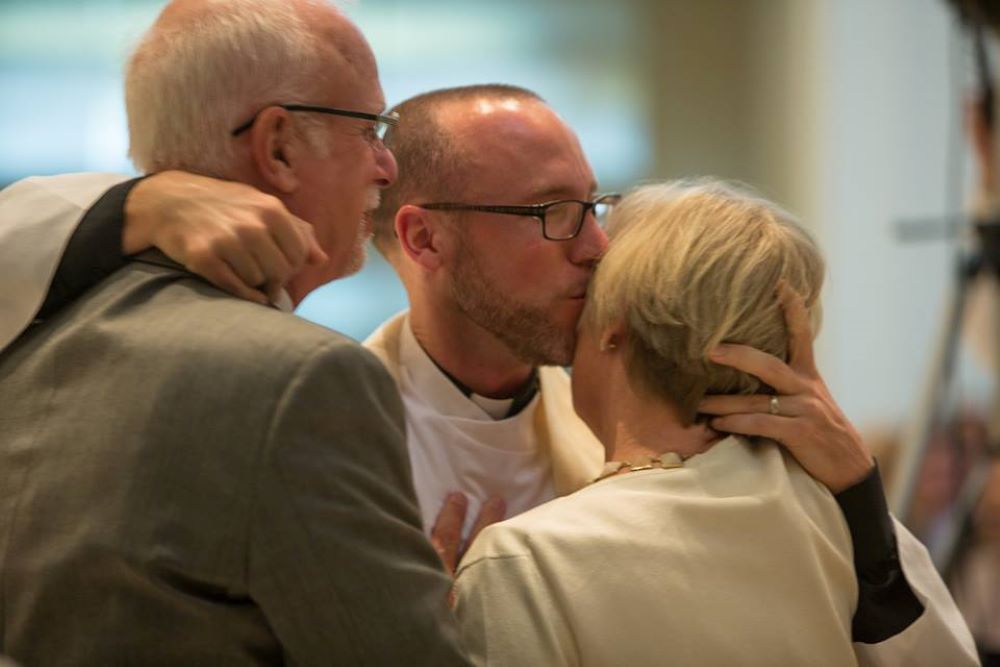
Jesuit Fr. Patrick Gilger gives his mother, Kristin Grady Gilger, Communion for the first time. (Courtesy of Gilger family)
"I think it's fair to say that I was able to get close to God because somebody somewhere could talk about God in my own language, the language of Saturday Night Live and the Milwaukee Brewers and Springsteen. And those somebodies were Jesuits," Patrick wrote in The Jesuit Post in 2012.
Gilger, on the other hand, saw only "a lifetime of poverty, chastity, and obedience," prompting her to wonder "what college kid in his right mind would sign up for that?"
Patrick's impending priesthood resurrected the author's conflicts with the church and, more fundamentally, her own crisis of faith. Partly to dig into those questions and partly to reduce some day-to-day stress, Gilger made a retreat based on the Spiritual Exercises of St. Ignatius, where retreatants are encouraged to put themselves in various Gospel stories and experience "imaginative prayer" as a way of encountering Jesus.
It wasn't working for Gilger. At one point she broke the rule of silence to phone Patrick to tell him so.
"Did you talk to God about that?" he asks.
"I can't do that either," she responds.
"God is the most important thing in my life," she recalls her son telling her. "The fact that you and dad don't give God the same chance is hard. It's hard all the time. I know that God is not a person to you like He is to me. And what I want to say to that is: 'Not yet.' "
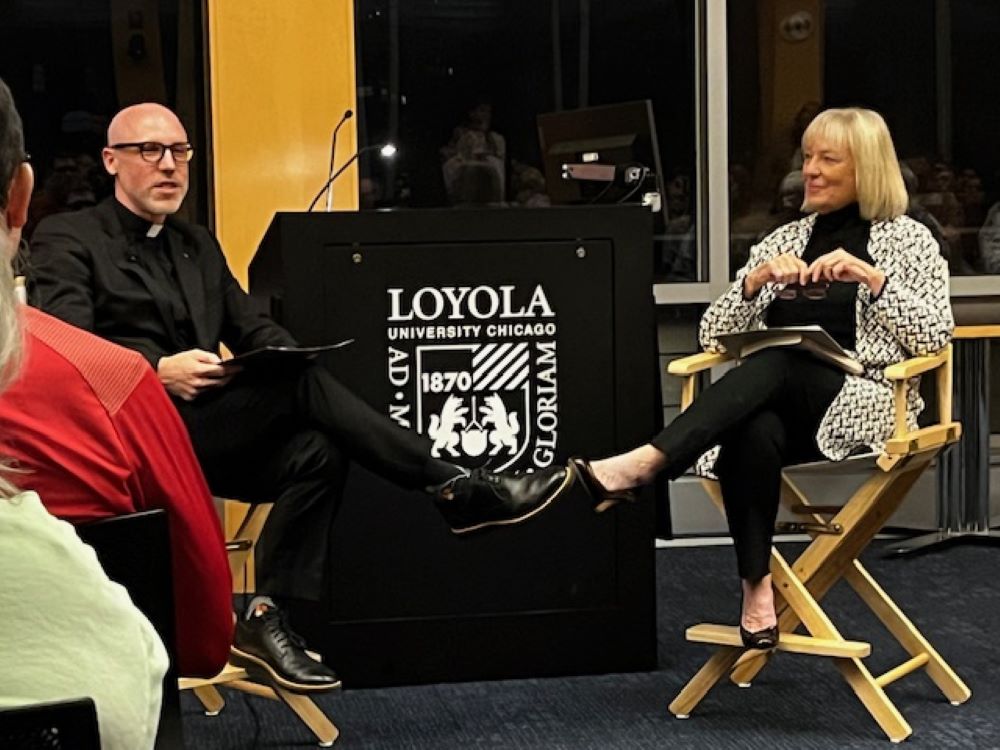
Kristin Grady Gilger and Jesuit Fr. Patrick Gilger speak at the book launch for Gilger's book, "My Son, the Priest," at Loyola University Chicago. The book concludes with an epilogue by Patrick. (Courtesy of Gilger family)
Ever the reporter, Gilger kept exploring her beliefs in the same ways she persisted in probing Patrick's path. As much as she describes herself as "an unlikely candidate to be the mother of a priest," Gilger found that Patrick's vocation provided a revealing jolt to her spiritual life. Over time, she found herself a rekindled Catholic, crediting the sacraments with enabling her return.
"It did not require a miracle to bring me back to the Catholic Church," she writes, "but it did take just about every sacrament the church has to offer."
Still, severe differences with the church remain: "I still chafe at the church's treatment of women and LGBTQ+ people and the excruciatingly slow pace of change. I still don't agree with a whole litany of teachings that seem to me both pigheaded and provincial. And I don't think I'll ever become reconciled to the music."
And yet, the author accepted a harsh reality: All the journalistic rigor in the world would still fall short of nailing down exactly what she believes.
"I think it's safe to say that some things defy explanation, or at least defy explanations that satisfy everyone, that leave no room for doubt," she writes. "God is one of them; our choice of religion is another. Recognizing the presence of God, becoming Catholic again, has added mystery and wonder to my life. I've given up trying to know everything, and I'm beginning to accept what I can't possibly know, yet deeply feel."
She ended up somewhere she never imagined at her journey's start.
"These are, without a doubt, my days of awe."
Advertisement