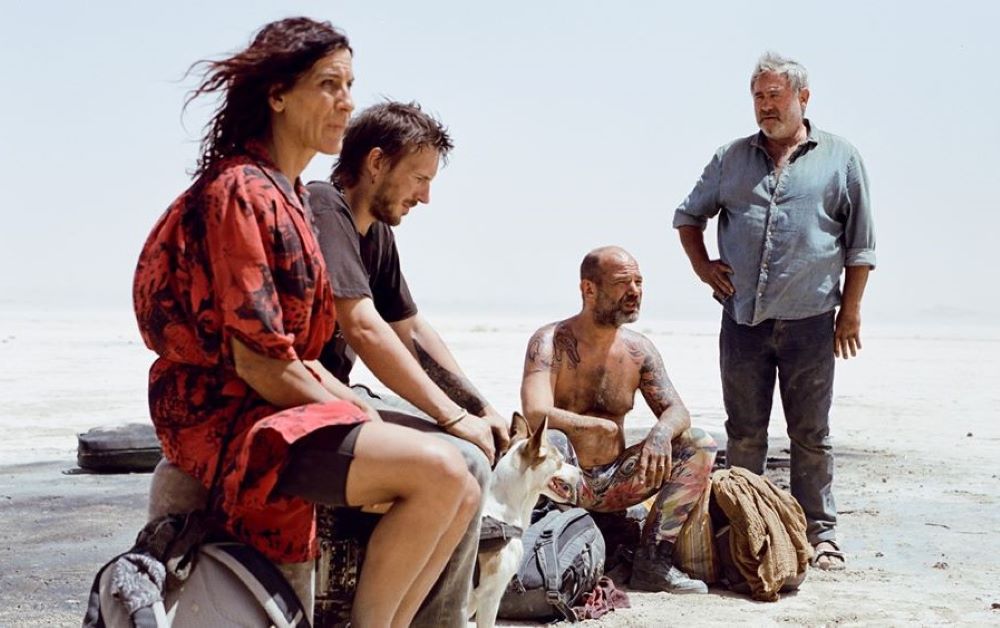
Stefania Gadda, Joshua Liam Herderson, Richard 'Bigui' Bellamy and Sergi López appear in a scene in the Oscar-nominated film "Sirāt." López plays a father who goes to search for his missing daughter at a rave in the Moroccan desert. (Madman Entertainment)

by Zachary Lee
Join the Conversation
Send your thoughts to Letters to the Editor. Learn more
There's an almost intoxicating spirituality to director Óliver Laxe's "Sirāt," which was nominated for Best International Feature Film and Best Sound at this year's Oscars.
The film focuses on a father, Luis (Sergi López), who goes to search for his missing daughter at a rave in the Moroccan desert. While he's searching, among the mass of bodies lost in the throes of technomusic, an unspecified war between two countries forces him, his son Esteban (Bruno Núñez Arjona) and a group of ravers to trek across the desert. From this point on, "Sirāt" morphs into something more existential. The apocalypse isn't here as much as it's always been around us. What else can we do but dance?
The 98th Academy Awards show will be broadcast live on ABC and Hulu March 15.
Laxe spoke with the National Catholic Reporter in person at the 2025 Toronto International Film Festival about art that kills the ego, disruption in the creative process and facing our shadows.
This conversation has been edited and condensed for length and clarity.
NCR: Tell us about the film's title. How did your encounter with the word "Sirāt" shift throughout making this film?
Laxe: "Sirāt" means "path," and it's a word that I repeat every day in my practice. Life, every day is a path. We have to learn to come back home with dignity. In Arabic, it more specifically refers to the "right path." This concept gave me a lot of peace. All I need to do is be conscious about every one of my steps. If I'm doing the right step, I'm totally serene about the consequences. As a filmmaker, I'm not concentrating on having success. I'm trying not to be afraid of failing.
It's making me think of a scene in Scripture where Peter is trying to walk on water to meet Jesus, but his worries make him nearly drown.
It's all the same. To have your values reign over your ego is a battle.
You filmed in Morocco from May to July, which you've said is the worst time of the year to film there. I'm sure that was ego death in some way. What role does disruption play in your creative process?
In my art, I'm always looking for problems. It's important when a piece of art transcends the author. The author can be the worst enemy of your own movie. This is my theory … the intention I have is that I like to go through my limits. At some point, you have to submit to reality. God doesn't give you what you're looking for; he's giving you what you need. This is the challenge that we have as human beings. That's why most human beings think God is unfair, because it's difficult to discern the difference between what we're looking for and what we really need.
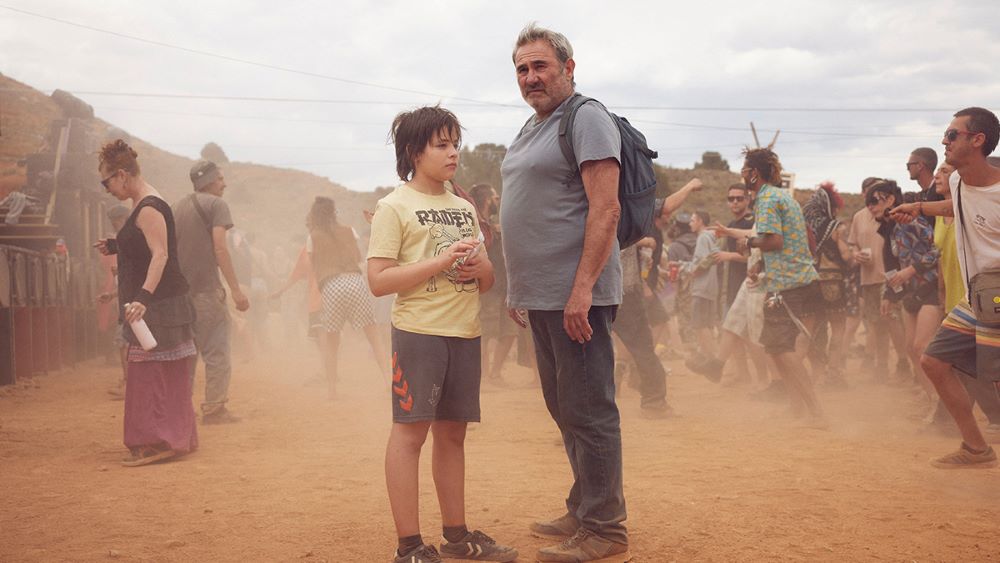
Sergi López, right, and Bruno Núñez play father and son in "Sirāt." The film has been nominated for Oscars in Best International Feature Film and Best Sound. (Madman Entertainment)
It's difficult for us to accept that all that we have is mercy. Whether life is giving you tragedy or accident, there's an undercurrent of mercy. I don't have any doubt about this. It's easy for me to say that now, during this interview, because I'm removed from the shooting of the film. Growing and having more experiences allows me to be in more harmony, and when you're in more harmony, you have more gifts.
It made me think of a funny anecdote you shared in past interviews about filming those car sequences, how when you're filming fast car scenes, the cars don't actually need to go that fast.
To evoke speed, I didn't need to go fast. I like to go through my limits, and I think this applies to my spirituality. You become crazy, drunk, and don't calculate. You surrender. I'm thinking now about the film's rave scenes. First and foremost, I would like to tell you that all of us are broken. From the beginning, I wanted to shoot a real rave. Nowadays, we are too rational; we forget life and forget the small details. We forget that the transcendence is in the imminence. That the transcendence is in the detail.
For the first images, we are portraying human beings in 2025. We're showing human beings who need to transcend themselves and connect with something larger than themselves. It's difficult to transcend properly. A rave is not really the tool to come back home necessarily, but for me as a filmmaker, there's a transcendence when we accept our inability to transcend on our own. When Luis is looking at the sky in the desert, he's totally naked. There's a kind of humility when he considers his place in this world. We have several images like this in the film.
This film provokes the spectator to look inside, which is a good thing. This film made me connect with my wounds, scars and vulnerability. I hope others can do the same.
There's a great shot where the design of the speaker looks like it's holding a crucifix. To your point, I wonder if my generation needs more transcendent cinema that can take us outside of ourselves in a healthy way.
We totally need that. I'm trying to do what the masters did when I discovered them twenty years ago … the cinema of Tarkovsky and Bresson. Their works warmed my soul. I was parched for light.
You've also cited the Iranian filmmaker Abbas Kiarostami as an influence as well, yes?
I always have a joke that after I finished my studies before moving to Morocco, I knew three masters and would offer the following prayer: In the name of the father (Bresson), the head, the son, the heart (Kuiarostami), and the Holy Spirit (Tarkovsky).
Some people who watch this film may suffer. To look inside is not always nice, and this film is a rite of passage. It's a ceremony of death, and because of what happens to the characters, you experience death. I consider this a spiritual film, since it hopefully helps people connect with their shadows.
Advertisement
What's of note is that this film, even despite all that happens, was made with serenity. The creative decisions I took express acceptance and detachment. I shot people with a type of loving light. We love the people in this film despite what happens.
There's a semblance of that in the ending, where the survivors have nothing to do but dance after all that's transpired.
It's catharsis. For thousands of years, human beings could do nothing else but dance with their wounds. Like in Ancient Greece, they wouldn't just go to the theater to have fun. It was a social ceremony; it's like a carnival. You get to play with feelings, and you discover the regions of your personality, particularly the areas that need to be brought to light. We need these ceremonies where we can purge ourselves.
There is a liturgical, almost sacred nature to the club that young people step into. It becomes the arena to release and purge.
What's been a blessing for rave culture is that you can cry, scream and fall on the floor, but you can never stop dancing. It's powerful. You see in ravers' faces they’ve been challenged by life, they've been challenged by God. In some cultures, it is said that if God loves you, He will test you.
It reminds me of that Nietzsche quote, which says, "I would believe only in a god who could dance." Hopefully, the god who tests you is also a god who dances.
God is nearer to you than your own jugular. So when you dance, you dance with Him.
I like how little we actually see of the World War III conflict. How did you decide how much of that to show?
I'm a European, so we don't have the budget to depict large-scale conflict in this way. But cinema is all about evoking. Art should be a balance between what you say and what you directly evoke. The people are not escaping from this conflict. They're waiting for the reset to arrive.
I find it haunting that we never find out what happens to the daughter.
The focus of the movie shifts, just like life. You have a plan to do, and something else happens. Something I've heard audience members share is that Sergi is never closer to his daughter than when he's dancing. He may not find her physically, but he finds her spiritually.