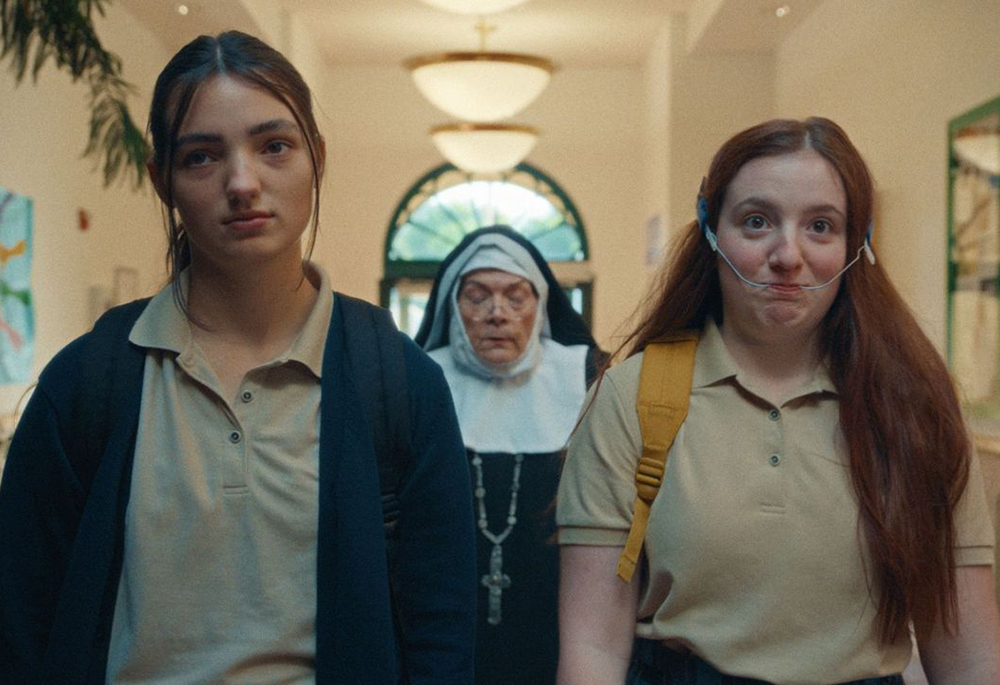
Adi Madden Cabrera, left, and McKenna Tuckett play Catholic school outcasts who start a punk band in "Edie Arnold is a Loser." (Katrina Wan PR)

by Zachary Lee
Join the Conversation
Send your thoughts to Letters to the Editor. Learn more
Visually inventive and pulsating with youthful, vivacious energy, "Edie Arnold Is a Loser" might just be the first Catholic coming-of-age punk rock story.
The film, which recently premiered at the SXSW Film & TV Festival, centers Edie (Adi Madden Cabrera), an outcast at an all-girls Catholic high school, who teams up with her best friend Frances (McKenna Tuckett) to form a punk band called The Nundead. If you have doubts that punk rock and Catholicism can coexist, this movie will prove them unfounded: One of the band's songs is about the power – and body horror – of partaking in the Eucharist.
The enthusiastic popularity of "Edie Arnold Is a Loser" at SXSW earned it a follow-up screening after its initial run. While in Austin, directors Megan Ricco and Kade Atwood spoke with the National Catholic Reporter about making the film.
This interview has been edited for length and clarity.
NCR: Megan, I read that you were basing the story on your experiences and feelings around growing up in Catholic school. I'm curious what it was like to dive back into that headspace in writing, and Kade, what was it like to set a story in a world you didn't quite know a lot about?
Ricco: I grew up in that environment but I wasn't trying to write a movie about Catholicism as much as I was just trying to write about what I knew. I knew the details of Catholic school and that particular part of Miami. I did take some things for granted during pre-production that I realized might have been innate to me, but weren't for others. Like for me, I know there's a difference between a chapel, a cathedral and a church.
Atwood: I would be so confused because I would say, "These are all the same thing. We're shooting in a church," but Megan would say, "No, we need a chapel."
I found the costuming to be very modern and not what I would expect Catholic schoolgirl attire to be. Can you talk about working with costume designer Amelia Kuhlmann to come up with the look?
Ricco: In Miami, there were two main Catholic schools, and one of them had the more traditional attire, with the skirts and polos. Where I went, everyone looked like mailmen, with Bermuda shorts and oversized rugby shirts. So I brought Amelia photos of myself in high school, and I said, "Look at us and how we've styled ourselves and use that as inspiration." The outfits aren't cute, they're messy, and when you get a bunch of girls together in a school, any sort of appearance-based impression goes out the window.
Atwood: There was an issue with church attire because we filmed in Utah, which is like a Mormon community. When we asked our extras to bring their own wardrobe, they brought dresses.
Ricco: I was like, "Why is everyone in a dress?" Then I realized that people probably thought that you wear a dress to church.
You were an evangelist in a way. You had to tell them, "Hey, we've updated our wardrobe a little bit."
Atwood: [Laughing] You show your ankles now?
Ricco: Shooting in a different religious community also made me appreciate Catholicism more. I realized that compared to other denominations, Catholicism is pretty goth. We love our bones, relics, blood … the imagery is so visceral. It has informed my creativity without me realizing it until this project. You go to Mass every Sunday, and that stuff seeps into you. And I think it really informed my sensibilities.
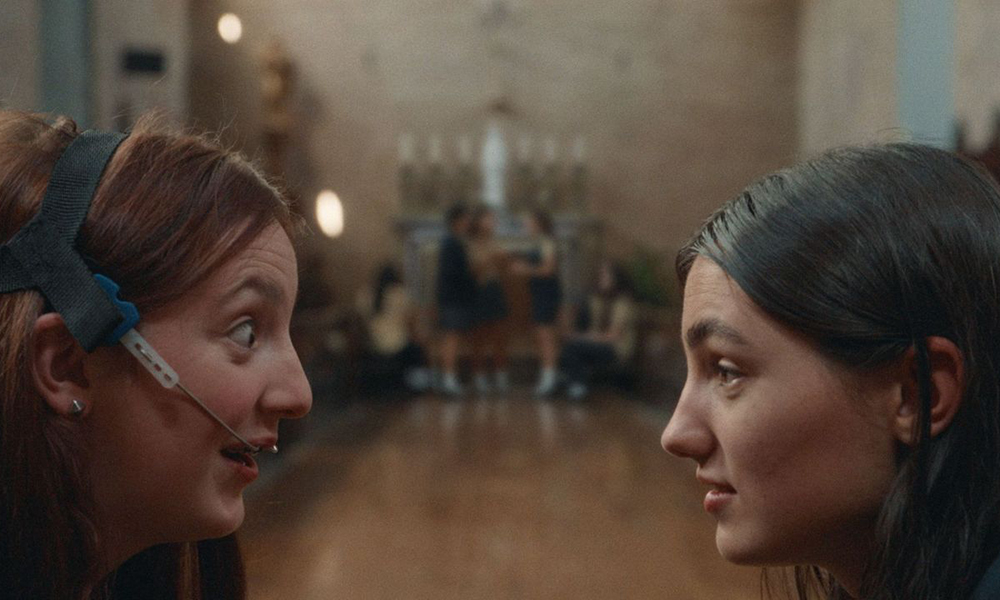
McKenna Tuckett, left, and Adi Madden Cabrera star in "Edie Arnold Is a Loser." "I realized that compared to other denominations, Catholicism is pretty goth. We love our bones, relics, blood … the imagery is so visceral. It has informed my creativity without me realizing it until this project," said director Megan Rico. (Katrina Wan PR)
Some of my favorite scenes were the ones that took elements that may be common to a churchgoer and poked fun at the ways they might be weird for people on the outside looking in.
Ricco: Church giggles are a real thing, where it's serious — we're taking the body and blood of Christ — and you have to be respectful because of what's happening around you. If one weird thing happens, the fact that you can't laugh makes you laugh even harder, and then you get yourself in trouble. I feel like the film kind of taps into that a little bit.
What was your entry point into the punk rock scene?
Ricco: We're both fans of punk music, and the punk ethos really resonates with us because it is very loud, it's messy, it's a raucous form of self-expression. We really love the DIY nature of it. That came up in the process of making a film where we didn't wait around for anyone; we said what we wanted to say. We must reflect the scene authentically through the eyes of these girls who are just coming into it. There are more hardcore punk spaces that this film does not look like, but the kind of all-ages punk that I was doing is very similar to [what] we depicted.
Atwood: I grew up listening to a lot of pop punk, but I wasn't aware of the girl riot scene. This was a real introduction for me. That movement was founded on rejecting traditional feminine roles and wanting to create a new voice and how they were portrayed and viewed within society. That is very similar to our movie, where these girls don't necessarily fit into the traditional expectations and they're having to forge their own path for who they are as people, even though it might not necessarily fit within the confines of everyone else's expectations of them.
'Compared to other denominations, Catholicism is pretty goth.'
—Megan Rico
It was striking how you contrasted the rigidity of the church space with the freedom of the punk spaces, but also how you drew connections between the two. There's a liturgical element to the punk music scene in that it has its own rhythms and rules of engagement.
Ricco: Anytime there's a communal gathering of people who like coming together to feel something deeply, there's a similarity and divinity there.
You have said it was important to use age-appropriate actors for this. What was it like to work with them, especially since it was, for many, their first time doing film?
Atwood: A great thing about working with first-time actors is that more experienced actors sometimes come in with habits that they've developed from other productions, and a lot of our actors didn't have those habits. Sometimes those habits are not great habits to have.
Ricco: We did feel very protective over our actors because they are so young, and a lot of them are young girls who have already been the recipients of negative messaging about themselves. We wanted to build them up because we cast them. They were so unique and spectacular, and I wanted to make sure they felt that. We wanted to ensure that their confidence was at the highest it could be.
I think one of my favorite exchanges is between Frances and Edie, where Edie says, "That sucked," to something Frances made, to which Frances says, "Yeah, but it exists." How does that line land for you as filmmakers?
Atwood: There's a version of life where we don't finish this movie, and we're just like, "Oh, let's just scrap this. Let's hide it and let's do something else." But we were very persistent in forging this into something good, and that takes a lot of energy and work to bring it to fruition. Even at the end of the day, if we finish this project and it doesn't have this reception, if it doesn't play in any festivals, if no one sees it, I think it's still important that it exists for us as creatives, but then also the people that we made it with.
Ricco: For me, the process of creation is so important that the process in and of itself is so important. That's the point. If we get to share it with people and experience it with others, it's like the cherry on top, but it's not the reason that we make all this. It's a painful process, right? Especially as the writer. Kade and I both grieved versions of this many times. So you're always having to let go of the last version because it's just by the nature of the process that your exact hopes for a project die and are born again.
Advertisement
Your film taps into a very particular type of grief or stress; namely, for Edie, the question of whether she has to reject her faith and her community to be herself. It's not heavy-handed or somber, but it's there, and I'm curious what it was like to make that a central emotional undercurrent.
Ricco: That tension is very real to me. I forget that not everyone experiences the world through that lens. Going to a Catholic school, specifically where there is a religious element combined with the fact that you have to discipline kids, I feel like that can lead to a warped sense of understanding of what it is to be a good person. When I would get in trouble with minor infractions, I would conflate that with big sins. I still felt like I was a capital B bad person because I was getting in trouble all the time in this religiously coded environment. Writing into that came really naturally.
That's why I love Frances' dynamic and how she's pushing Edie to be more self-loving and accepting.
Ricco: With Frances, it's a gift to be so far outside of the norm. Frances is like never going to fit in because she's so different, and so she's able to see through the artifice, and thinks, "Trying to change yourself to be accepted is not worth trying for." She represents the gift of being outside of the status quo.
The film is currently seeking nationwide distribution. Keep up with the film on its Instagram here for more information and screening updates.