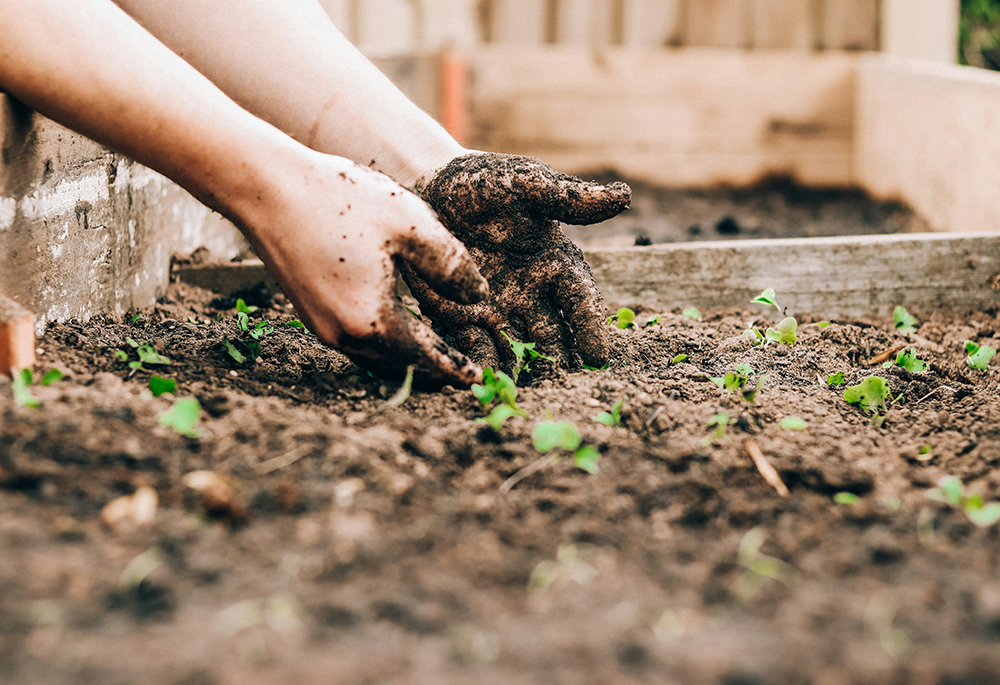
(Unsplash/Sandie Clarke)

by The Life Panelists
Join the Conversation
Send your thoughts to Letters to the Editor. Learn more

GSR logo/Toni-Ann Ortiz
For Catholic sisters around the world, acknowledging the interconnectedness between the Earth and humanity is at the heart of care for creation, whether that's expressed through protecting the Earth from destruction, or simply basking in the joyful quiet moments that allow nature to reach the depths of our being.
Creation, our panelists for The Life said, is a source of prayer and revelation in itself, and environmental stewardship cannot be separated from concern for those most vulnerable to ecological harm. Planting trees, lobbying for environmental policies, transforming spaces into community gardens, supporting young students as they learn about one's duty to care for the natural world — no gesture is too insignificant or daunting when contemplating the relationship between people and the planet, and the responsibility that relationship implies.
This month, we asked our panelists:
Do you have any plans to celebrate the Season of Creation this year? What creative, joyful or unexpected ways do you or your community use to honor and care for creation?

Sr. Deirdre Mc Kenna is a member of the Congregation of the Sisters of Mercy, an international congregation, and is based in the North of Ireland. She qualified as a fully licensed social worker in 1990 and has specialized in the area of palliative and end of life care for the past 17 years. She is author of the recently published When There Are Few Words: Exploring some of the questions that might arise for you, or someone close to you, at end of life. Alongside her formal ministry, she is currently working on her second book.
For the Sisters of Mercy, caring for creation is not simply an ecological concern; it is a sacred response to the presence of God revealed through all life. Nature is experienced not as background scenery to human existence, but as teacher, companion and a living expression of grace. The Earth speaks a quiet theology. Gardens become places of prayer. Rivers, trees, birdsong and changing seasons reveal something of the divine mystery unfolding through ordinary life.
The sisters honor and care for creation in many creative, joyful and sometimes unexpected ways. Some cultivate community gardens where vegetables, herbs and flowers are grown not only for nourishment, but also as acts of reverence and gratitude. Hands in soil become a form of communion. Others create opportunities for people to reconnect with the natural world through ecological retreats, outdoor liturgies and seasonal rituals. A sunrise prayer gathering, a blessing of seeds in spring, or a silent walk beneath autumn trees can awaken a renewed awareness that creation itself carries wisdom.

Mercy Sr. Deirdre Mc Kenna took this photo during the fall in Ireland. "Rivers, trees, birdsong and changing seasons reveal something of the divine mystery unfolding through ordinary life," Mc Kenna writes. (Deirdre Mc Kenna)
In these moments, nature becomes revelation, quietly reminding us that nothing is separate and everything belongs.
Underlying these actions is a deep sense of interconnectedness. The sisters recognize that care for the Earth is inseparable from care for people, especially the poor and vulnerable who are most affected by environmental destruction. To protect creation is therefore an act of mercy and justice. It reflects the understanding that grace moves through relationships; between humanity, the earth, and the divine presence sustaining all things.
There is also something beautifully humble in the sisters' approach. Often the work is quiet and unnoticed: tending a plant, feeding birds in winter, reducing waste, pausing to notice light falling through a window, or giving thanks for rain when the earth is thirsting. Yet these small gestures carry profound meaning. They remind us that we live within the interconnectedness of all life.
In this vision, caring for the Earth becomes more than environmental stewardship. It becomes prayer lived outwardly through tenderness, wonder, gratitude and joyful participation in the sacredness of life itself.
Advertisement

Sr. Erin Zubal, an Ursuline Sister of Cleveland, is chief of staff at Network Lobby for Catholic Social Justice. In this role, she leads internal coordination and integration of teams and operations to advance Network's mission. Zubal is the first person to serve in this position and brings a depth of knowledge and experience in education, social work and public policy to the role. She served for 15 years as a social worker and educator in Catholic elementary and high schools in the Cleveland Diocese. She holds a master's in social work administration from Case Western Reserve University and a master's in educational administration from Ursuline College.
This year the Season of Creation is hard. As people of faith celebrate the goodness of all of God's creation, we continue to face threats to the health and well-being of millions of our neighbors, as well as the destruction of the shared beauty of Mother Earth we call home.
The presidential administration of the United States has dismantled environmental protections against toxic chemicals, exposing millions of people to increased cancer risks and potential long-term health harms. This is a grave injustice fueled by indifference and disrespect to both the natural environment and human dignity.
Meanwhile, proposals to open areas near our national lands to the fossil fuel industries jeopardize wildlife habitats and beauty of nature that countless people have enjoyed and marveled at as our shared treasure. This is indifference mixed with commodifying, of taking what God has given all of us and hollowing it out for the short-term benefit of a wealthy few.

Every election year, the Network Lobby for Catholic Social Justice takes to the road with Nuns on the Bus, a cross-country tour that educates voters on multi-issue voting. (GSR photo/Carol Zimmermann)
It's tempting to lose hope. This is why I'm grateful to serve with the community of Network Lobby for Catholic Social Justice. My colleagues tirelessly advocate for justice at the federal level, including environmental justice.
It inspires me even more to see justice-seekers across the country taking up Network's call and advocating powerfully in their local communities and making their views known to their lawmakers. This energy is contagious. It's authentic and tenacious, truly in the spirit of the Sisters who founded Network over 50 years ago.
But our present day reminds us that the work is slow and that we will face setbacks and suffering along the way. Even with this knowledge, we keep acting in faith and hope. We keep trying, also knowing that everything touched by God is forever transformed.
We are challenged as Christians to remember that even the resurrected Jesus still had his scars. And in that spirit, this Season of Creation, we also pray for resurrection, wholeness and oneness for and with all God has made and gifted to us. May our actions on behalf of peace and justice continue to be our prayer back to the world.

Environmental activists march to the U.S. Capitol during a climate change protest in Washington Oct. 15, 2021. (CNS/Reuters/Jonathan Ernst)

Sr. Jacintha Rantšo is currently the provincial leader of the Servants of the Immaculate Heart of Mary, also known as the Good Shepherd Sisters of Quebec. She lives in Lesotho, southern Africa. She joined the congregation in 1983 as a postulant. First, she taught in high school and later on trained as a social worker. She holds a degree from the University of Namibia. After graduation, Rantšo worked with those affected by HIV and AIDS from 2004-2011 then became an assistant of the provincial leader. She was appointed as provincial in 2017.
There is something we discerned to do as a community of Sisters of Notre Dame, Syokimau through the Notre Dame School. The primary ministry of this place is to provide private education from play-group to junior secondary, where there are more than 1,000 students altogether.
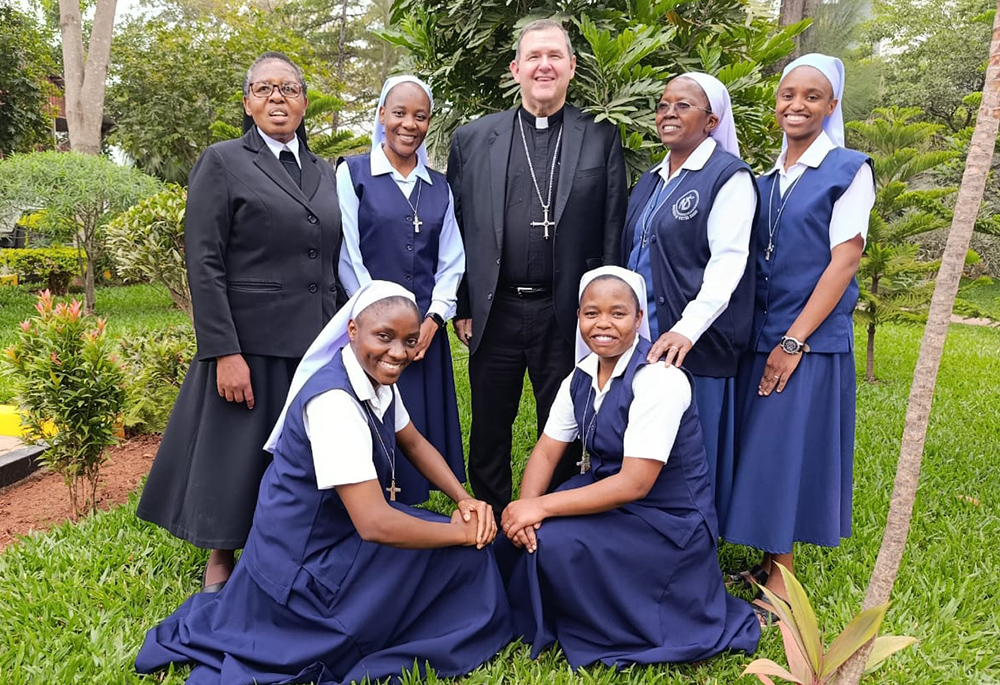
The Notre Dame Community at Syokimau in Kenya pose at their convent July 25, 2026. Pictured, from left: Sr. Jacintha Rantšo of the Servants of the Immaculate Heart of Mary; Notre Dame Sr. Mary Teopista; visiting Bishop John Curtis Iffert of Covington, Kentucky; Notre Dame Srs. Mary Christine and Mary Amalia; in front row: Notre Dame Srs. Mary Lucia and Mary Felisitas. (Sr. Jacintha Rantšo)
According to their syllabus, the grade 3 learners had some environmental subjects and decided with their teachers to hold an excursion; parents and the guardians could be invited to give educational support and be integrated in the process of caring for the environment. It was great indeed to observe such quality presentations made by 8-year-olds with such confidence and competence.
Among others, they presented on what the environment is and the role of other creatures towards the environment — particularly human beings as the core caregivers and stewards of God's creation.
Sr. Ritamary Brown, a Hospital Sister of St Francis, is a volunteer at Hospital Sisters Mission Outreach, a nonprofit global health entity founded in 2002 by the Hospital Sisters of St. Francis. Her professional experience includes a 40-year career as a dietitian and administrator throughout Hospital Sisters Health System hospitals. Her roles have been in both clinical and administrative areas, including food/nutrition, mission, facilities, environmental services and advocacy. She has also been involved with efforts that serve those who experience poverty and promote equitable access to health care, such as a pregnancy care center, an organ and tissue transplant program, and the American Dietetic Association, now known as the Academy of Nutrition and Dietetics.
As a Franciscan, I have been influenced by St. Francis much of my life. My community has special prayers, beautiful paintings and statues, and reminders of him throughout our motherhouse. Our sisters could get dying plants and love them back to beauty.
Every Earth Day we celebrate with a prayer service outdoors, followed by the planting of a tree. One of my favorite things to do is to take a long evening walk through our beautiful cemetery up to Crucifixion Hill. Here there is a life-sized statue of St. Francis and the wolf of Gubbio. I love to just sit on a bench and ponder what his life means to me and what a gift the hundreds of sisters buried here have meant to me as they followed our Franciscan rule.
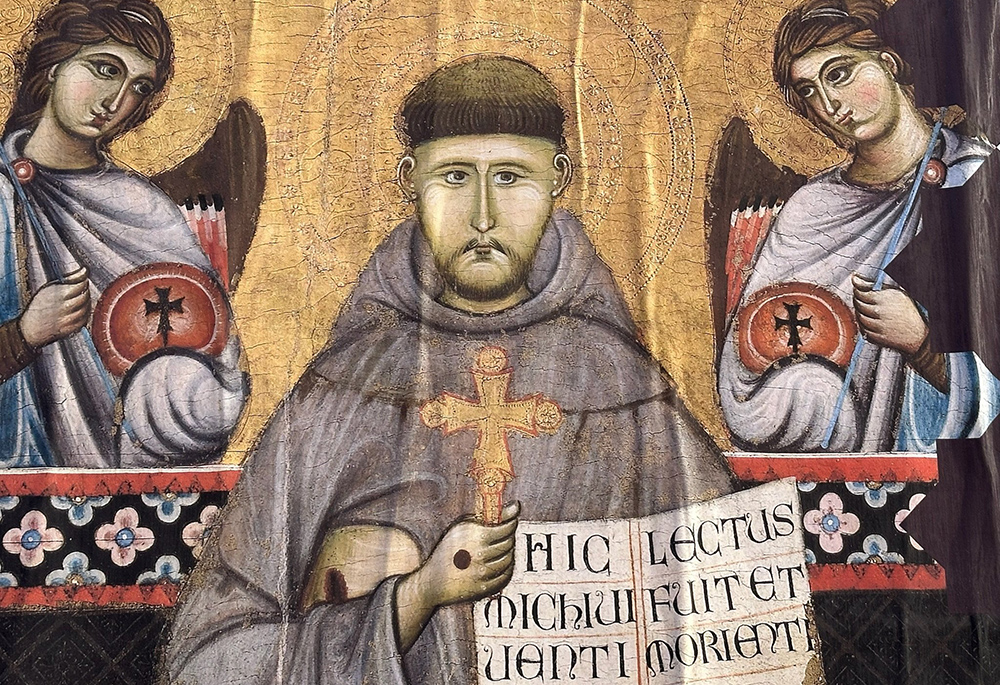
A 12th-century painting of St. Francis with Angels by an unknown artist known as the Master of St. Francis is on display at the Basilica of St. Mary of the Angels in Assisi, Italy, Feb. 22, 2026. (OSV News/Courtney Mares)
During the Season of Creation my community will hang a banner in the ambo of our chapel; we include intercessions during our morning prayer asking blessings for our world; we have Holy Hour with a Season of Creation theme on the feast of the Stigmata of St. Francis, Sept. 17; and we conclude this sacred time on Oct. 3 during our traditional Transitus with thanksgiving and praise for all of God's mighty works.
I love the theme this year, "Living Water" (Ezekiel 47:9, 12), which is a powerful biblical vision of hope and ecological healing. Ezekiel was offering a vision of hope expressed through active care for the Earth, our common home. His vision and hope are much needed today as we struggle with a consumeristic culture of tossing things out without thinking of the harm they are doing to our Earth.
Let us all listen to the call from the 2026 Season of Creation Celebration Guide:
Let us overcome our fear and step into the water of God's love — to be part of the River of Transformation for the world, to see the literal healing and renewal of creation and the blessing of the Earth.

Sr. Mary Lilian Akhere Ehidiamhen, from Nigeria, is a member of the Sisters for Christian Community. She is a certified trainer on nonviolent communication with the Center for Nonviolent Communication in Austin, Texas. She majored in theological ethics with specific interest in social and peace ethics from KU Leuven in Belgium. Her ministry focuses on how nonviolent communication can contribute to Catholic Social Teaching on peace. She is currently teaching religious education at St. Ignatius College in Enfield, London.
The Sisters for Christian Community show that caring for creation does not have to feel like a burden. Instead, it can be joyful, imaginative and deeply connected to everyday life. For the sisters, creation is not simply something that needs to be protected. It is a gift from God that can bring people peace, hope and a stronger sense of community.
Sr. Rita Yeasted's experience of gardening is a good example. When the previous owners of her house removed a children's paddling pool, they left a large circular hole in the garden. Rather than seeing this as an inconvenience, Rita turned it into a colourful flower bed. She planted spring bulbs, daylilies and summer flowers, then began growing tomatoes, peppers and vegetables in pots and raised beds.
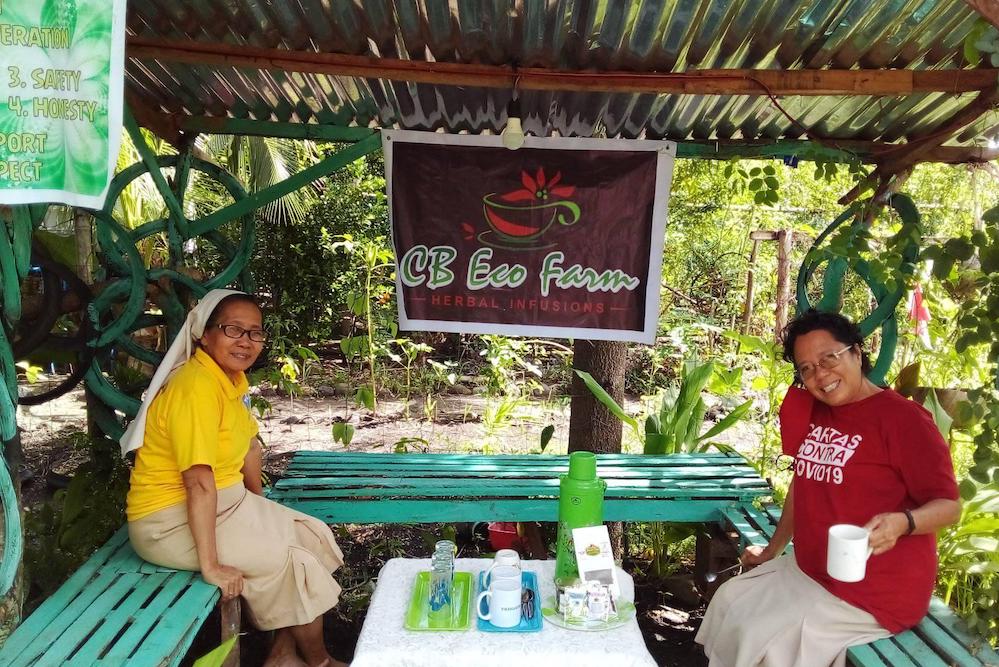
Sr. Ejasmin Lucasan, left, and Sr. Alma Mangao, members of Sisters For Christian Community , have tea at the Caritas Bliss Eco Farm in San Carlos City, Negros Occidental, Philippines. (Courtesy of Sisters for Christian Community)
Gardening became much more than a hobby for Rita, especially during the COVID-19 pandemic. Planting, weeding and harvesting helped her cope with a difficult and uncertain time. It also taught her patience because plants do not always grow as expected. Even the deer and rabbits that ate some of her vegetables became part of the story. Working with the soil helped Rita feel closer to nature and to God, turning her garden into a place of prayer.
In the Philippines, Srs. Alma Mangao and Ejasmin Lucasan care for creation on a larger scale. They transformed 1.5 hectares of land into Caritas Bliss Eco Farm. The farm grows organic fruit, vegetables, trees and medicinal plants. It provides food for the sisters while also supporting poorer families. Local mothers sell the produce and keep the profits, showing how environmental care can create dignity and opportunity.
Sisters for Christian Community teaches that caring for creation can be practical, spiritual and fun. Through gardening, farming, recycling, walking, photography and laughter, the sisters celebrate the natural world while helping others. Their example reminds us that creation is not only something to save, but also something to notice, enjoy and love.