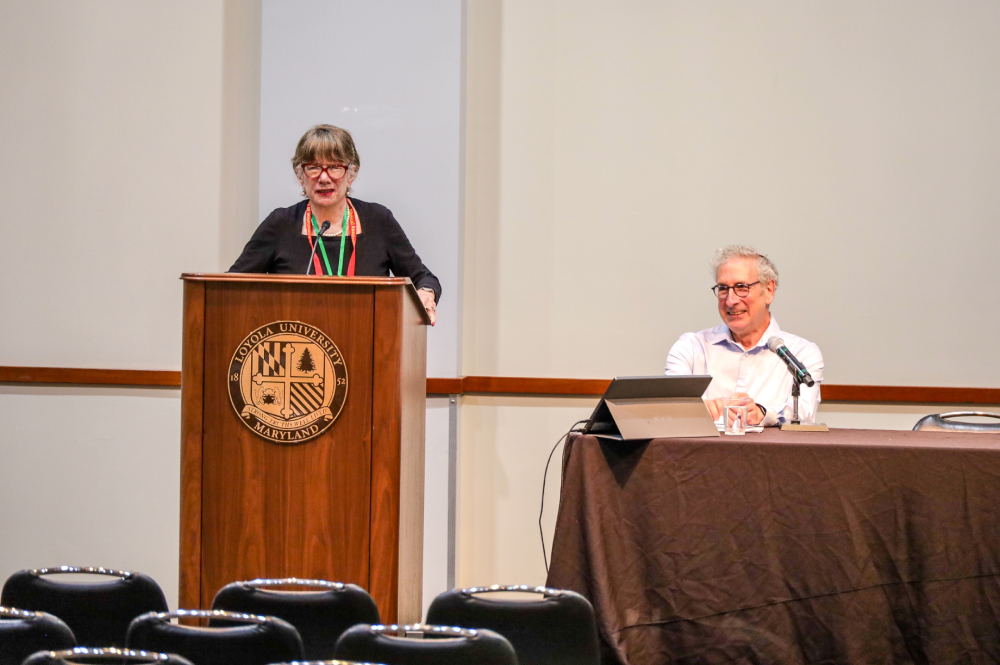
Amy-Jill Levine addresses the 2026 Annual General Meeting at the Catholic Biblical Association of America after being elected president and honored at the evening general session, July 20. (Courtesy of Catholic Biblical Association of America)

Join the Conversation
Send your thoughts to Letters to the Editor. Learn more
When Amy-Jill Levine learned that she was being considered for the presidency of the Catholic Biblical Association of America, the veteran New Testament scholar wondered whether someone was playing a trick on her.
"When the chair of the nominating committee informed me of this last year, I actually wrote to another member of the committee and said, 'Is this a joke?' because I was stunned," Levine said, adding that she is honored and grateful to be chosen for this role. "I'm honored and I'm grateful."
The surprise became official at the association's 2026 annual general meeting in Baltimore, July 20, where members affirmed Levine as president for the 2026-2027 term — making her the first Jewish scholar to hold the position in the organization’s history.
Her election marks a significant moment for an organization created by American Catholic biblical scholars in 1936. Initially connected as an effort to revise the English-language New Testament used by Catholics, the association gradually expanded its mission to include academic research, scholarly publications and the dissemination of biblical scholarship to broader audiences. It began with 50 charter members and had grown to more than 1,070 members worldwide by 2024. Although faith remains central to its mission, the association includes Catholic, non-Catholic and Jewish scholars.
Levine said she sees her election as a recognition of nearly five decades of involvement in the association. She has served on numerous committees, worked as a consultor and spent 12 years as book review editor for "The Catholic Biblical Quarterly." The organization's records list her as a full member since 1988, as well as a former associate editor, consultant, book review editor and vice president.
"In part, it's a recognition for the hours and hours and hours I have put into the work of the association, and I'm very appreciative that that work has been recognized," she said.

Amy-Jill Levine, the first Jewish president in the history of the Catholic Biblical Association of America. (Courtesy of Catholic Biblical Association of America)
Levine is the Rabbi Stanley M. Kessler Distinguished Professor of New Testament and Jewish Studies at Hartford International University for Religion and Peace, in Hartford, Connecticut, and professor emerita at Vanderbilt University in Nashville, Tennessee. She has written and edited widely-read works including The Misunderstood Jew, The Bible With and Without Jesus and The Jewish Annotated New Testament. In 2019, she became the first Jewish scholar to teach the New Testament at the Pontifical Biblical Institute in Rome, and she was elected to the American Academy of Arts and Sciences in 2021.
Her relationship with Catholicism began long before her academic career.
"I have been carrying on a love affair with the Catholic Church since I was 7 years old, and that hasn't stopped," Levine said. "It's chaste, and it continues."
Levine said she values the association because its members connect rigorous historical research with theology and pastoral life. Rather than asking only what a biblical passage meant in the world in which it was written, she said, the association's scholars also consider how it has been interpreted through history and how it functions today in churches, classrooms, Bible studies and catechetical programs.
That connection between scholarship and religious practice is expected to be central to Levine's one-year presidency. Among her priorities are implementing recommendations from the association's strategic planning process, increasing transparency in its executive work, strengthening relations with the U.S. Conference of Catholic Bishops and expanding international outreach, particularly through materials for Spanish-speaking audiences.
She also wants the association to confront anti-Jewish interpretations of Christian Scripture and help ensure that contemporary biblical research reaches priests, teachers and homilists.
"The problem is getting the academic material into the hands of priests and homilists," Levine said.
Many clergy members, she argued, continue to rely on commentaries acquired during their seminary education decades ago rather than newer research on the Jewish contexts of Jesus, the Pharisees and the Gospels. She also expressed concern about clergy members using artificial intelligence to produce sermons, saying such systems can reproduce antisemitic stereotypes drawn from broader cultural material.
Advertisement
"I would like to get this better material into the hands of people who are speaking to people in the pews, into the hands of people in parochial schools who are teaching biblical studies to teenagers or to little kids, and mainstream it," Levine said. "It hasn't been done."
Sr. Mary C. Boys, a longtime scholar in Jewish-Christian dialogue and professor of practical theology at Union Theological Seminary in New York, said anti-Judaism in contemporary Catholic life is often transmitted through a failure to recognize the implications of particular biblical interpretations. Her latest book, Blessing of a New Dawn: Reorienting Christianity's Relation to Judaism, focuses on how antisemitic and anti-Judaic narratives are still present in today's Catholic practices.
"In my experience, most homilists are unaware of the potential of texts to reinforce certain stereotypes about Jews and Judaism. Texts that can lend themselves to antisemitism, particularly now given certain cultural direction," Boys said.
She believes the Catholic Biblical Association's scholarship and publications could exercise greater influence on pastoral practice, but only when clergy choose to study biblical texts in their historical contexts.
"I don't think the bishops are giving enough emphasis to the importance of the study of Scripture, as it has pastoral meaning," Boys said. "That worries me."
For Boys, Levine's election cannot be separated from the relationships she has built within the association. At the annual meeting, colleagues surprised Levine with a book titled Disruptive Readings: Essays Honoring the Work and Wisdom of Amy-Jill Levine, a collection celebrating her scholarship.
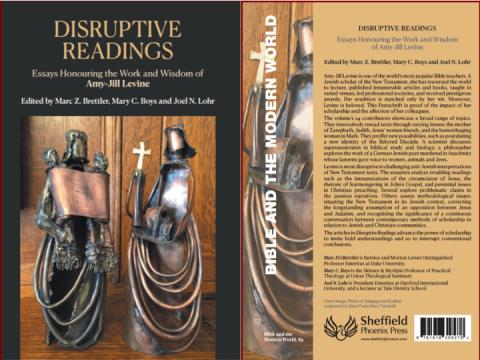
At the 2026 Catholic Biblical Association of America annual meeting, colleagues surprised Levine with a book titled Disruptive Readings: Essays Honoring the Work and Wisdom of Amy-Jill Levine, a collection celebrating her scholarship. (Courtesy of Sr. Mary Boys)
"The affection in the room for Amy-Jill that evening" was unmistakable, Boys recalled.
"It's not just that she's a Jew, but because she has been part of the work of the CBA for years, the friendships, the collaboration, the commitment to working, all of those things," Boys said. "Those are what counted."
Levine described herself as "a guest in this house," albeit a nearly permanent one. Her approach to Jewish-Christian scholarship is not to challenge Catholic doctrines, she said, but to examine the historical and human setting in which Christianity emerged.
During one of her three encounters with Pope Francis at the Vatican, Levine and biblical scholar Marc Zvi Brettler presented him with a copy of The Jewish Annotated New Testament, the volume they co-edited to help readers understand the New Testament within its Jewish historical and cultural setting.
Levine recalled that Francis "reached out and he took my hand and he took Marc's hand and said 'this is very important, please continue your work,' and then he took the book and said to his aide 'please keep this where I can use it.'"
Boys described the volume's pastoral significance more directly: "That book is something every Catholic preacher and teacher should have," she said, holding it smiling with pride in front of the camera.
"What I'm interested in doing is taking Jesus' humanity with full seriousness and seeing him as embedded in a particular time and place, as a Jewish man," she said. "Because if we get the culture wrong, we're going to get Jesus wrong."
For Levine, that historical approach does not diminish Catholic faith. Instead, she said, it can deepen Catholic theology by taking "with abundance seriously the humanity of this person [Jesus Christ] whom the church proclaims to be God."