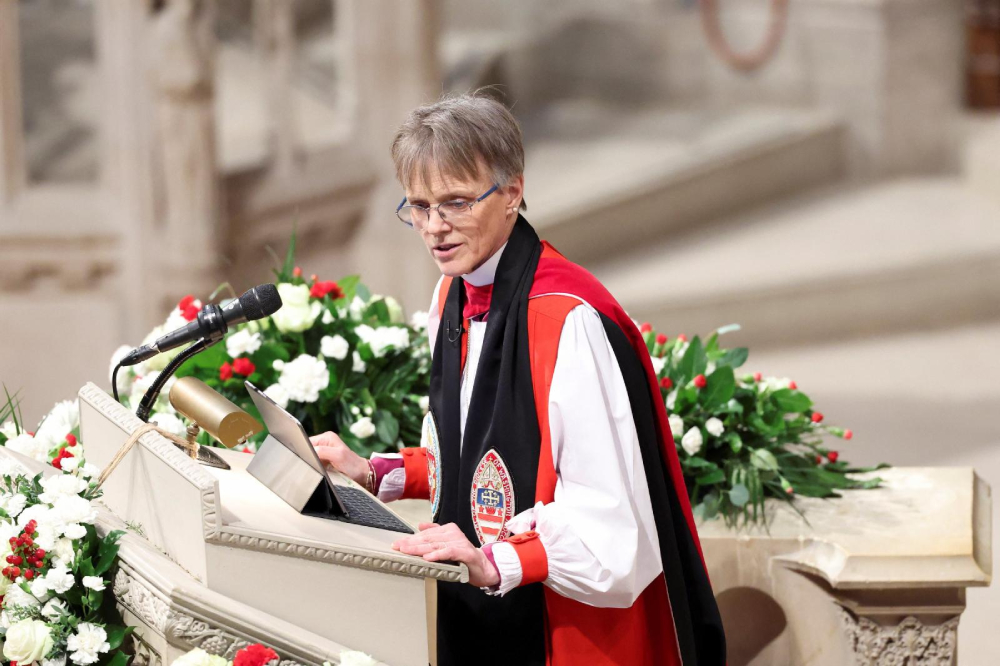
Bishop Mariann Edgar Budde delivers the sermon at a national prayer service Jan. 21, 2025, at the Washington National Cathedral. (OSV News/Reuters/Kevin Lamarque)

Religion News Service
Join the Conversation
Send your thoughts to Letters to the Editor. Learn more
The Rt. Rev. Mariann Budde, who shot to fame after urging President Donald Trump to have mercy on immigrants and others, announced on Thursday, Oct. 1 that she plans to resign as head of the Episcopal Diocese of Washington. The move sets in motion a nearly two-year process to find her replacement as she finishes out her lengthy tenure as one of the country’s most visible religious leaders.
Budde will remain the Episcopal bishop of Washington until June 2028, when her replacement will be consecrated.
In an exclusive interview with Religion News Service on Wednesday, Sept. 30, Budde said that when her term is over, she plans to return to Minnesota, her home state.
“I’m going to do all that I can to both lead well in this period, and to ensure that there’s as much wind in the sails of the future leader and the diocese going forward as is humanly possible,” Budde said via a video call.
Budde said her departure is officially designated as a resignation, not a retirement, because prelates in the Episcopal Church typically retain the title of bishop even after they leave posts. But she will remain bishop throughout the process, which will involve creating a search committee, choosing a slate of candidates and electing a new bishop in January 2028.
“It’s kind of awkward in that way, because I have to announce it — or we have to announce it — and then life goes back as usual for two years,” she said.
Budde herself will be largely divorced from the selection process. But the bishop said she has been studying “eldership” — reading up on biblical models of older leaders, such as Moses — and is focused on “leaving well” so her successor and the diocese “can thrive” after she is gone.
“They deserve another long, fruitful tenure, and I’d like to do everything in my power to make that happen,” she said.
While leading the Episcopal Diocese of Washington is considered to be an influential position within the Episcopal Church, Budde’s term has been long (she will have led the diocese for 17 years when she leaves) and unusually prominent. She made headlines from the start: When she was elected to the position in 2012, she became the first woman to hold the position, inspiring women throughout the Anglican Communion — some of whom trekked to Washington to learn from her.
Advertisement
Budde is even more widely known for her role in U.S. politics, which has garnered an atypical level of national attention for an Episcopal bishop. Like many Washington-based faith leaders, Budde has participated in activism, such a joining a protest outside Kentucky Republican Sen. Mitch McConnell’s office in 2019 to call for legislation to prevent gun violence. She also offered a prayer at the 2020 Democratic National Convention.
But it’s Budde’s confrontations with President Donald Trump that have made her a nationally known figure. The bishop initially struck a conciliatory tone when Trump was elected in 2016, agreeing to host the national prayer service at the National Cathedral for the incoming president despite calls to cancel the long-running event. But Budde was involved in protests against the president during his first term, and when federal police directed by the Trump administration forcibly removed racial justice demonstrators from Lafayette Square in June 2020 — which included expelling an Episcopal priest and a seminarian from the patio of St. John’s Church, an Episcopal congregation — Budde voiced outrage in national news outlets, condemning the police action as well as the president’s photo-op in front of the church immediately after.
The back-and-forth between the two culminated with a dramatic moment on the first day of Trump’s second term, when the president sat in the pews of the Washington National Cathedral as Budde delivered a sermon urging him to “have mercy” on immigrants and LGBTQ children. The sermon, which spurred a fierce rebuke from Trump and his allies, transformed Budde into an international figure overnight: Supporters created “Bishop Budde Fan Club” T-shirts, and Budde’s book, How We Learn to Be Brave: Decisive Moments in Life and Faith, suddenly became a hit.
But when asked about highlights from her time as bishop, Budde demurred, saying she is “not ready to do that whole retrospective thing” because she remains focused on the next two years of her term.
If anything, she said, the fraught nature of U.S. politics has kept the bishop in her post longer than she originally planned to be. It was not because of the fame she attracted, although she said she is “mindful” that her role has “shifted dramatically” since she delivered the sermon to Trump. Instead, Budde cited the “impact that the dramatic realignment of the federal government had on our diocese” as pushing her to “stay longer.”
The winnowing of government agencies under the Trump administration, she said, had a “huge seismic impact” on congregations she serves — a trend that affected religious communities throughout Washington, D.C. As a result, Budde’s original plans for resignation were delayed, as it was “not the time,” she said.
But she continued to talk to friends, colleagues and family members about potentially resigning and to pray about “core questions of identity and faithfulness” such as, “Where am I, Lord, in the arc of things?” Eventually, Budde made the decision to begin the resignation process.
As the changeover begins, she says she understands that “there will be sadness” from many of her supporters, such as those who have chanted words of thanks to her at various protests. Budde also joked that some of her critics may react differently to the news.
“I think there may be a few people who are like, ‘Oh — OK then,’” she said, laughing.
Even so, Budde stressed that while she may accept fewer speaking invitations over the next two years, she doesn’t intend to stop participating in religious advocacy.
“That won’t slow down until I leave,” she said.
In the meantime, Budde said, she is looking forward to moving with her husband to Minnesota, where she also recently joined religious activists protesting the Trump administration’s mass deportation effort in and around Minneapolis earlier this year. She’s not sure what happens after that, she said, but after years of living the strictly managed life of a diocesan bishop, Budde seemed almost excited about the prospect of a less structured existence — even if it’s nearly two years away.
“I don’t have clarity about that,” she said. “All I know is that we’re going back to Minnesota, and I’m going to be close to my grandchildren, which I miss dearly.”
Budde then grinned, adding: “And then we’ll see.”