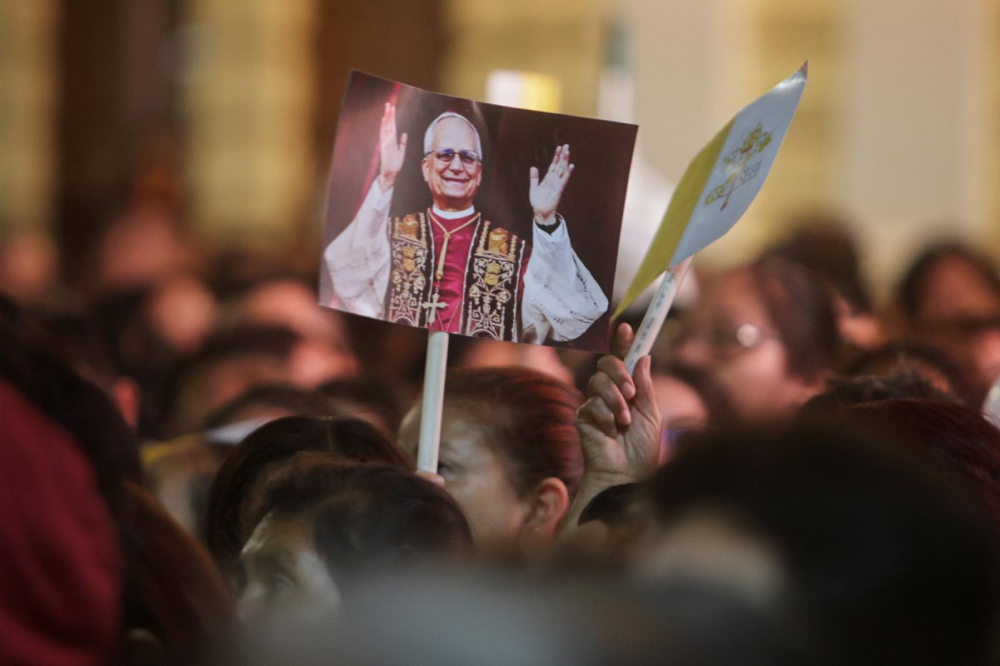
Someone holds a placard with an image of Pope Leo XIV on the day of a Mass at the Cathedral of Santa Maria de Chiclayo in Peru May 10, 2025, celebrating the election of Pope Leo XIV May 8 at the Vatican. The new pope was bishop of Chiclayo between 2015 and 2023. (OSV News/Reuters/Sebastian Castaneda)
Join the Conversation
Send your thoughts to Letters to the Editor. Learn more
From the first words of his pontificate, Pope Leo XIV called for a synodal church that listens to its members and has repeatedly demonstrated his determination to press ahead with the sometimes controversial concept of synodality.
In a June meeting of the world's cardinals at the Vatican, the pope continued to make the case for synodality — the catch-all term for creating a more participatory church among all of its members promoted by Pope Francis — calling it "a spiritual way" for the church, but not without backlash.
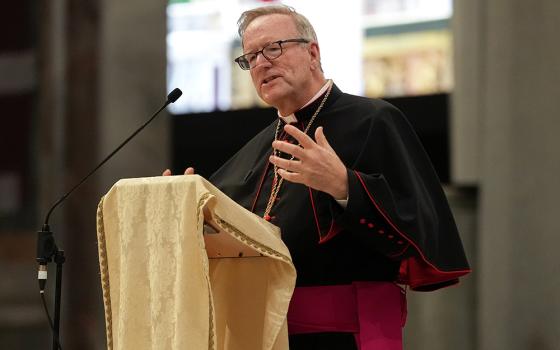
Traditionalist Catholics, in particular, fear that synodality and the increased role of the laity and women in church decision-making could erode the authority of the hierarchy. U.S. Cardinal Raymond Burke recently said in reference to the meeting of cardinals that Catholics must "insist that this whole synodality business stop."
Yet looking back at Leo's track record as bishop of the ecclesiastically complex Diocese of Chiclayo, Peru, from 2014 to 2023 showed that prior to Francis' popularization of the term in 2021, and long before the papacy was even a distant prospect for the U.S.-born missionary, the future pope was in many ways ahead of the curve in implementing synodality.
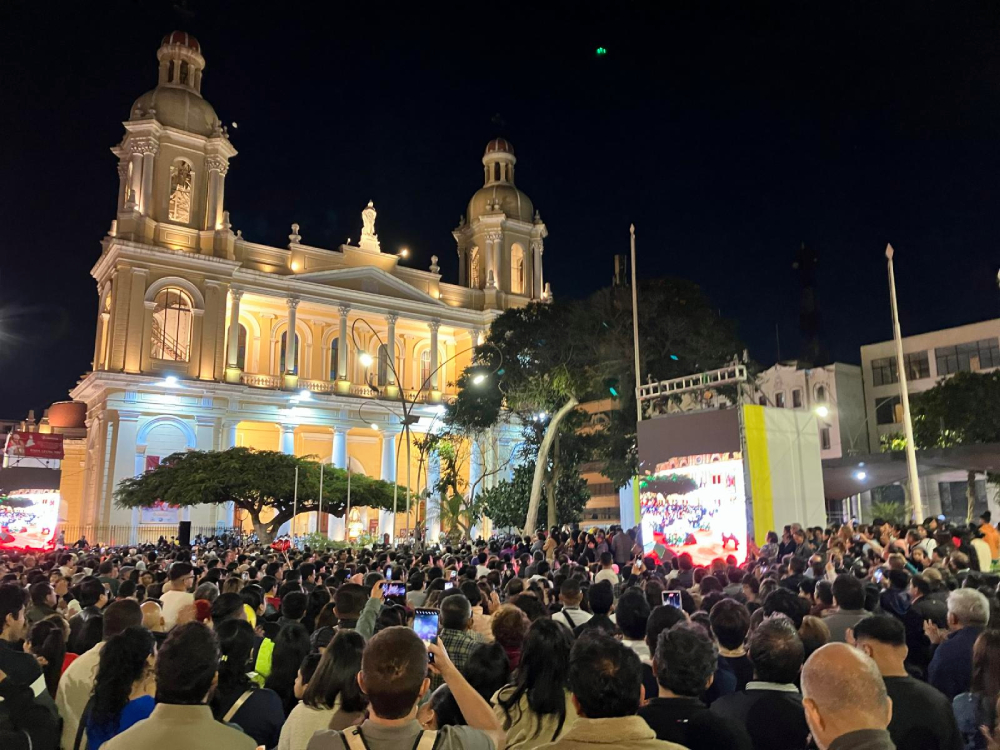
Thousands of people gather for Mass outside the Cathedral of Santa Maria de Chiclayo in Peru May 10, 2025, celebrating the election of Pope Leo XIV, who was bishop of Chiclayo between 2015 and 2023. (OSV News/David Agren)
Just three years before being elected pope, then-Bishop Prevost stood before a packed assembly hall in Chiclayo and urged his flock to embrace something that, he said, "comes from the first years of the church, but for us is perhaps new: to feel that we are truly co-responsible members of the life of the church."
With that speech he delivered his vision of synodality to representatives of 40 parishes across his diocese, many still wearing face masks after the COVID-19 pandemic had devastated northern Peru.
"Much more than a process, it is an attitude of being missionaries," Prevost told the May 2022 gathering. "We have to go out, we have to reach out, invite, and seek out those who may still be far from the church or from the Lord," he said.
Prevost arrives in a divided Chiclayo
Arriving in Chiclayo in November 2014, Prevost entered a church landscape with a vibrant lay community, but one that had often felt sidelined from diocesan life and which remained heavily shaped by clericalism. Religious movements, pastoral groups, catechists and parish volunteers performed much of the church's work but often operated in silos.
César Piscoya, a lay theologian from Chiclayo who would become one of Prevost's closest collaborators in the diocese, wrote that laypeople and foreign missionaries had formed groups outside of institutional church structures in the 1980s to cultivate a spirituality rooted in liberation theology, focused on caring for the community's poor and marginalized, amid resistant diocesan leadership heavily influenced by the conservative Catholic group Opus Dei.
The result was a decidedly divided church both in its spirituality and vision for the local Catholic community. It was against that backdrop that Prevost, in 2017, brought Piscoya, then living in Bolivia, back to Chiclayo to help coordinate the diocese's pastoral outreach.
The roots of Prevost's synodal approach started with the creation of the "diocesan pastoral animation team," known by its Spanish acronym EDAP and which was spearheaded by Piscoya.
The group began with roughly a dozen priests, religious and lay men and women who received ongoing biblical, spiritual and pastoral formation. They then traveled through nearly all of the diocese's approximately 50 parishes to listen to local needs, lead meetings, retreats and days of reflection, and help communities organize pastoral initiatives such as soup kitchens or youth ministries.
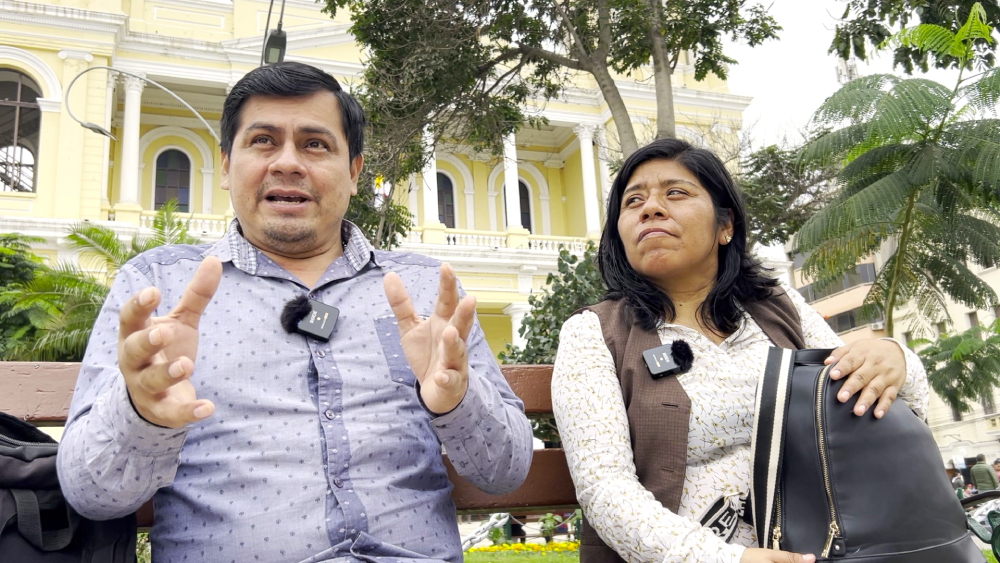
Luis Antonio Zapata, left, and Gladys Calderón, right, speak to the National Catholic Reporter during an August 2025 interview in front of St. Mary's Cathedral in Chiclayo, Peru, in August 2025. (NCR photo/Justin McLellan)
Piscoya later described the EDAP as a kind of "synodal laboratory" where church authority met new forms of shared discernment that included the voices of the laity.
"At that time, Msgr. Robert [Prevost] talked about co-responsibility of the layperson," said Luis Antonio Zapata, a catechist who joined the EDAP in 2018. Prevost would say, "the priests are busy with their tasks, get more laypeople in here, because the laity is best able to reach the laity," he recalled.
EDAP members visited parishes to reproduce the formation they had received at the diocesan level. What emerged was a diocesan-wide network of "pastoral animation" teams made up of clergy and laypeople, extending from individual parishes through Chiclayo's five arciprestazgos, or deaneries, and connecting back to the diocesan team.
Those structures gave the diocese a channel through which formation, pastoral priorities and local concerns could move between its center and individual communities.
They also brought together Catholics who had long operated in separate worlds within the same diocese.
Prevost, Zapata said, inherited "a diocese where each charism, each lay movement, pastoral team, each confraternity was the master of its own rules and its own planning."
As a result, EDAP encountered many "stubborn ones that don't want to change, or want to stay as the boss," he said. "It was not something that was easy, because many said, 'How can this young person, or this old lady, also do this, if I've always done it?'" Zapata told the National Catholic Reporter.
In those moments, "Msgr. [Prevost] would come, communicate, transmit our formation and spirituality and transform them," he said.
Learning synodality
The EDAP infrastructure provided a skeleton onto which the formal synodal process was easily mapped.
When Pope Francis launched the worldwide Synod on Synodality in 2021, calling for global discussions on church participation in local communities, Chiclayo's pastoral team pivoted its focus toward the synodal process and brought in additional priests, religious and laypeople. As it had done with earlier pastoral formation, the EDAP-trained members would then travel into parishes and help form local synodal teams.
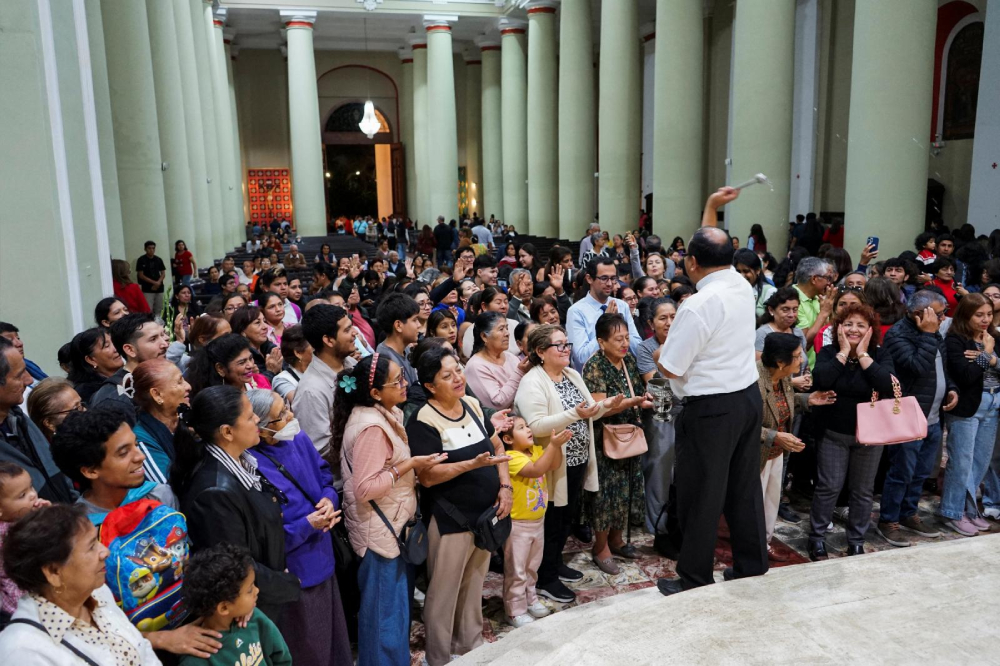
A priest sprinkles holy water on worshippers after Mass at the Cathedral of St. Mary in Chiclayo, Peru, May 8, 2025, the day Cardinal Robert Francis Prevost was elected pope, choosing the name Leo XIV. As an Augustinian priest, then-Father Prevost spent many years as a missionary in Peru. (OSV News/Reuters/Diego Torres Menchola)
But even in Chiclayo, where participatory structures were already taking shape, the meaning of synodality could be difficult to grasp.
Fr. Elmer Uchofen, who helped lead the diocese's synodal process, said that when the project was first unveiled, "we thought it was a small thing, that we would just have to do one meeting and it would be over."
Prevost had other ideas.
To help the diocese understand what the process required, he turned to a fellow Augustinian: Bishop Luis Marín de San Martín, then undersecretary of the Vatican's synod office.
The Spanish bishop, who Prevost as pope would tap to lead the Vatican's charitable arm, traveled to Chiclayo and met with diocesan priests and laypeople to explain synodality.
"He spoke to us about encounter, about needing to listen to later see what path to take, but our mentality and that of the church is, 'We want an answer, we want to take an action and that tomorrow it is finished,' but we had to understand that it was a process," Uchofen said. "I told Msgr. Prevost, 'If after these talks we don't understand what synodality is, what hope do we have here?'"
Prevost participated in the diocesan training sessions, sharing Vatican resources and assigning study topics to formation groups. He later sat in on the synodal assemblies, modeling synodality for those who were just learning it.
"His way of being helped a lot, because he was a bishop that knew how to listen and to be patient," said Uchofen. "He would sit in the groups and listen to the people, to everyone: priests, the laity, to the ones that were drifting a bit or had fallen away from the church. In that sense he was a real pastor."
EDAP members hosted assemblies for parishes and other church groups to learn about synodality, instructing participants on the teachings of the Second Vatican Council, the Latin American bishops' 2007 Aparecida document — a foundational text for Francis' vision of a pastoral-first church that draws close to those on the margin— and the synodal themes of communion, participation and mission.
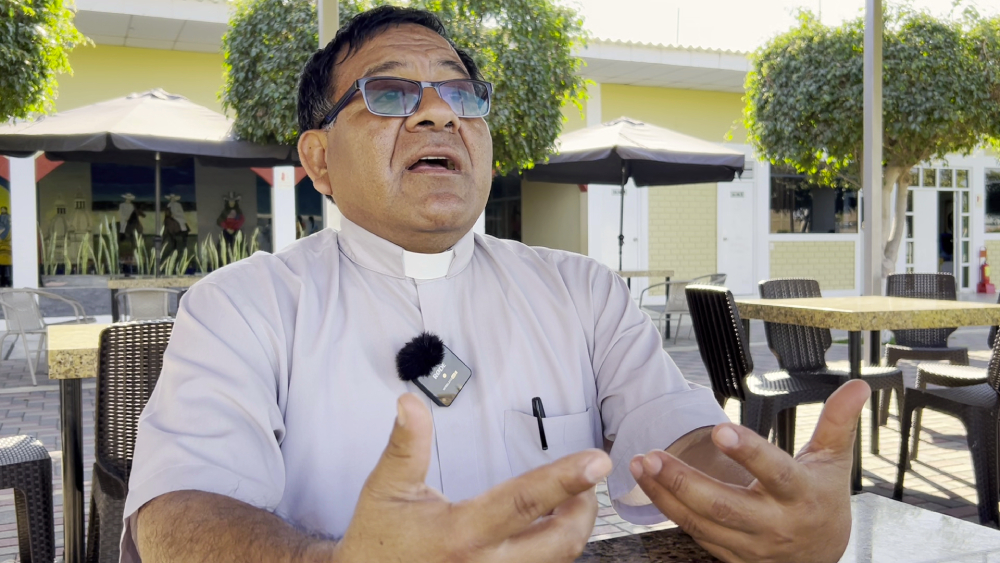
Fr. Elmer Uchofen speaks to the National Catholic Reporter during an August 2025 interview in Chiclayo, Peru. (NCR photo/Justin McLellan)
Those trained at the diocesan level were expected to adapt and reproduce the material in parishes, movements and rural communities, a system called the réplica. Dense church documents were translated into workshops, biblical reflections, short presentations and accessible explanations that could be carried outward through existing pastoral networks.
The process also invited the many Catholic movements active throughout the dioceses that had often operated independently from the local church to form their own synodal teams.
Gladys Calderón, a member of the Catholic Charismatic Renewal in Chiclayo, joined the EDAP in 2021 through its biblical formation workshops and later participated in the synodal process.
As a result of that formation, she said, her renewal movement created its own synodal team which organized listening sessions throughout the movement's 12 zones across the diocese.
"As a movement we saw ourselves as keeping a certain distance from the diocese, because as a charismatic movement we have a particular way of living [the faith], but Msgr. Roberto shook up that structure and brought us on board to walk together," she told NCR. "We became more united, more integrated into the diocese, sharing our different charisms — it was a beautiful experience in building unity."
Particularly significant was the role women played in carrying the process into Chiclayo's parishes.
Birgit Weiler, a theologian at the Pontifical Catholic University of Peru, said the smaller teams trained to provide synodal formation in parishes were often led by women.
"Not all parish priests were so happy when a commission came, led by a woman," she said, but Prevost "fully backed up the women."
"He said, 'They are prepared as well as the men are and this commission is led by a woman, full stop,'" Weiler recalled.
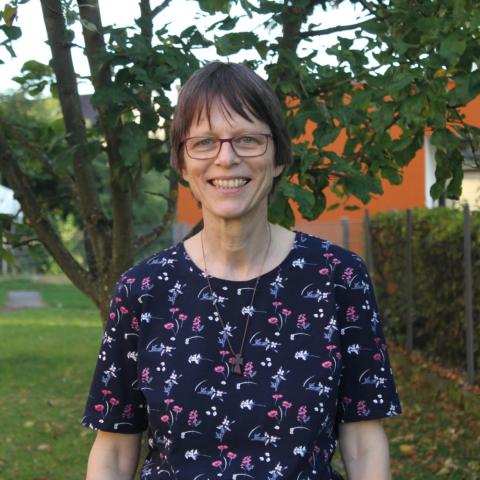
Birgit Weiler, a theologian at the Pontifical Catholic University of Peru and a member of the Congregation of the Medical Missionary Sisters. (Courtesy Birgit Weiler)
Weiler also noted that Prevost's Augustinian formation, with its emphasis on community life and collaboration, combined with his decades in Latin America — where women have long sustained Catholic communities, especially in rural areas with few priests — led him to see laypeople not merely as recipients of the church's ministry, but as participants capable of identifying their own needs, gifts and contributions.
Uchofen, the priest Prevost tapped to help lead the process, said that mentality was reflected throughout the synodal process, where Prevost "trusted a lot in the people."
"When he gave you a task, he trusted that you would do it, and later he would accompany you through the most difficult part," he said.
Since the start of the diocese's formal synodal journey in 2021, Uchofen said he has seen "more active participation of the faithful when there is something happening in the diocese."
From Chiclayo to the universal church
By 2023, Prevost had been elevated to a cardinal and was leading the influential Vatican office for bishops. The following year, he participated in the Vatican's second universal assembly of the Synod on Synodality.
During that October 2024 meeting, he said that participating in the synodal process both as a bishop who "participated in the formation of groups, in the promotion of a synodal process" as well as a curial official "gives a variety of experience, a great richness, to then enter into dialogue with other members of the synod."
In his only major interview given in his 15-month pontificate, Leo said that the church's effort to become more participatory "began long before the last synod, at least in Latin America."
"I think that offers a great opportunity to the church and offers an opportunity for the church to engage with the rest of the world," he said. "Since the time of the Second Vatican Council, I think that's been significant, and there's a lot to be done yet."
That work is already underway.
Advertisement
After worldwide consultations beginning in 2021 and Vatican assemblies in 2023 and 2024, dioceses are now being asked to implement the synod's final document and determine what concrete changes should emerge from years of listening. The implementation phase will culminate with a global assembly of synod leaders at the Vatican in October 2028.
Despite the controversy surrounding synodality — Leo himself acknowledged that "some people have felt threatened by that" — the pope's ministerial record shows that the principles of a participatory church are deeply embedded in his pastor's DNA, even apart from the modern nomenclature that has come to be associated with it.
Although the formal synodal process supplied the universal church with the vocabulary of communion, participation and mission, Zapata, the lay catechist from Chiclayo, told NCR that those underlying principles were long at work in Prevost's Peru.
"We were already living what was later given the name synodality," he said.
The National Catholic Reporter's Rome Bureau is made possible in part by the generosity of Joan and Bob McGrath.