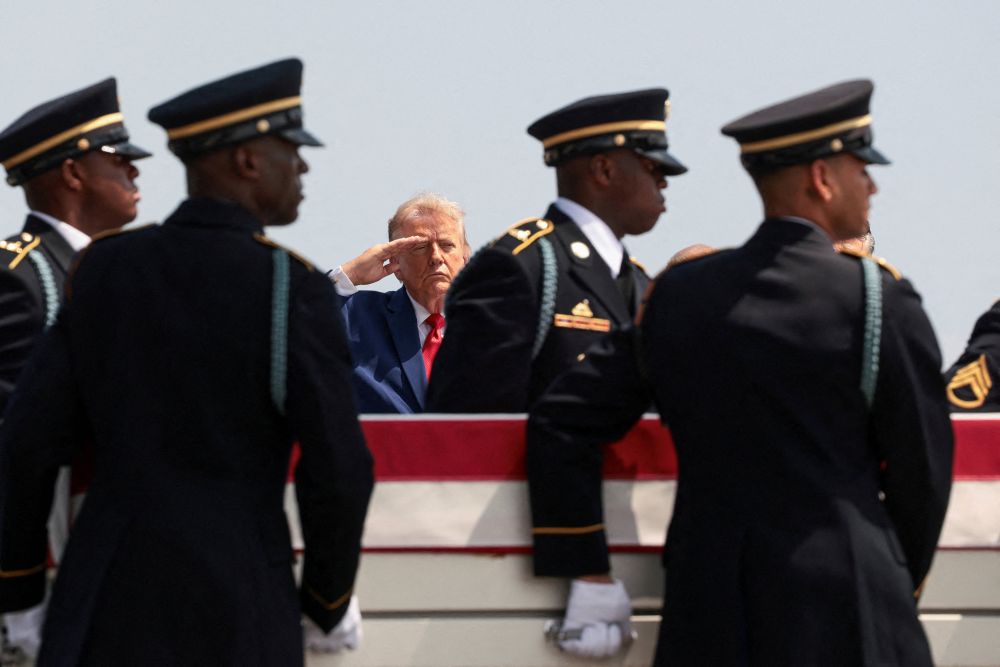
U.S. President Donald Trump salutes as members of the military carry the transfer case of U.S. Army Pvt. Isabella Gonzales during a dignified transfer of her remains at Dover Air Force Base in Delaware July 22, 2026. Gonzales was killed during an attack at Muwaffaq Salti Air Base in Jordan. (OSV News/Reuters/Evelyn Hockstein)

Join the Conversation
Send your thoughts to Letters to the Editor. Learn more
Days after the United States ramped up its war with Iran, Cardinal Joseph Tobin of Newark issued a forceful reflection on war and Catholic teaching, describing armed conflict as "always evil," even when undertaken in circumstances the church considers morally justified. Tobin also urged Christians to reject the romanticization of warfare in favor of peacemaking.
"War is the result of sin," he wrote in a reflection published July 23 on his diocese's website. "It is the destruction of the harmony and moral order that God intended to exist among individuals, nations, and peoples."
While acknowledging that military action can at times become unavoidable to defend human life or restore peace, Tobin said war itself should never be welcomed or celebrated.
"War is always evil even when it is undertaken out of necessity for the defense of humanity," he wrote. "The Church opposes all war, and it stands in favor of peace — always and everywhere."
Tobin's remarks add to a series of comments by Pope Leo XIV and prominent U.S. Catholic leaders amid the war involving the United States and Iran.
Leo has repeatedly suggested that the church take another look at its tradition of calling any war "just," including in his recent encyclical, Magnifica Humanitas.
In March, Cardinals Blase Cupich of Chicago and Robert McElroy of Washington separately raised moral concerns about the conflict and the way it was being presented to the American public.
Cupich, in a March 7 statement, condemned a White House social media video that combined footage from the Iran war with scenes from action movies, saying the presentation risked turning real-world violence into entertainment. "A real war with real death and real suffering being treated like it's a video game — it's sickening," Cupich wrote. He warned that Americans risk losing their humanity when military destruction becomes a spectacle.
Two days later, McElroy argued that the U.S. decision to go to war with Iran was "not morally legitimate" under Catholic just-war principles. He said the conflict failed to satisfy several requirements of that tradition, including just cause, right intention and proportionality, and called for an immediate end to the fighting.
Tobin's latest reflection approaches the question more broadly, focusing not only on whether a particular conflict can meet the traditional requirements for a just war but also on the church's underlying preference for peace.
He said Catholic just war teaching remains a useful framework for evaluating military action under "very strict and limited conditions," while underscoring Leo's words about modern warfare.
Tobin pointed in particular to unmanned drones powered by artificial intelligence, which he said raise new questions about moral responsibility, and he echoed the pope's warnings against treating war as something glorious.
"Belligerence and warmongering are the opposite of peacemaking," Tobin wrote. "War is not glorious, and while we are right to honor the heroism of those who have fought against tyranny and injustice, we should never pretend that the acts of war are themselves worthy of celebration."
For Tobin, peace means more than the absence of combat. He described it as requiring humility, forgiveness and restraint, including when the desire for retaliation is strong.
"True peace demands that we surrender egoism, false pride, and vengeance," he said.
Citing the Second Vatican Council's condemnation of the arms race and the biblical vision of nations beating their swords into plowshares, Tobin concluded that the church has an enduring obligation to advocate for "justice, charity, and lasting peace."
"Rather than celebrating war," he wrote, "we look for ways to rejoice in the art of peacemaking."
Advertisement