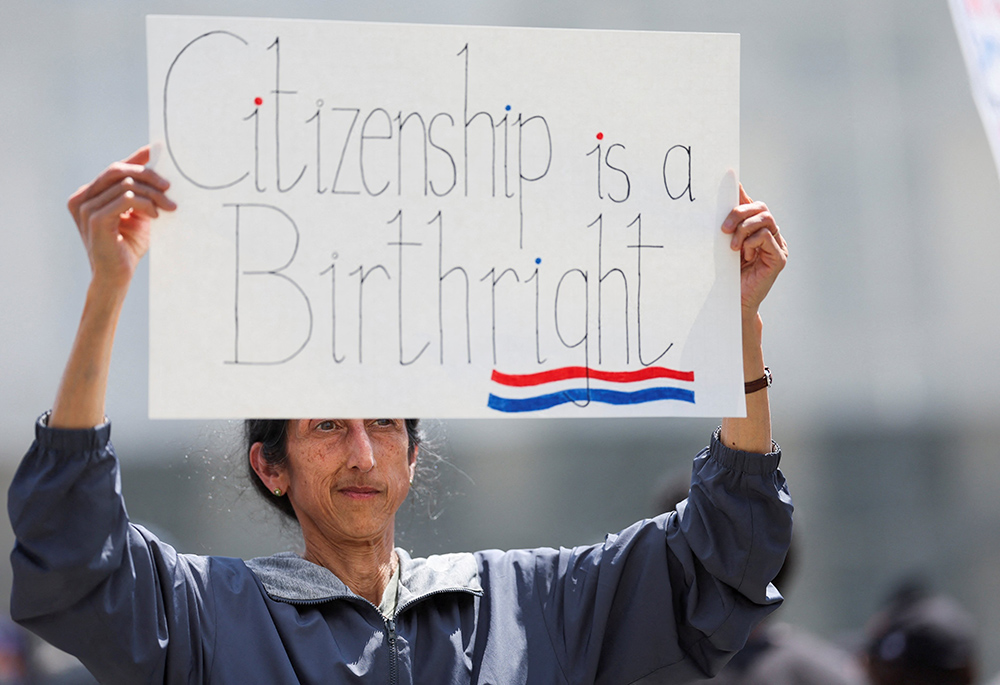
A demonstrator holds a placard during a protest outside the Supreme Court in May 2025. (OSV News/Reuters/Leah Millis)

by Brian Fraga
Staff Reporter
Join the Conversation
Send your thoughts to Letters to the Editor. Learn more
Catholic immigration advocates praised the U.S. Supreme Court's June 30 ruling that upheld birthright citizenship for children born in the U.S., regardless of the immigration status of their parents.
"A child born on American soil is an American, and that truth has been reaffirmed," Missionary of Jesus Sr. Norma Pimentel, executive director of Catholic Charities of the Rio Grande Valley in Texas, said in a social media post after the court's ruling.
"I have walked alongside many families who have worried about their children's future here. Today is a moment of peace for them," Pimentel said.
Kelly Ryan, president of Jesuit Refugee Service USA, said in a statement that the ruling "affirms a constitutional principle that safeguards the dignity and rights of countless children born in the United States, and protects them from discrimination based on the immigration status of their parents."
"We believe as Americans and Catholics that we must never deny the dignity of the human person," Ryan said. "Ending birthright citizenship would have done exactly that, creating an ever-growing underclass of stateless people without basic protections or opportunities."
The high court rejected President Donald Trump's January 2025 executive order that sought to prevent children born to immigrants who are in the U.S. illegally or temporary foreign residents from becoming American citizens. Writing for the majority, Chief Justice John Roberts said the executive order violated the 14th Amendment of the Constitution.
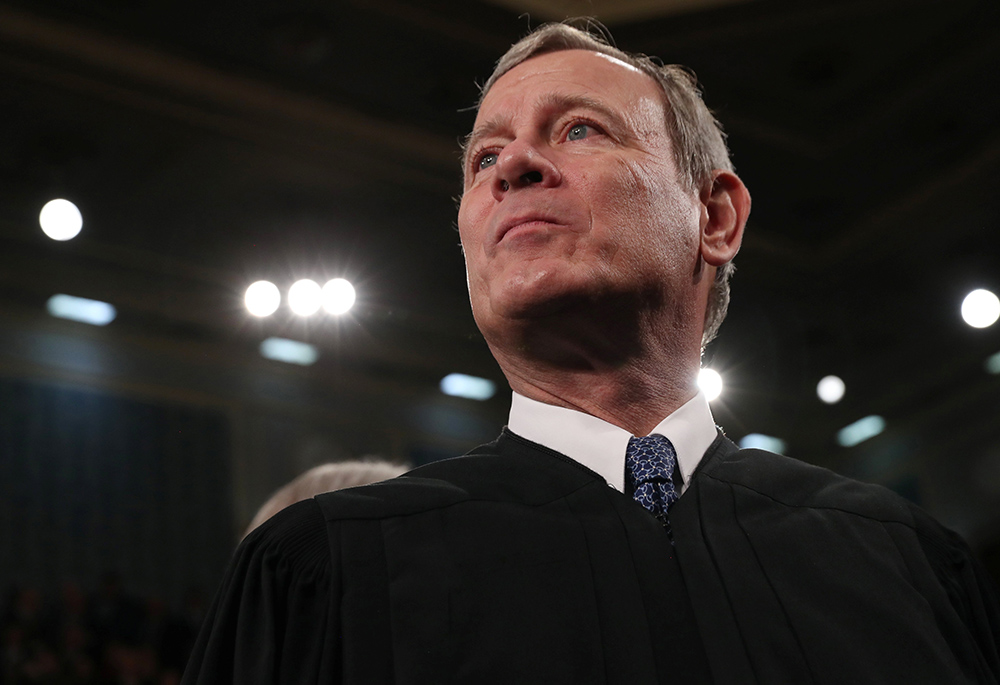
Chief Justice of the United States John Roberts is seen in the U.S. Capitol in Washington Feb. 4, 2020. (OSV News/Leah Millis, Pool via Reuters)
"Citizenship, then and now, was the right to have rights — to freely participate in our political community," Roberts wrote. "The framers of the 14th Amendment extended that promise to 'every free-born person in this land.'"
Roberts added: "We keep that promise today."
If the court had upheld the executive order, it would have created a second-class citizenship for countless numbers of children, said Kevin Appleby, senior director of international migration policy at the Center for Migration Studies, a think tank in New York founded by the Scalabrinians.
"It would have returned us to a bygone era where certain parts of the population had rights and other parts did not," Appleby told National Catholic Reporter. He added that the ruling "shows that you can't change the Constitution with the stroke of a pen."
"It's a document that's held firm for 250 years," Appleby said, "And to change its interpretation or how it's implemented or how rights are protected under it is not something that a president can do on his own."
Appleby also said that he believes church leaders' defense of birthright citizenship might have made a difference with the six Catholic justices on the Supreme Court, four of whom voted in the majority. He said the Catholic Legal Immigration Network, Inc. (CLINIC) and the U.S. Conference of Catholic Bishops filed amicus briefs in support of birthright citizenship.
"So I think the justices may have heard the church's position on this," Appleby said.
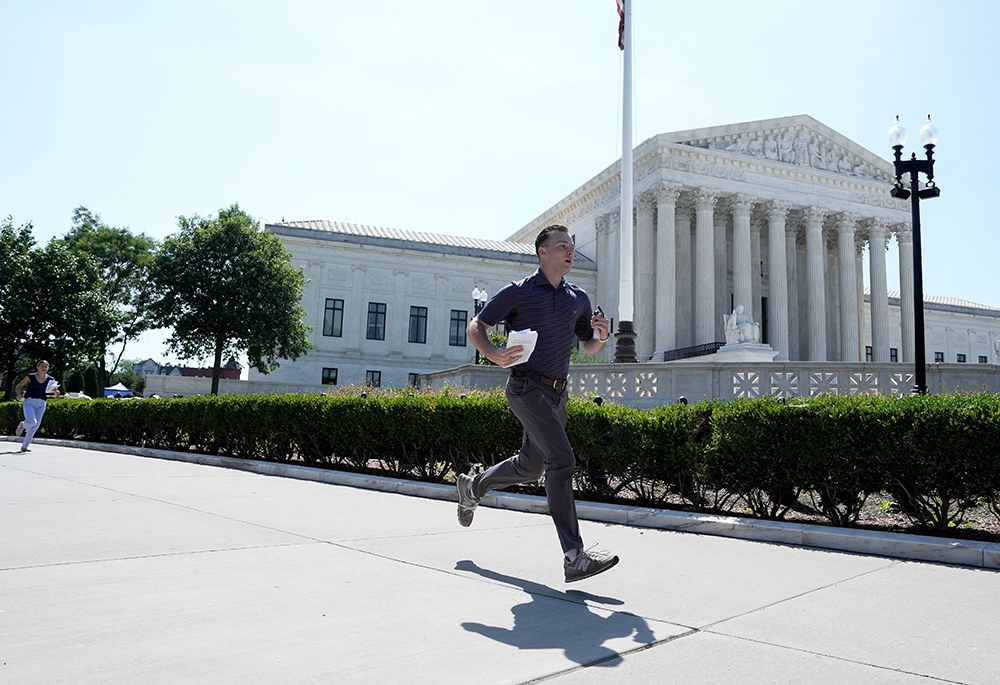
An intern runs outside the U.S. Supreme Court in Washington June 30, 2026, to deliver the court's ruling on birthright citizenship to the media. (OSV News/Reuters/Cheney Orr)
The U.S. bishops' conference did not comment on the Supreme Court's ruling, but in its brief it said that doing away with birthright citizenship would undermine church teaching and the country's "moral foundations."
"The intended and unintended effects of the Executive Order are immoral and contrary to the Catholic Church's fundamental beliefs and teachings regarding the life and dignity of human persons, the treatment of vulnerable people — particularly migrants and children — and family unity," the brief said.
Anna Gallagher, CLINIC's executive director, said in a statement that her organization was "relieved and grateful" that the court upheld a right that she said is "so important for our identity as a nation and for safeguarding justice and human dignity in line with Catholic social teaching."
"We are glad to receive a decision that will bring relief to immigrant families and our network," Gallagher said. "This is a win for immigrants, and a win for justice."
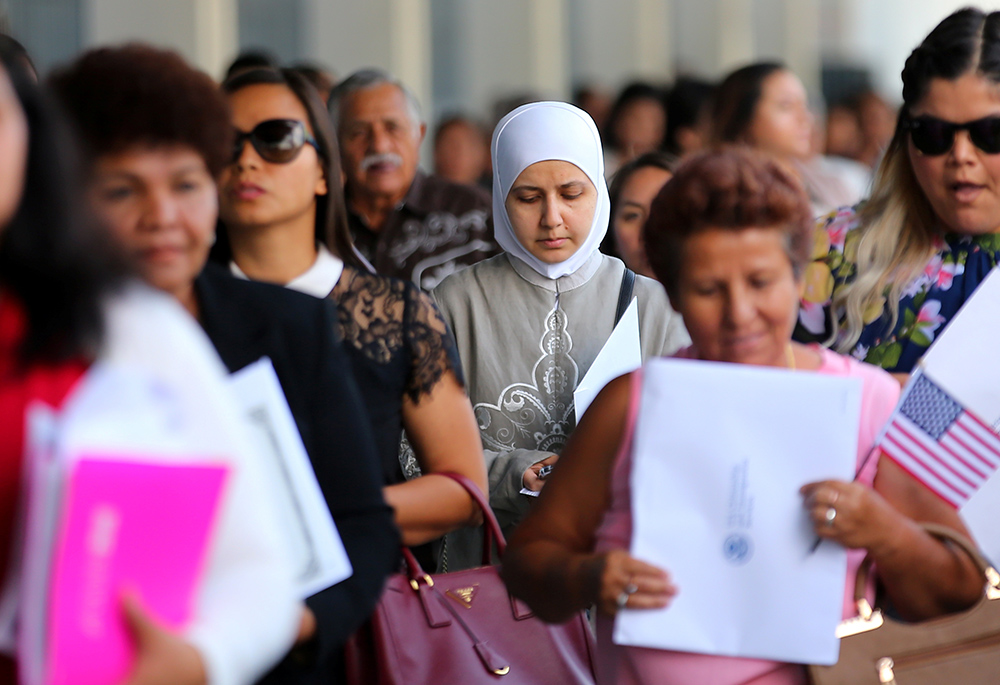
Naturalized citizens leave a swearing-in ceremony in Los Angeles, July 18, 2017. (CNS/Reuters/Mike Blake)
Christopher Kerr, executive director of Ignatian Solidarity Network, similarly praised the court's decision, saying in a statement that it "ensures that hundreds of thousands of children born on U.S. soil will not be cast into a lifetime of statelessness or second-class citizenship."
"Catholic teaching emphasizes the universal rights of children to belong, to be protected, and to have a place in society," Kerr said.
Giovana Oaxaca, senior government relations manager at Network Lobby for Catholic Social Justice, said the ruling "pushes back against the White House's attempt to deem some children born here as less deserving of full recognition and rights."
"Central to the Catholic faith is the conviction that all people are made in God's image," Oaxaca said. "It would be a violation of their inherent human dignity to not recognize all children born here as anything other than full citizens under the law."
Advertisement
Conservative-leaning Catholic organizations and individuals criticized the court's decision. CatholicVote, a political nonprofit that endorsed Trump in the 2024 presidential election, called the ruling "short-sighted at best." Vice President JD Vance, who is Catholic, told Fox News that birthright citizenship is "an absurdity to the 14th Amendment."
Denise Murphy McGraw, national co-chair of Catholics Vote Common Good, a progressive-leaning organization, said the Supreme Court's ruling rejected Trump's "attempt to rewrite the Constitution" and serves as a reminder that "no president is above the Constitution."
"Attempts to divide families, demonize immigrants, and redefine who belongs in America are contrary to both our Constitution and our deepest moral values," McGraw said.